The main purpose of this blog will be to track planetary extreme, or record temperatures related to climate change. Any reports I see of ETs will be listed below the main topic of the day. I’ll refer to extreme or record temperatures as ETs (not extraterrestrials).😜
Main Topic: A Grinding, Pivotal Year Ahead on Climate
Dear Diary. Mostly in the United States there have been dizzyingly displays of awful disappointing policy changes on climate during 2025 stemming from the Trump administration. He and his fossil fuel loving cronies are trying to prop up oil and coal production at every turn. From anti-wind farm efforts to opening up the Arctic National Wildlife Refuge area in Alaska for oil drilling, we have seen big setbacks on the road to a green society.
Despite Trump, progress was made during 2025:
Climate champion Bill McKibben in his latest essay outlines a way for us to fight forward in 2026 despite Trump:
A grinding, pivotal year ahead – by Bill McKibben
A grinding, pivotal year ahead
A few thoughts from the holiday rest before the plunge into 2026

| Bill McKibben Dec 26, 2025 |
I hope and trust it’s been a holiday with some joy—certainly it was for me, since we got to spend Christmas with both my 95-year-old mother and her 21-month-old grandson, watching the two of them amuse each other and hence the rest of us. And Boxing Day broke this morning with bitterly cold temperatures, perfect for a long ski through the maples of Vermont—right by Robert Frost’s old cabin, in fact, where I stopped by the woods on a snowy noon, but not for long since my fingers were starting to freeze.
One of the best things about this week, in the modern world, is that the noise dies down for a few days—the emails drop off. Which means a little time to think. I’ve been thinking about the year ahead, and I feel as if I should probably give you a bit of fair warning: I fear this newsletter is going to be a bit more about electoral politics than usual. Because, though 2026 will doubtless be about many things, the one fixed star will be the midterm elections. Those contests will either affirm our slide into the dank pit of authoritarianism for a good long time, or they will be moment when we find the first leverage to start the slow but crucial process of pulling ourselves out of the mire.
I’ve been thinking a lot about this over the past few days in part because the Trump administration did yet another indefensible thing—they shut down all work on five offshore wind farms off the eastern seaboard. As the Times put it, the move
essentially gutted the country’s nascent offshore wind industry in a sharp escalation of President Trump’s crusade against the renewable energy source.
The decision injected uncertainty into $25 billion worth of projects that were expected to power more than 2.5 million homes and businesses across the Eastern United States, according to Turn Forward, an offshore wind advocacy group. The five wind farms were projected together to create together about 10,000 jobs.
The administration said there were “national security” reasons for the shutdown that they couldn’t explain but that had something to do with radar. You are forgiven your skepticism about this rationale. Retired naval commander Kirk Lippold said the Department of Defense had fully vetted the projects, and added “ironically, these projects will actually benefit our national security by diversifying America’s energy supplies, providing much-needed reliable power for the grid and helping our economy.” If you want more on this aspect, check out Peter Gleick’s fine essay. Or maybe just look at a map of Asian wind installations, offshore and on; the Chinese coast, by Trumpian logic, is apparently the most vulnerable place on planet earth.

No, everyone knows that this decision, like so many in 2025, results from a combination of two obvious things. One is the president’s detestation of windpower, because you can see turbines from the 18th hole of his Turnberry golf course in Scotland, a sight he has described as “disgusting.” (By the way, it’s a prejudice he shares with his sidekick Bobby “Measles” Kennedy—here’s the letter some of us wrote to him 20 years ago next week pointing out that he was being an ass for trying to protect the view from his Cape Cod compound). The second thing, of course, is Trump’s efforts to pay off his fossil fuel donors—they gave him half a billion in campaign help, and they are now reaping the largest return on investment in recorded history.
But there’s a third reason too, I think, and one that reminds us of the politics inherent in all of this. For New England, New York, and Virginia those now-halted windfarms offer something like a first stab at energy independence. And that’s anathema to the fascist mind, which values centralization and control above all. California has already begun to escape that control—it has so much solar and wind energy that it could, if it had to, increasingly make do on its own (and the hydro-charged northwest as well). But the northeast is the other center of resistance to Trump’s ugly project; it’s currently tied to the end of the gas pipelines stretching back to the Gulf, and Trump et al are determined to keep it that way.
And for now there’s nothing we can do about it (except go to court, which actually worked when Trump tried to shut down one wind farm in the fall). Without control of either the House or Senate, Democrats have no way to stand up to even something as egregiously stupid as this windpower ban. Getting a majority in either chamber would not rein in the MAGA project, but it would allow questions to be publicly asked, and it would allow at least a budget fight about such venality. It’s nowhere near what we need, but it’s not nothing. And nothing is what we have right now, which is why the last year has been so hard—those of us who care about, say, science and economics (or justice) have had to stand there and take it, our hands essentially tied behind our backs.
We’ve done our best in the circumstances—the No Kings Day protests, for instance, have been crucial in sapping support for what seemed at first like a juggernaut. But the reason to drive down Trump’s popularity is to make it harder for him to win elections (and harder to rig elections—the refusal of the Indiana GOP to go along with the president’s redistricting plan this month was a good reminder that Trump at 38 percent approval is less effective than Trump at 55 percent).
The elections will, of course, be a hard fight. Hard because MAGA has all the advantages of incumbency (including an ever-more-compliant media—the fact that the White House now controls CBS is a particular blow to those of us old enough to remember Murrow and Cronkite). And hard because in many places the Democrats we will need to support won’t be precisely the champions we’d most like. Prepare for a lot of tap-dancing around “climate,” for instance—what we need to hope for is that these candidates are sensible enough at least to seize on the popularity of solar and windpower and make a decent argument for energy both cheap and clean. Some Mamdanis will emerge, and we’ll treasure them, but the basic job is straightforward: beat MAGA everywhere we can, hopefully with margins sufficient to start reorienting our hideous politics.
I’ll obviously keep covering the energy marvels appearing in the rest of the world—reporting on the ongoing sunpower revolution keeps me optimistic enough to stagger on. But I think my main job over the next ten months is to do all I can to help the elections on Nov. 3 come out the right way; I’ll be writing, and through Third Act I’ll be organizing (look for the next rounds of the Silver Wave tour). Those hoped-for victories are the necessary first step to preserving both some of our democracy and some of our climate system. And remember how good it felt to take home some preliminary wins last month in New York, New Jersey, Virginia. Wiping more of the smirk off the presidential mug is our potential reward—that and a future.
In other energy and climate news:
+As they shut down wind farms, America’s energy czars are pledging billions on a particularly absurd scheme: big gas pipelines in Alaska designed for an export LNG market that almost certainly won’t exist by the time they’re built. Lois Parshley has some fine reporting in Grist
the cost is staggering: Official estimates put it at $44 billion, though independent analysts suggest it could top $70 billion. Experts say it has required substantial government support to develop and will require “a mix of public and private capital to move forward.”
The pipeline’s backers are already eyeing additional federal support, including $30 billion in loan guarantees. That backstop would leave the public on the hook if the endeavor falters, an outcome that has plagued previous state megaprojects. “Every taxpayer should be furious that the federal government is chasing this project,” said Cooper Freeman, the state director for The Center for Biological Diversity, which is suing the federal government over the proposed pipeline’s threat to endangered species.
Meanwhile, a wave of liquified natural gas development is expected to flood global supply by 2030, including from export projects in British Columbia that are closer to completion and share Alaska’s proximity to Asian markets. In a blunt assessment, independent energy market firm Rapidan Energy Group warned that investors “could incur substantial financial losses” and said the Alaska project is what happens when “politics overrides commercial logic.”
Prediction: the federal government won’t be able to find private parties to put up serious money for this project. It will be a taxpayer-financed boondoggle if it happens at all—which is the same dynamic affecting plans for Canadian tarsands pipelines. Perhaps Trump has the political muscle to make all of us pay for this folly; or perhaps the upcoming elections will provide a stumbling block (see above). By the way, a widely predicted the EU seems not to be living up to its pledges to buy more LNG in return for reducing its tariffs.
+Don’t miss David Roberts’ Volts interview with Saul Griffith from earlier today. Readers of this newsletter will be long acquainted with his basic arguments about how to make solar cheaper, but his comparison of putting solar on the roof of his home in Sydney and his office in San Francisco is truly breathtaking. (Spoiler: five times cheaper down under). Here’s how he describes the Aussie process:
You have to remember, this is a first world country where 40% of people have rooftop solar. At 40% of households having it, it’s pretty hard to commute home from work without seeing a truck that says on the side of it, “Hot Electric” or “Solar Hub Electric” or “Joe’s Mom and Her Dog’s Electric Solar and Water Heater Service.” You can probably call one of those on your commute. They will probably show up the next morning before 7 am and have a look at your roof. Depending upon their backlog, they’ll be on your roof within 48 hours. Or maybe it’ll be a week
+Robert Rosner has a comprehensive rundown on the prospects for nuclear power in the decades ahead from the Bulletin of the Atomic Scientists. Though I’m going to put in bold the question I think may actually turn out to be most decisive.
Whether a nuclear renaissance actually occurs in the coming decade or two will depend, to a significant degree, on the answers to three fundamental questions: Are these new designs safer than their predecessors? Do the new designs lead to changes in how one will have to deal with the inevitable waste products (including the “spent” fuel)? And do thee new designs raise additional (or new) questions regarding nuclear weapons proliferation? In posing these questions, I am willfully excluding from my analysis additional key questions that actually determine whether a true “nuclear renaissance” is now likely to arrive in the United States: Will the strong increase in assured 24/7-always available electricity demand continue? Will the cost of electricity from the new generation of nuclear reactors be competitive with that obtained from alternate electricity-generation technologies? And will we finally succeed in dealing responsibly with our high-level nuclear waste and move this material into permanent repositories?
+Kentucky is the absolute heart of coal country, of course—but a new study finds that if you started retiring aging coal-fired power plants and replacing them with renewable energy, Kentuckians would save immense amounts of money. As Liam Niemeyer explains,
“Here in Kentucky, coal was the least-cost way to produce electricity, but as our coal plants age and as the cost of renewable energy continues to fall, that’s simply no longer the case,” the head of the group that commissioned the report, said. “Continuing to rely on aging, uneconomic power plants simply leads us to less stable, less dependable and higher-cost electricity when compared to the other pathways that are modeled in our report.”
Using an open source electricity planning model, the report analyzes four pathways that Kentucky utilities could take. The analysis considered pending proposals to build new power plants and other planning documents filed by utilities. It found the least-cost pathway creates up to $2.6 billion in savings for ratepayers through 2050 by replacing coal-fired power with “clean energy resources,” primarily solar power paired with batteries to store the power.
+Americans have some company in our political misery. Czechia has a new environment minister, from the rightwing Motorists for Themselves party (admittedly, a great name that pretty much sums up all the forces wrecking the earth), and he is vowing that “green blood will run” as he makes policy changes. On assuming office, the new guy announced “the climate crisis is over today.”
+Sadly, “enhanced rock weathering” does not seem to be as useful a carbon removal technology as some had hoped, a new study finds. “Integrating the pore water results with model analyses, we estimated that the average CO2 removal rate was 100 ± 30 kg CO2 ha–1 yr–1, which is 10 to 30 times lower than the upper rates reported in some previous modeling and experimental studies.”
+In much better news, check out these numbers: E-bike (and trike and rickshaw) sales are soaring across the planet, and doing far more than EVs to drive down oil demand. From Muhammad Rizwan Azhar and Waqas Uzair:
On the world’s roads last year, there were over 20 million electric vehicles and 1.3 million commercial EVs such as buses, delivery vans, and trucks.
But these numbers of four or more wheel vehicles are wholly eclipsed by two- and three-wheelers. There were over 280 million electric mopeds, scooters, motorcycles, and three-wheelers on the road last year. Their sheer popularity is already cutting demand for oil by a million barrels of oil a day—about 1 percent of the world’s total oil demand, according to estimates by Bloomberg New Energy Finance.
As they point out, it comes down to money: far more humans can afford to buy these vehicles. And to operate them.
If you commute on an e-bike 20 km a day, five days a week, your charging cost would be about $20—annually.
+And one other delightful note on which to end the year. A new study is showing that growing crops in solar farms is not just good for the crops, it’s good for the farmworkers.
Agrivoltaics creates coveted shaded areas for farmworkers. That’s critical when you consider they are 35 times more likely to suffer fatal heat-related illnesses than nonagricultural workers.
Scientific data backed the workers’ instincts on the shade. Solar panels reduced the wet bulb globe temperature, a heat-measuring system, by up to 10 degrees.
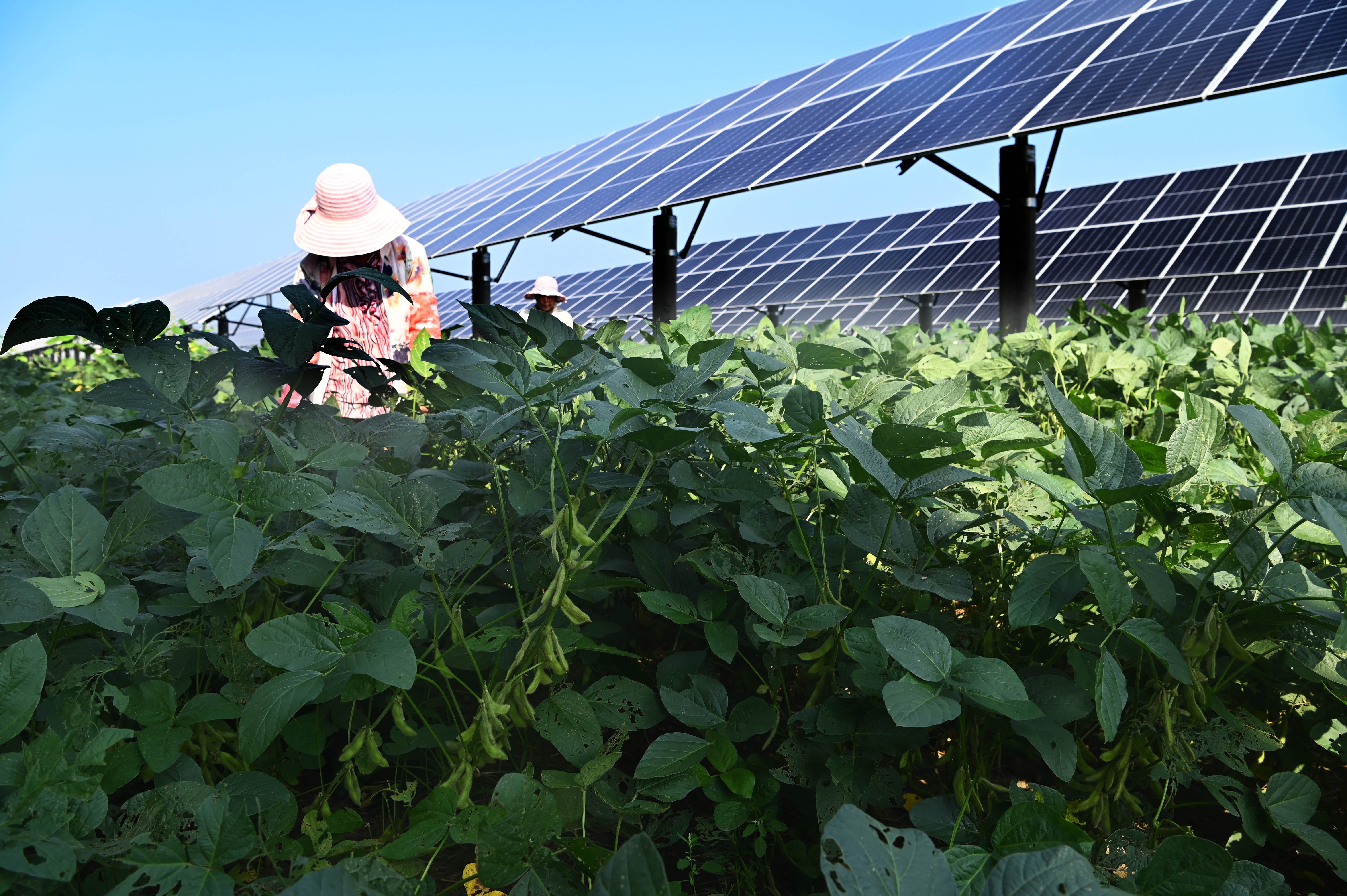
Here’s an image from Shandong province, China.
The researcher, Talitha Neesham-McTiernan at the University of Arizona, interviewed lots of farmworkers. One of them
confessed they found it hard to imagine ever going back to work on traditional full-sun farms — where, they added, their favorite crops had always been tomatoes, because of the shade the tall plants offered.
“By 9 a.m., in the summer, you’re just cooking,” Neesham-McTiernan said. “Being able to take that direct heat load off makes such a difference.”
Shade keeps drinking water cool too, the workers noted — a crucial benefit, given water’s role in mitigating heat stress. “They can pop their bottles under the panels and they stay cool all day,” Neesham-McTiernan said, “rather than it being, as one of the farmworkers described it, like drinking tea.”
Another worker said these benefits helped them feel less exhausted by day’s end, leaving more energy for social life and allowing a faster recovery for the next day’s work. Others said simply knowing shade was nearby reduced their mental stress.
On that note, I wish you too a week with reduced mental stress, the better to prepare for the important work ahead. See you in 2026!
The Crucial Years will keep coming next year, free for all. But if your year is ending with a little financial margin, it would be a kindness to take out a voluntary and modestly priced subscription!
Subscribe to The Crucial Years
Here are some “ETs” recorded from around the planet the last couple of days, their consequences, and some extreme temperature outlooks, as well as any extreme precipitation reports:
Here is More Climate News from Saturday:
(As usual, this will be a fluid post in which more information gets added during the day as it crosses my radar, crediting all who have put it on-line. Items will be archived on this site for posterity. In most instances click on the pictures of each tweet to see each article. The most noteworthy items will be listed first.)