The main purpose of this blog will be to track planetary extreme, or record temperatures related to climate change. Any reports I see of ETs will be listed below the main topic of the day. I’ll refer to extreme or record temperatures as ETs (not extraterrestrials).😜
Main Topic: Hundreds of Residents Signed Up for FEMA Buyouts After Helene. Not One Has Been Approved.
Dear Diary. Fortunately, during 2025 there were no landfalling hurricanes in the United States. Unfortunately, some residents are still picking up the pieces from hurricanes that did make landfalls in 2024, which were strengthened by warming Gulf of Mexico waters. The worst was Hurricane Helene in which residents in and around the Asheville North Carolina area are in rebuild mode.
It’s a dead shame that our federal government cannot keep its promises to help hurricane victims for people who desperately need it. Some families are going bankrupt because they are paying mortgages on homes that have been destroyed while also paying rent or another mortgage for a property where they are currently staying. The Federal Emergency Management Agency was supposed to buyout destroyed properties, but under Trump this is not happening, and Trump went to ground zero of the destroyed area of North Carolina lying through his teeth that affected families would be taken care of.
In the future there will come a time when there will be multiple Helens destroying many areas of the country in one hurricane season. Due to climate change, we must prepare for that scenario now. Certainly, we should be able to take care of people from just one big event per year as happened in 2024.
Here are details from the Washington Post:
Hundreds of residents signed up for FEMA buyouts after Helene. Not one has been approved.
Some of the homeowners seeking help are still paying mortgages on homes that are no longer livable.
12/30/2025
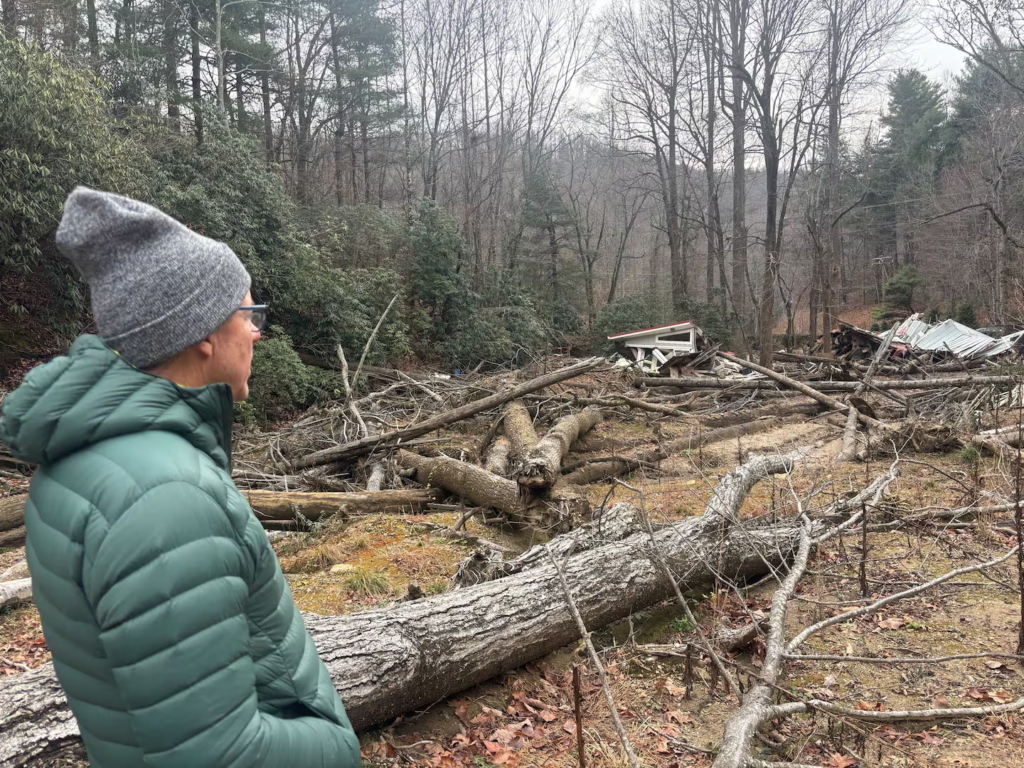
Steve and Carey Hayo’s home outside Hendersonville, North Carolina, was destroyed by a landslide during Hurricane Helene in September 2024. (Brady Dennis/The Washington Post)

By Brady Dennis
FAIRVIEW, N.C. — A dusting of December snow had turned the mountains around her white, but Elizabeth Clark barely had time to notice.
It had been 438 days since Hurricane Helene’s floodwaters wrecked her home’s foundation, inundated the first floor, destroyed the septic system and swallowed their belongings. Her mortgage company agreed to pause her payments for a year, but now seemed to be losing patience over the $270,000 she still owed on a house no longer safe to live in.
“I’ve never missed a payment in my whole life,” said Clark, a neonatal nurse at a nearby hospital. “Here now, at 42 years old, I’m having to consider foreclosing.”
In November 2024, Clark was among the first storm victims in her county to apply for a voluntary program funded by the Federal Emergency Management Agency that would enable the government to buy out her property.
Not only can qualified homeowners get the pre-storm value of their house — and the chance to move on with their lives — but the program is also meant to help at-risk communities reduce future disaster losses by getting the most vulnerable structures permanently out of harm’s way.
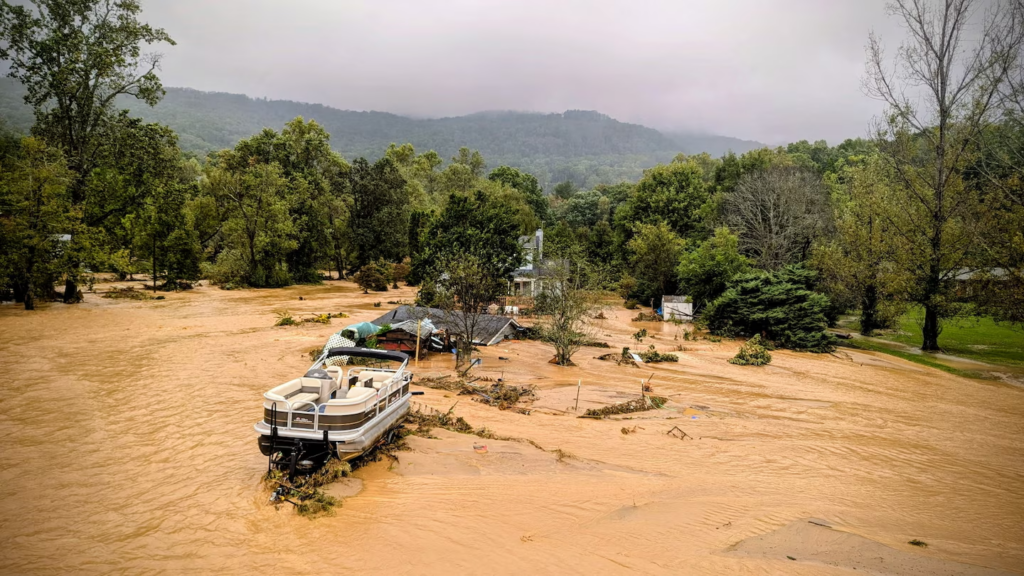
The view from Elizabeth Clark’s house on Sept. 27, 2024, as Helene’s rains caused nearby Cane Creek to swell far beyond its banks. (Brady Dennis/The Washington Post)
After the storm, Clark and her husband, Calvin, spent weeks living in a hotel, before renting a home from friends for eight months. Finally, they moved nearly an hour away to a small house in Waynesville, North Carolina, that they had been leasing to tenants. It feels cramped with their three school-aged children, and each day brings hours on the road to return to the community where their kids go to school, play sports and visit grandparents. The loss of renters has been another financial hit.
Meanwhile, more than 13 months after applying for a buyout, Clark has heard almost nothing definitive.
She is hardly the only one enduring another winter of uncertainty.
More than 800 storm victims around Helene-battered western North Carolina have applied under FEMA’s Hazard Mitigation Grant Program. State officials vetted applications and began sending them up the chain to FEMA as far back as February. As of Dec. 15, they had sent nearly 600 buyout requests to Washington, with more likely to follow.
So far, they say, not a single approval has come through.
North Carolina Gov. Josh Stein has called the paralysis “absolutely unacceptable,” and has pushed for answers. Earlier this month, he wrote to FEMA’s acting administrator, detailing the startling number of applications that “remain without a final decision.”
“Further delay of these approvals,” he wrote, “keeps communities and families in limbo, in some cases paying expenses on homes they cannot live in while they await word from FEMA.”
FEMA did not initially comment on questions about the program. Several days after publication of this story, the agency sent a short statement saying it “remains committed” to Helene recovery in North Carolina and that the reason so many applications had not been approved yet is “because they do not comply with federal regulations.” State officials said they take care to ensure each application meets or exceeds such requirements.
The situation is just one element of the sprawling and ongoing recovery, and of the palpable frustration in western North Carolina — especially given promises by President Donald Trump during a visit early this year, where he vowed to “slash through every bureaucratic barrier” and insisted that “every single inch of every property will be fully rebuilt, greater and more beautiful than it was before.”
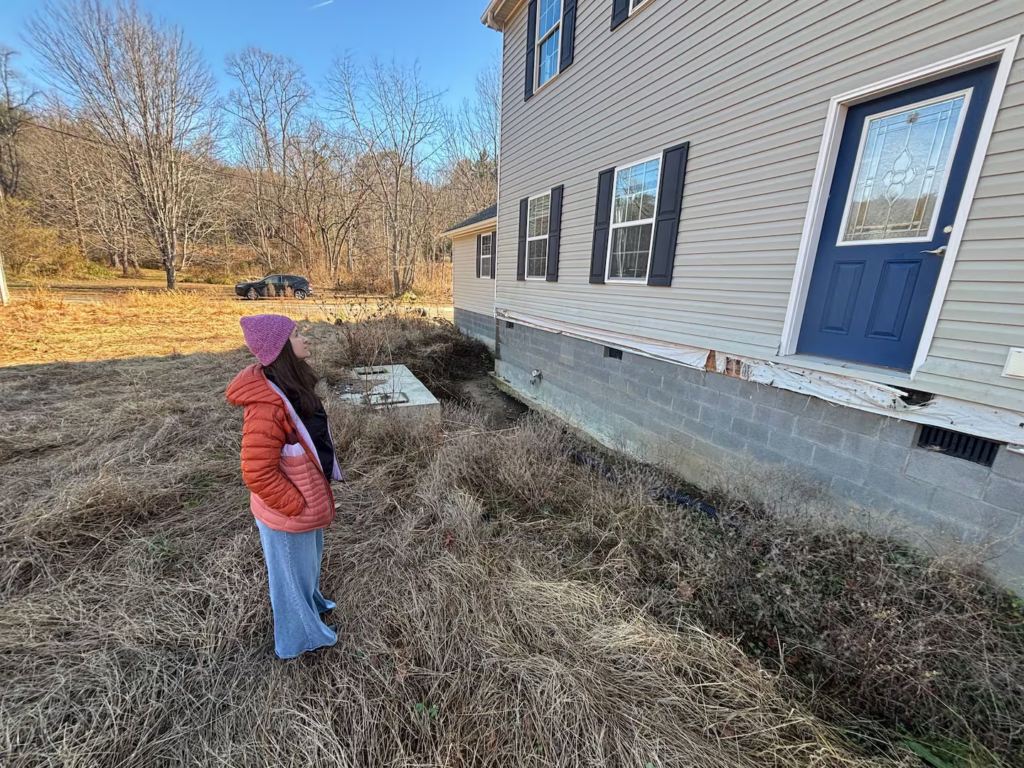
Flooding from Hurricane Helene inundated the first floor of Elizabeth Clark’s home and undermined the foundation. Her mortgage company offered a year of paused payments, but she has had to ask for extensions. (Brady Dennis/The Washington Post)
For homeowners such as Clark, the not knowing has become all-consuming.
“The uncertainty has taken a heavy toll — financially, emotionally, and on my family’s sense of security,” she wrote to Stein in one August letter. “It is heartbreaking to think that, after surviving a disaster, we may lose everything because of timelines and red tape that are beyond our control.”
Months later, she feels much the same.
“There’s so little information,” she said. “Nobody really has any answers. We are just sitting here, waiting.”
‘That hope is dwindling’
Rob Moore, who has long studied flooding risks and disaster policy for the Natural Resources Defense Council, said buyouts under FEMA’s hazard mitigation program have been an important tool for decades.
When it works as intended, voluntary buyouts allow homeowners to receive the pre-disaster value for their homes so that they can relocate and start over. The program can help communities reduce overall flood risk and better prepare for future calamities, as part of the deal is that properties acquired by the government are turned into open space.
In a 2019 study, Moore and a colleague reviewed nearly 30 years of FEMA data on buyouts — including speaking with former owners of some of the more than 43,000 properties the agency had acquired since the 1980s. Those acquisitions have taken place in 49 states and several U.S. territories, the report said.
In short, they found that the program played a critical role in the wake of disasters, and is likely to become only more vital as rising seas and escalating flood risks displace more Americans.
But one issue has been a constant: Buyouts are complex, and almost never happen quickly.
“Under the best of circumstances, these things take more time than they should. But these are clearly not the best of circumstances,” said Moore, referring to deep staffing cuts at FEMA this year and the uncertainty about the agency’s future and its mission.
The 2019 study found that it takes a median of about five years between a flooding disaster and the completion of a FEMA-funded buyout project. FEMA has said almost 80 percent of acquisitions are approved in less than two years, and 93 percent are approved in under three years.
“While every buyout project is different, one thing is clear: long wait times make buyouts less accessible, less equitable, and less effective for disaster mitigation and climate adaptation,” the researchers wrote.
Moore thinks something deeper than the normal lag times could be at play in North Carolina, where many county and state officials moved quickly to open up applications for homeowners interested in potential buyouts.
“Typically, communities are so focused on cleaning up and recovering that they don’t even think about other risk reduction activities until a year goes by,” he said.
But in North Carolina after Helene, many localities moved much quicker.
Leaders in Buncombe County, home to Asheville and other municipalities, were among the local officials who tried to speed up the process in hopes of getting help to qualified residents sooner. The county began taking applications for buyouts in January, barely three months after the storm.
“We were hoping that because we started earlier, that we would see buyouts already started and/or reconstruction already started, but we haven’t seen that,” said Avril Pinder, Buncombe’s county manager.
Pinder said local FEMA representatives have worked tirelessly since the storm hit, and that the region would be in much worse shape without their help over the past year. Indeed, hundreds of millions of dollars have poured in from the agency for a range of recovery programs, with much more expected.
The reality is that local governments continue to wait for large sums in federal reimbursements for debris cleanup and other projects. Roads still need repair. Renters and homeowners remain displaced. Certainly for those storm victims still awaiting a buyout, it has been a season of silence and stress.
“What we are hearing is, ‘What do we do now? How do we pay for this, as well as [another] place to live?’” Pinder said. “There is hope, but that hope is dwindling because it’s been a year now that they’ve applied for this, and they’re still carrying a mortgage or rent someplace else. And they’re trying to move ahead with their lives.”
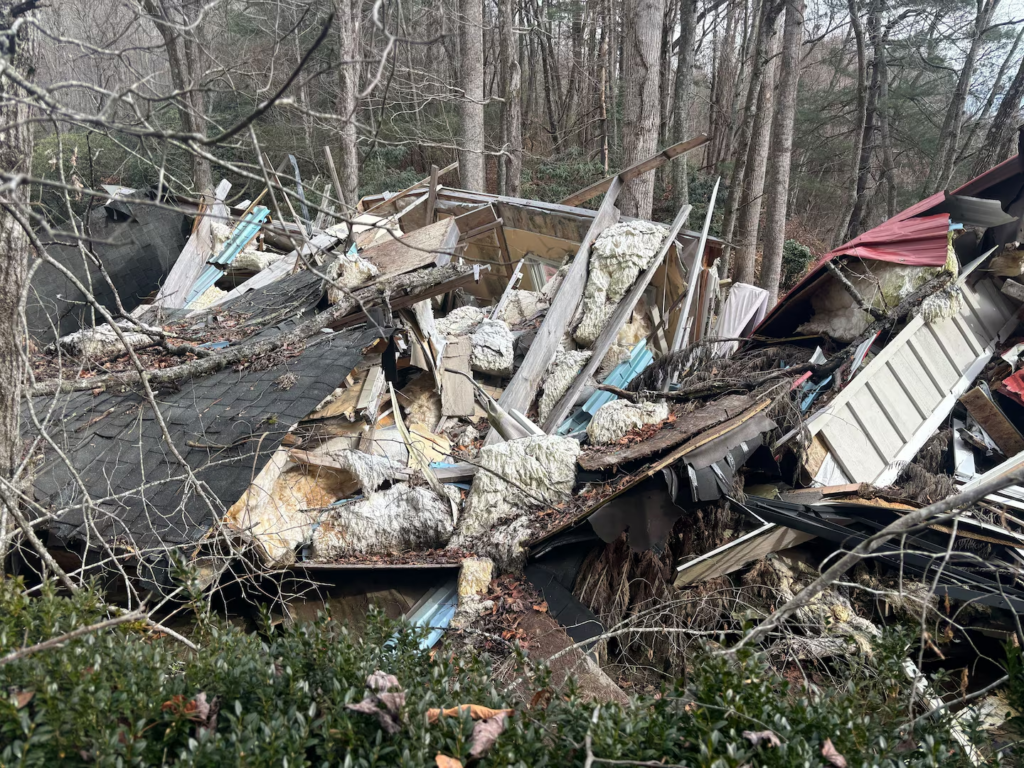
What is left of Carey and Steve Hayo’s home outside of Hendersonville after Helene. “It was a nice little oasis,” Steve recalled. (Brady Dennis/The Washington Post)
Carey and Steve Hayo, whose home just outside Hendersonville was devoured by a landslide during Helene, are among those struggling to move ahead.
The couple was fortunate to be out of town when a wall of mud and debris came screaming down a mountainside, knocking their home, a guesthouse and a garage clean off their foundations. But the disaster swallowed most of their life’s investment and virtually all their belongings. A pile of rubble is all that remains.
The Hayos no longer had a mortgage, but also have no clear way of recouping their losses, as insurance doesn’t cover landslides. They are living in their third place since Helene. Both in their 70s, they are in counseling for trauma. Many weeks have passed in a blur of phone calls to insurers, bankers and lawyers, local officials and FEMA.
“It’s like a bad nightmare,” Carey Hayo said of the experience. As signs of recovery unfold around them, they feel stuck. “You get hopeful, and then you don’t hear anything … There’s just no information.”
More than a year has passed since the couple applied for a buyout through the federal hazard mitigation program. But as with everyone else who did the same, that prospect remains uncertain. Recently, the couple spoke at a Henderson County commission meeting, pushing local officials to help secure funding — and answers.
“We’re just frustrated,” Steve Hayo told panel. “This doesn’t seem to have an end. And that’s what we are searching for.”
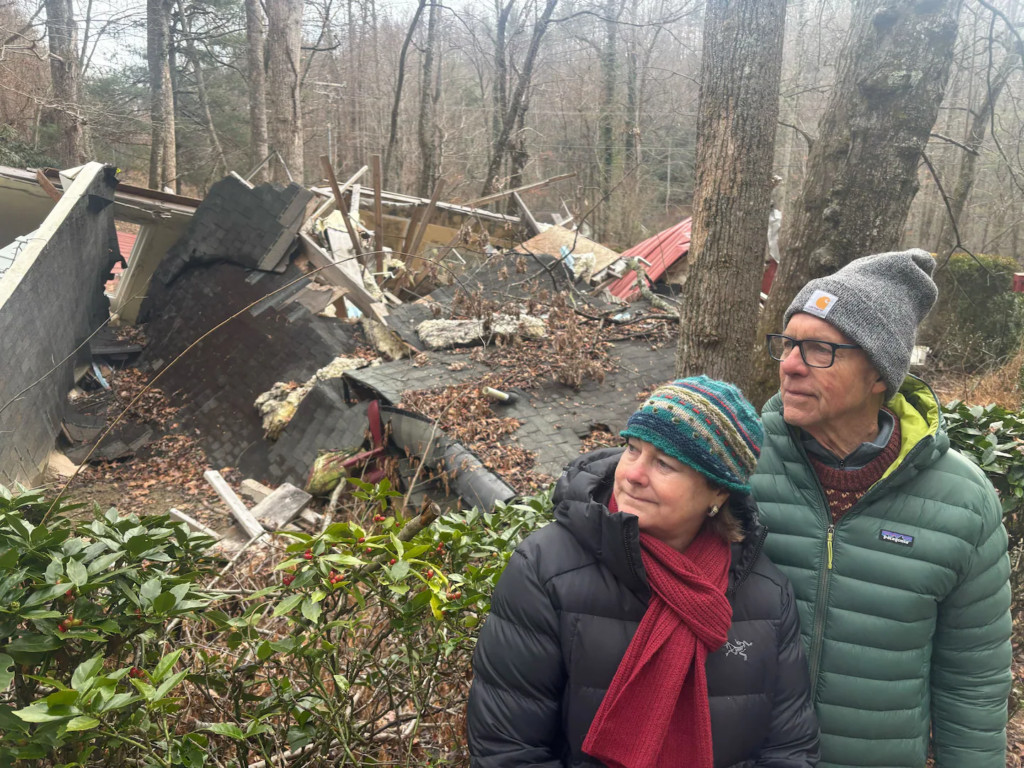
The Hayos, both in their 70s, have moved rental homes multiple times since Helene. After a year of trying to get their property cleaned up and secure a FEMA buyout, they are weary of a process that never ends. “Don’t let anybody tell you this is over,” Carey Hayo said. (Brady Dennis/The Washington Post)
‘Unfinished business’
For their part, North Carolina officials insist they are doing all they can.
The state has overseen hundreds of millions of dollars in hazard mitigation across multiple disasters beginning with Hurricane Floyd in 1999, and prides itself on ensuring that each hazard mitigation application “meets or exceeds federal guidelines,” said Justin Graney, a spokesperson for N.C. Emergency Management.
“North Carolina is unfortunately no stranger to disasters and has become a national leader in the hazard mitigation space,” Graney said, saying the state “is not a novice” when it comes to implementing such projects as buyouts and elevations. In addition, he said, the state “moved at a rapid pace” after Helene to process applications from affected homeowners.
In its statement, FEMA said it had provided $16.3 million in hazard mitigation funds to projects in North Carolina identified by state and local leaders. But when it came to the hundreds of pending applications from homeowners hoping for buyouts, the agency said they had not met federal requirements. The agency did not elaborate on why. FEMA said it is “working diligently” with state officials “to identify a lawful path forward.”
Graney said officials had indeed worked with FEMA to resolve issues with a small number of buyout applications where portions of the property might be needed for nearby road reconstruction or repair projects, which are subject to review by another agency. But he said the vast majority of applications under review should not be impacted by such issues, and that the state is confident it had addressed concerns “with projects caught in this federal quagmire.”
Don Campbell, chief of staff to North Carolina’s emergency manager, recently told members of a state task force on Helene recovery that overall, officials had been given little guidance from FEMA on why no buyouts had been approved since Helene.
“We understand that many of those applications are sitting on the desk of the secretary of homeland security,” Campbell said, adding that state and local officials are acutely aware of the real-world implications for homeowners struggling to hang on in the meantime.
Matt Calabria, the head of the Governor’s Recovery Office for Western North Carolina, said there is reason for cautious optimism. The state received notice shortly after the first anniversary of Helene that it will be eligible for up to about $1.5 billion in hazard mitigation funding, depending on the size and number of qualified projects.
But those dollars are not guaranteed, and changes in criteria have made it tougher for some projects to qualify, he said. Either way, nothing is likely to happen as quickly as anyone would like.
“The folks who are seeking buyouts, in a lot of cases, have been displaced from their homes. They are in some cases paying mortgages on damaged or destroyed homes,” Calabria said. “And so, these delays are very acutely felt by so many of these families.”
Unlike some other FEMA programs that are reimbursement-based, buyouts require an up-front approval from the agency, Calabria said.
“That’s why we are seeking word from FEMA, so that we can begin proceeding with these projects,” he said. “These delays have been outsized, and we know that for hundreds of families, this is going to make a tremendous difference. So, we continue to push every day.”
In Fairview, Elizabeth Clark is wrestling with what to do when the next mortgage payment comes due.
“At this point, we have decided we are not going to pay a dime on a house we can’t even live in,” at least until she has clarity about whether FEMA is likely to approve a buyout, she said.
Clark worries about losing the home, which sits within sight of her parents’ house, to foreclosure. She worries about wrecking her credit. But, she said, “We had to spend so much money replacing things. We don’t have money to throw away.”
A 45-minute drive to the south, Carey and Steve Hayo are also fighting against cynicism and weariness as they figure out what comes next. On a cold December afternoon, they returned once more to the place that gave them more than a decade of happy memories.
The garden where they once lovingly tended to vegetables. The rooms where they welcomed family and friends. The hillsides blanketed in rhododendrons.
“People would drive up and say, ‘You live in paradise,’” Carey said.
“It was a nice little oasis,” said Steve, looking out over the heap of twisted metal and glass and insulation buried amid a sea of mud and fallen trees.
Whether a federal buyout ultimately comes through has significant financial implications for the couple, of course. But it is clear they are seeking something more than just a check. They crave closure.
“It’s unfinished business,” Carey Hayo said. “It’s like if your mother died and you couldn’t bury her. You can’t complete the mourning.
“That’s what this is: mourning.”
By Brady Dennis Brady Dennis is a Pulitzer Prize-winning national reporter for The Washington Post, focusing on environmental and climate stories, primarily around the Southeast. He previously has covered the Environmental Protection Agency, international climate policy, the Food and Drug Administration and the nation’s economy. follow on X@brady_dennis
Here are some “ETs” recorded from around the planet the last couple of days, their consequences, and some extreme temperature outlooks, as well as any extreme precipitation reports:
Here is More Climate News from Tuesday:
(As usual, this will be a fluid post in which more information gets added during the day as it crosses my radar, crediting all who have put it on-line. Items will be archived on this site for posterity. In most instances click on the pictures of each tweet to see each article. The most noteworthy items will be listed first.)