The main purpose of this ongoing blog will be to track planetary extreme, or record temperatures related to climate change. Any reports I see of ETs will be listed below the main topic of the day. I’ll refer to extreme or record temperatures as ETs (not extraterrestrials).😜
Main Topic: U.S. Average Temperature Forecast for Winter
Dear Diary. It will be the start of meteorological winter by December 1st, so once again as we do on this blog, it is time to make a forecast for the coming season. As forecast, Fall 2025 had above average temperatures for the lower 48 states, another sign of anthropogenic climate change. In fact, September was the 7th warmest, October was the 8th warmest, and by all indications November will be a top ten warmest November despite some cold weather happening early in the month and currently during its last week.
At the very start of winter, it’s time for me to make another attempt at a forecast for average seasonal temperatures in the U.S. This forecast will be very broad and not specific for any one state comprising the continental United States (or lower 48 states).
So how did the forecast work out for Fall 2025? Here is a link to the post for that forecast:
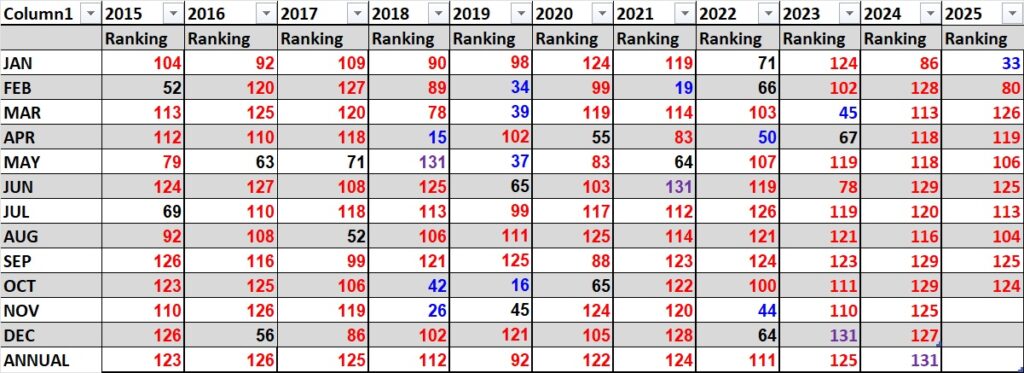
By December 10th the National Center for Environmental Information will finish their climatological assessment for Fall 2025 so our verification is not complete as of November 30th. Let’s do fill in ranking numbers with 1 being the coldest and 131 warmest for a verification for months during 2025, which have already been assessed:
Here are my two cents for a broad, rough forecast for the U.S. for Winter 2025/26, which I guarantee to be colder than this past fall, of course, as the amount of daylight decreases across the Northern Hemisphere.
I like to look at spikes on graphs because they can tell us something. Last year we had a big warming spike for 2024, so it stands to reason that we will not see back-to-back warmest years on record unless our climate is truly way out of whack with global warming becoming exponential. Winter 2024/25 was right up there because it was the 27th warmest on record:
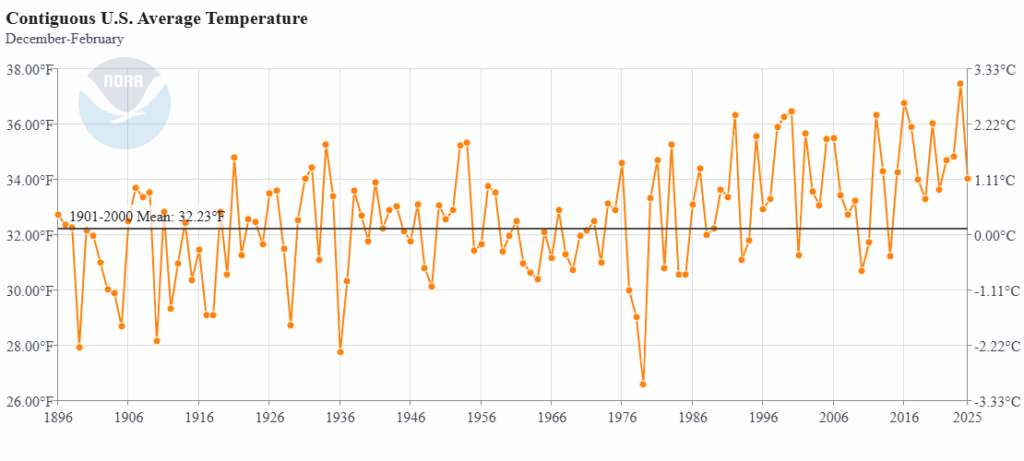
However, that’s a big drop from Winter 2023/24, which was the warmest in recorded history for the lower 48 states. So, for Winter 2025/26 I would expect another uptick on the above chart, putting this coming season at plus 20 of warmest winters but not at warmest on record.
Second, I like to look at water temperature anomalies surrounding North America just before the start of a season to get a sense of how much potential anomalous heat can be added to the atmosphere across the continent. Here is what we see:
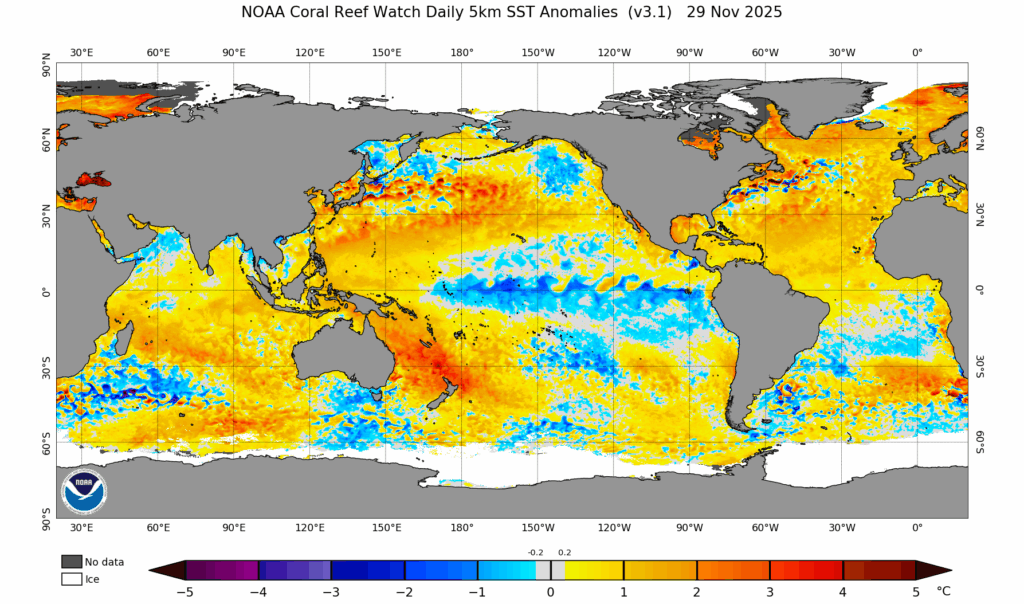
Anomalously warm seas surround North America. Mostly warmer than average conditions lead me to think that SST influence will be a positive factor for this coming season. Also, it appears that the current ENSO Pacific is in a La Niña phase. This usually means that the polar vortex over Canada will be strong enough to send arctic shots of frigid air into the lower 48 states. This might be a cooling factor this season.
We do note that the first week or two of December will be cold across most of the eastern and central U.S. while it will be warmer than average in the West:
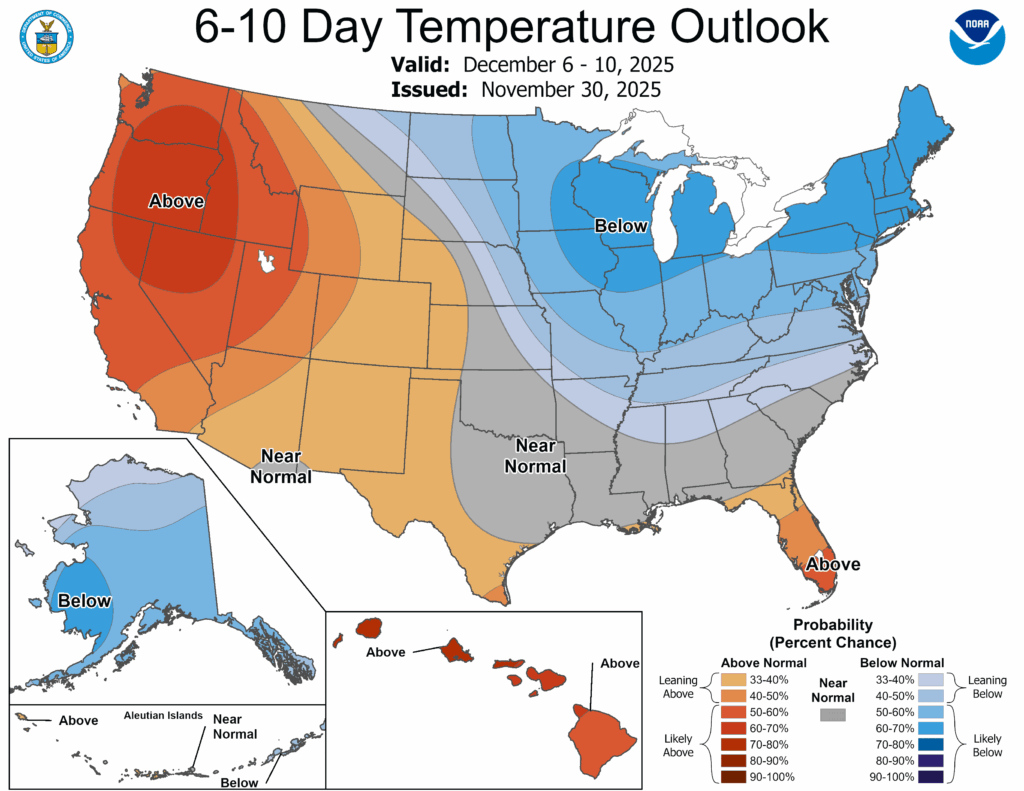
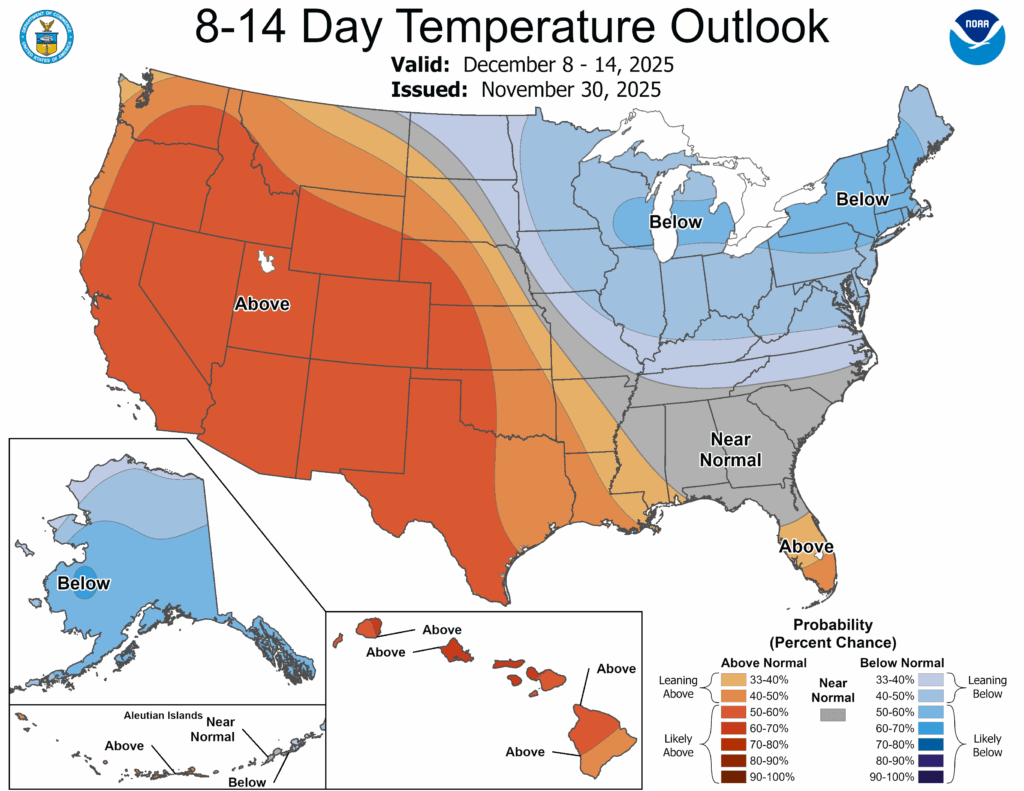
December 2025 might be our first near average month in quite some time and possibly slightly below average.
Here is the National Weather Service forecast for Winter 2025/26:
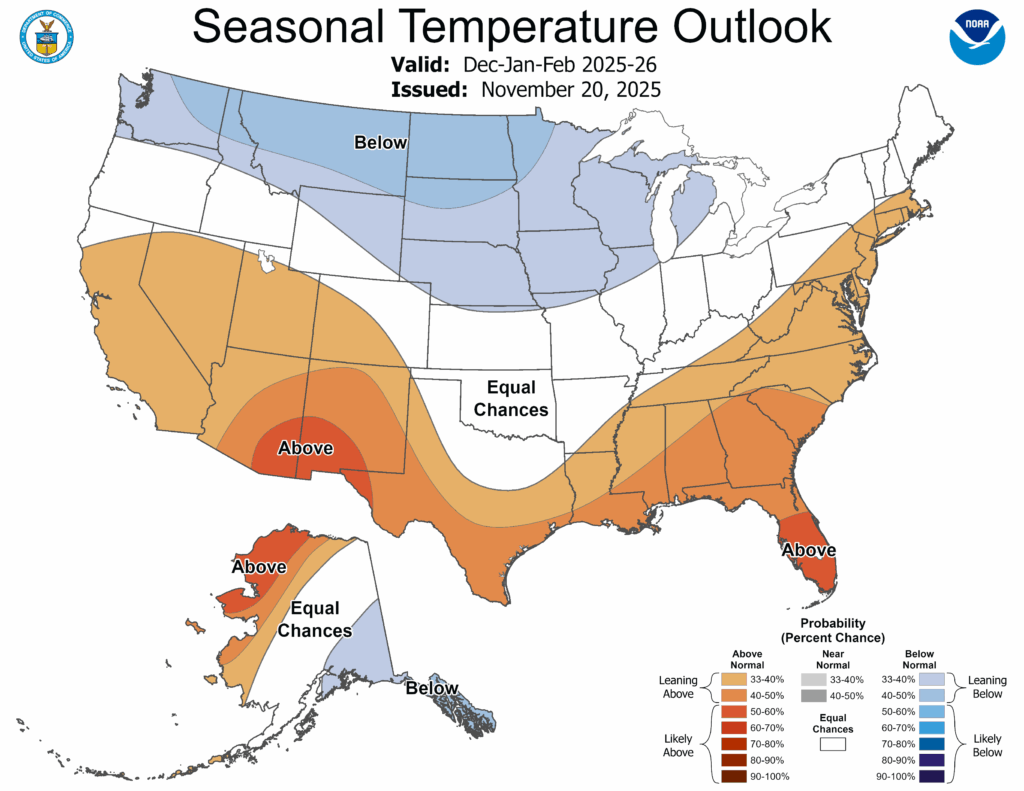
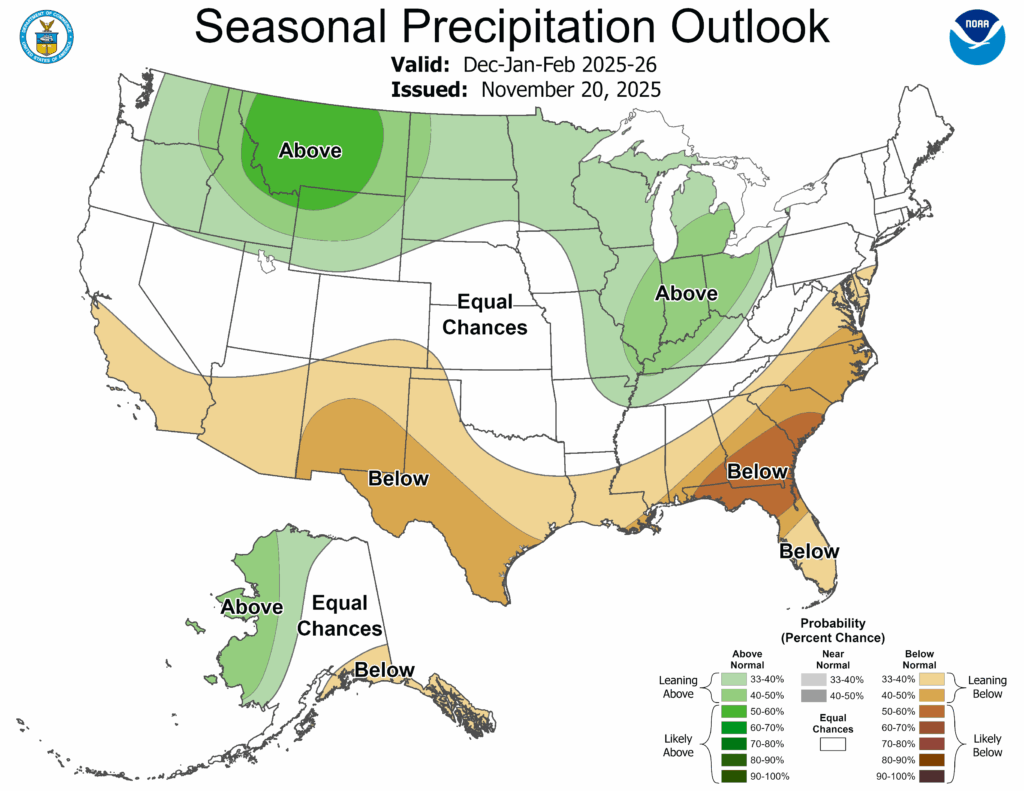
I can’t pinpoint one area where their forecast is incorrect, but overall, I think that this fall’s ranking should verify a tad above that of Winter 2024/25, which was 120.
Next, we can get another clue looking at prior National Center for Environmental Information ranking and temperature record count data. For this I like to drag out my “Record Scoreboard” (updated through 11/29/2025):
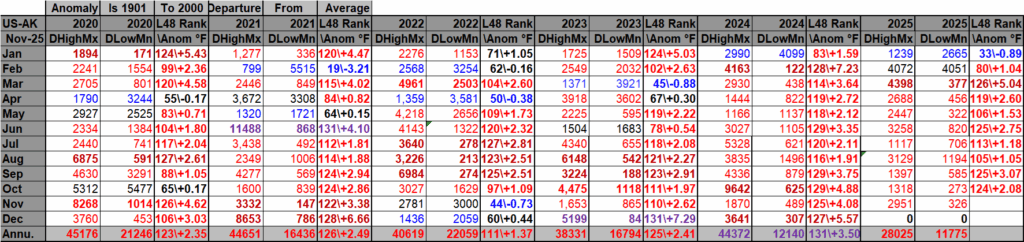
For these data sets all monthly ratios of > 10 to 1 DHMX to DLMN or > 10 to 1 DLMN to DHMX are in bold type. The rankings are for the lower 48 states with the warmest ranking since 1895 of average temperatures being 131 and 1 being the coldest as of 2025. Blue colors represent cold months and red warm. Those months and years with counts close to a 1 to 1 ratio of highs to lows are colored black. Boldly red-, blue-, or purple-colored months, such as January 2020 and October 2024, have ratios of >10 to 1 daily record highs to lows or <1 to 10 daily record highs to lows, and are either historically hot or cold, most of which have made news. All-time record hot or cold ranked months are highlighted in purple. I’ve subtracted Alaska record counts so we can better compare apples to apples with record totals and rankings for the lower 48 states.
Looking at trends, warm months should continue, but it looks like we are due for a cooler than average month like that of January 2025. Will that month be December 2025? The last two Decembers were exceedingly warm, so we are due for a cold December, or at least one closer to average.
I’m predicting that December 2025 will be near average with January and February 2026 being well above average. Here is the link to avg. rankings per year for the lower 48 states since 1895:
https://www.ncdc.noaa.gov/cag/national/rankings
Just about every season in the future will see above average temperatures, so seasonal forecasters are beginning to “chuck it,” discounting colder than average scenarios due to carbon pollution.
Here are all seasons ranked for the last decade:

The last time we had a below average winter season was before 2015. An average ranking on the above chart would be 65.5 as of 2025. Will Winter 2025/26 buck this trend? I think not.
Here is my bottom-line forecast for Winter 2025/26:
“I think that Winter 2025/26 will be ranked above average. I’m going to forecast that the Winter 2025/26 ranking will be around 120 + or – 10, with above near average confidence given all of the factors written within this post. It should be slightly warmer than Winter 2025/26.
My forecast for Summer 2025 of a ranking of 115 + or – 10 was 5 rankings too cool, but right on target considering that the upper end of my forecast was 125, and the verification was at 120.
We will see how well my forecast ranking of near 110 for Fall 2025 worked out in a few days.
As of 2025 the top ranking for any month or season would be 131 since climatological rankings for the United States started in the year 1895. Carbon pollution is definitely making below average seasons so rare that they are about to be a thing of the past. As stated, I’m going to guess that Winter 2025 gets ranked at 120 + or – 10, and with near average confidence given all of the factors in this post.
Have a fantastic winter.
Here are some “ETs” recorded from around the planet the last couple of days, their consequences, and some extreme temperature outlooks, as well as any extreme precipitation reports:
Here is More Climate News from Sunday:
(As usual, this will be a fluid post in which more information gets added during the day as it crosses my radar, crediting all who have put it on-line. Items will be archived on this site for posterity. In most instances click on the pictures of each tweet to see each article. The most noteworthy items will be listed first.)