The main purpose of this blog will be to track planetary extreme, or record temperatures related to climate change. Any reports I see of ETs will be listed below the main topic of the day. I’ll refer to extreme or record temperatures as ETs (not extraterrestrials).😜
Main Topic: Looking at the Los Angeles Fires One Year Later
Dear Diary. It has been a year since the awful Palisades Fire destroyed a large chunk of Los Angeles. As residents continue to try to recover, this is a good time to remember what climate change can do to an already dry environment. Southern California’s problem now is heavy rain causing mudslides in burn scars from last year. Jacob Soboroff has a new book out called Firestorm: The Great Los Angeles Fires and America’s New Age of Disaster (First hardcover ed.). New York: Mariner Books. ISBN 9780063467965. It’s title is what I’ve been emphasizing, which is that more of these disasters will be occurring due to our long term burning if carbon based fuels. Let’s prepare to deal with more wildfires, floods, and large coastal storms.
Bloomberg has written a summary on the Los Angeles fires a year later. On this date I am posting this now:
What Los Angeles Looks Like a Year After the Fires – Bloomberg
What Los Angeles Looks Like a Year After the Fires
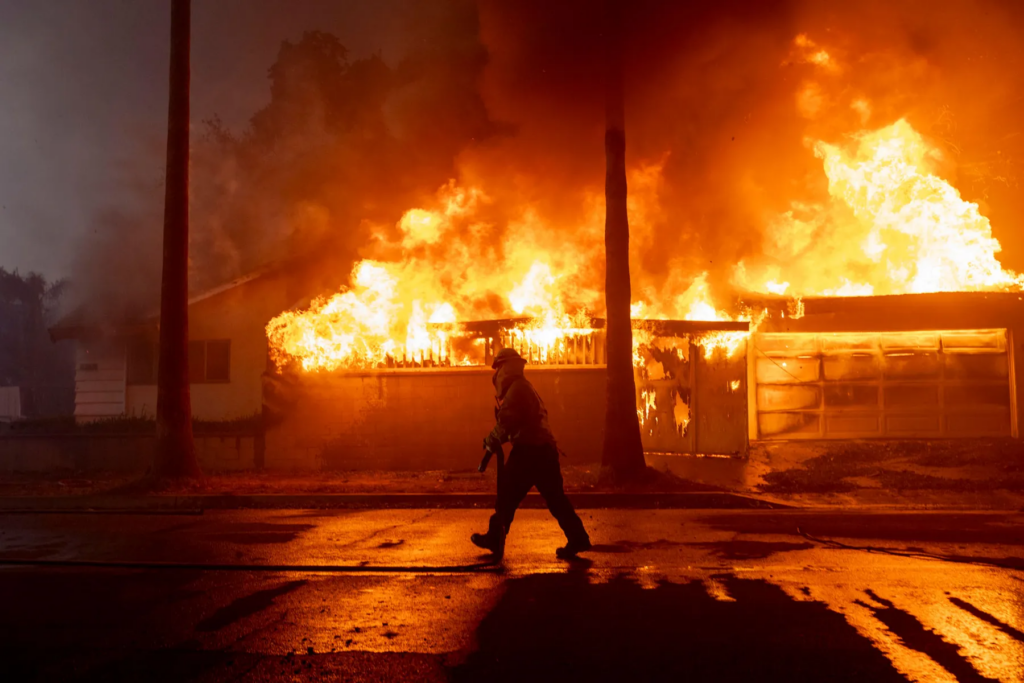
A firefighter battles the Eaton Fire in Altadena, California, in January 2025.Photographer: Bloomberg/Bloomberg
By John Gittelsohn and Michelle Ma
January 7, 2026
A year after Los Angeles’ tragic fires, recovery is beginning to take root. Houses are under construction — and in at least one case, already finished — some residents are still struggling to make ends meet and speculators are circling for deals on land to develop.
Today’s newsletter takes you to Pacific Palisades and Altadena for a snapshot of life 12 months after the flames wiped neighborhoods off the map. Please subscribe to Bloomberg News for the latest on climate change’s impact on the real estate market.
‘We will not walk away’
By John Gittelsohn and Michelle Ma
- Indian Climate Activist Investigated for Receiving Foreign Funds
- One Year After LA Fires, Recovery Is a Battleground
- Amsterdam Airport Runs Low on De-Icer as Polar Blast Hits Europe
- World’s Tallest Vertical Farm Opens in Import-Reliant Singapore
As an inferno roared toward her California home last January, Pauline Ching didn’t have time to grab family photos or her Chinese jade and ivory antiques. The house where she had raised her children and welcomed grandchildren soon became a statistic: one of more than 16,000 structures destroyed in the costliest wildfires in US history.
A year on, Ching is among the first homeowners to begin rebuilding in Altadena, the Los Angeles suburb ravaged by the Eaton Fire. She persuaded almost half of the 54 homeowners in her gated community to hire a single contractor, securing bulk discounts and faster permit approvals out of reach for many neighbors.

The site of Ching’s home and a photo showing her daughter’s wedding, which took place at the rear fountain. Photographer: Elizabeth Weinberg
Still, the rebuild will cost Ching about $350,000 more than her insurance will cover. To close the gap, she has joined a class-action lawsuit against utility Southern California Edison, whose power lines are suspected to have sparked the blaze.
“My situation is better than a lot of others,” Ching, 69, said from the home of her 96-year-old mother, where she’s staying while awaiting her house’s completion. “But once I got to the bottom line, I saw it costs a lot more than my insurance is covering. And there are things I lost that you can’t put a price on.”
Ching’s experience captures the difficult reality of LA’s fire recovery one year after the Eaton and Palisades blazes killed 31 people and blackened almost 40,000 acres: Rebuilding is possible, but only for those who can negotiate deals, absorb losses or take on risk — and even then, the money often doesn’t add up.
“California has been and will continue to fight for these communities,” Governor Gavin Newsom said in an emailed statement. “We will not walk away.”
Rent shock
Before it burned in the Eaton Fire, Chrissy Austin’s $1,600-a-month cottage was her sanctuary. Today, she’s paying $2,300 a month for a rental in South Pasadena after spending $30,000 on temporary homes and motels since the fire.
Because she’s nearly depleted her savings, she is trying to move into affordable housing. “You’re lucky if you can get in or get on a list even if there’s an opening,” she said.
About 40% of over 350 renters surveyed this summer by Eaton Fire Collaborative, a community group, reported paying less than $1,500 per month in Altadena before the fire. Today, the average asking price for a one-bedroom is about $2,350. More than three-quarters of surveyed renters reported not being able to afford that price.
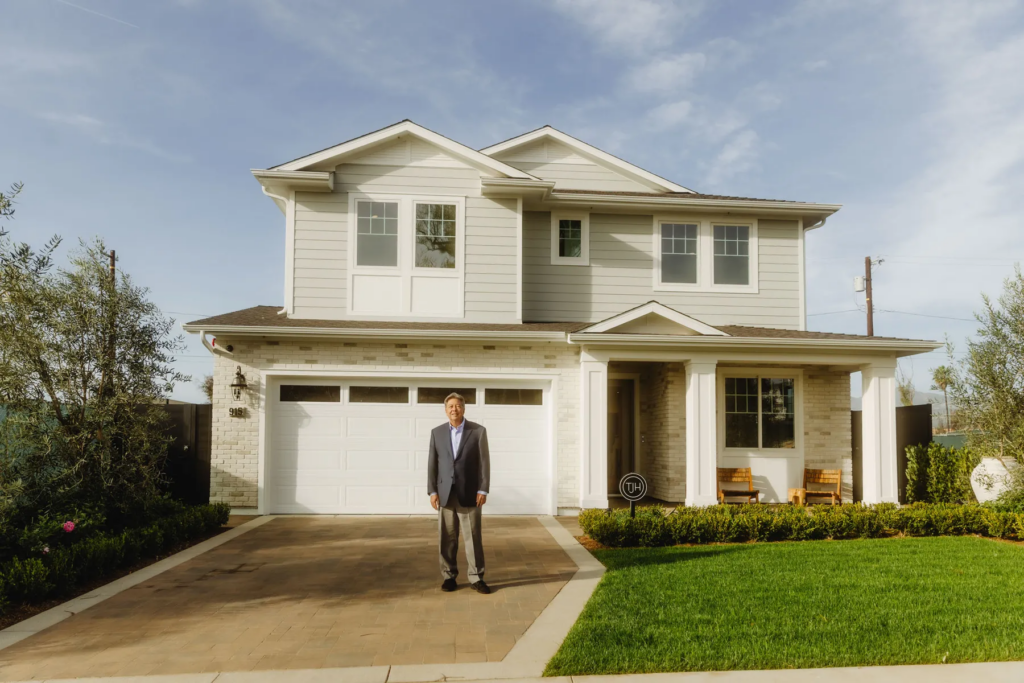
Jamie Mead, CEO of Thomas James Homes, which completed the first house in Pacific Palisades. Photographer: Elizabeth Weinberg
Slow rebuilding
Rebuilding applications so far outnumber lot sales, but construction has lagged. In Altadena, permits have been filed for more than 1,700 parcels, with at least 544 homes started, according to LA County data. In Pacific Palisades, owners of roughly 1,400 of 4,500 burned lots have applied to rebuild.
The first completed house in the Pacific Palisades is a four-bedroom traditional-style home built by Thomas James Homes and backed by private equity firm Oaktree Capital Management. For now, the firm is keeping it as a model to showcase the area’s rebirth.
“It’s a very lonely house right now, but it’s a house,” CEO Jamie Mead said in an interview.
Beachfront bet
Some investors see an opportunity.
New Zealand billionaire brothers Mat and Nick Mowbray have spent $128 million buying 16 burned Malibu beachfront lots, betting they can more than double that investment by building and selling new homes.
The investment is the biggest so far by any developer in the burn areas. With an average sale projected at $25 million per home, the Mowbrays are betting prices will climb to new heights in an area known for sprawling estates owned by Larry Ellison, Marc Andreessen, Beyonce and Laurene Powell-Jobs.
Read the full story to hear how more survivors are handling the recovery process.
A worrisome precedent
40%
The percentage of 488 homes destroyed by the 2018 Woolsey Fire that have been rebuilt.
Insurance gaps
“The systems in the county need to be changed so they can be equipped to handle disasters. They weren’t prepared for what happened.”
Zaire Calvin
Altadena homeowner
Calvin, a football couch and small business owner, lost two homes in the Eaton Fire. Insurance paid out a fraction of their value.
This week’s Zero
Kim Stanley Robinson’s life project has been imagining utopias. He’s a science-fiction writer best known in climate circles for writing Ministry For The Future, which depicts a future in which the world grapples with climate change following an extreme heat event that kills millions. Robinson joins Akshat Rathi this week on Zero to discuss how to create better futures and whether it’s right to pursue abundance.
Listen now, and subscribe on Apple, Spotify or YouTube to get new episodes of Zero every Thursday.
Silver lining
Germany managed to reduce harmful carbon dioxide emissions last year, mainly because its industry continued to face weakness rather than efforts to pursue cleaner technologies.
Germany Is Struggling to Reach Its 2030 Emissions Goal
Greenhouse gas emissions by sector (in million tons of CO2 equivalent)
Europe’s largest economy is struggling to emerge from multiyear struggles that saw gross domestic product fall in 2023 and 2024, and only narrowly avoided a recession in 2025.
The country’s manufacturers produced 11 million tons of CO2 less than in 2024, according to an estimate from climate think tank Agora Energiewende. Germany’s overall emissions fell by 9 million tons to 640 million, with higher pollution from the building and transport sectors slowing down overall progress.
More from Bloomberg
- Business of Food for a weekly look at how the world feeds itself in a changing economy and climate, from farming to supply chains to consumer trends
- Hyperdrive for expert insight into the future of cars
- Energy Daily for a daily guide to the energy and commodities markets that power the global economy
- CityLab Daily for top stories, ideas and solutions, from cities around the world
- Tech In Depth for analysis and scoops about the business of technology
Explore all Bloomberg newsletters.
Here are some “ETs” recorded from around the planet the last couple of days, their consequences, and some extreme temperature outlooks, as well as any extreme precipitation reports:
Here is More Climate News from Wednesday:
(As usual, this will be a fluid post in which more information gets added during the day as it crosses my radar, crediting all who have put it on-line. Items will be archived on this site for posterity. In most instances click on the pictures of each tweet to see each article. The most noteworthy items will be listed first.)