The main purpose of this ongoing blog will be to track global extreme or record temperatures related to climate change. Any reports I see of ETs will be listed below the main topic of the day. I’ll refer to extreme or record temperatures as ETs (not extraterrestrials).😜
Main Topic: Climate Change Influences with Winter Storm Fern
Dear Diary. On a personal note, Atlanta only had a minor icing event from Winter Storm Fern, so my power never went out, therefore my reporting can continue for today. Yesterday I went into detail describing what Fern would do. Today we will list climate change influences that have gone into changing Fern from what it might have been without our long-term carbon pollution. I bet that my power would have gone out say if Atlanta had gotten down to 25°F instead of 30°F as happened last night, which was a positive effect from climate change.
Other climate change items did make Fern a nastier beast, though. Climate Central has cobbled together a list, which we will use as our main subject for today:
Climate Shift Index Alerts | Climate Central
The link between this weekend’s dangerous winter storm and climate change
A frigid, disruptive winter storm is taking shape for this weekend, Jan. 23–25. These kinds of events don’t happen despite a warming climate — they’re connected to it, especially when it comes to the ice and snow totals being forecast. Climate change doesn’t eliminate winter or Arctic outbreaks. Instead, it increases weather variability and raises the odds of extreme outcomes.
Watch a video about the climate change connection to this winter storm.
A low-pressure system is tracking across the U.S., providing the moisture and lift needed for freezing rain, sleet, and snow — from Texas through the Deep South and Southeast, and up the East Coast. Warm, moisture-rich air from both the Pacific and the Gulf of Mexico, several thousand feet above the ground, is overrunning a shallow layer of bitter Arctic air at the surface — a classic setup for dangerous winter weather.
Climate influence:
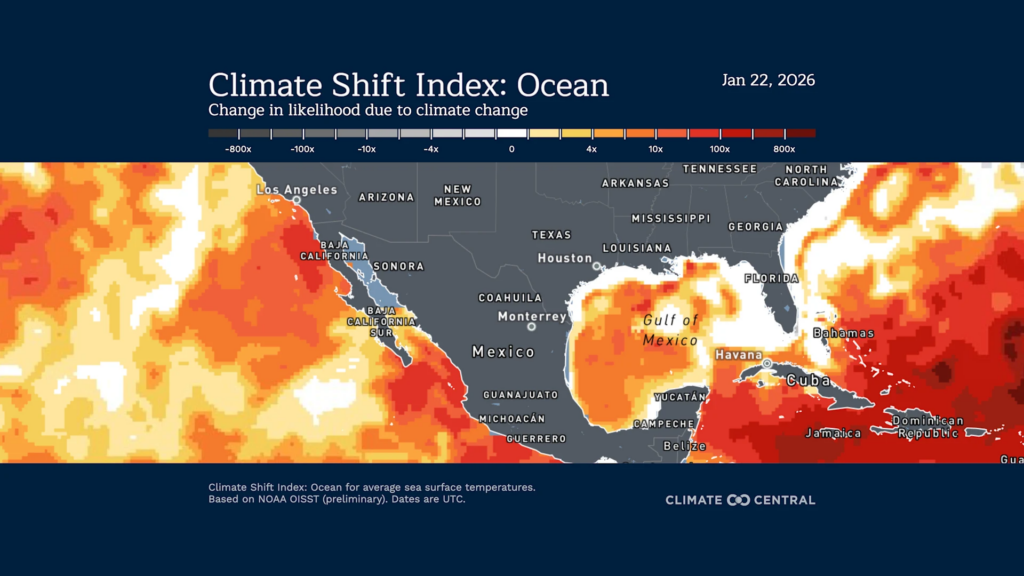
- Pacific waters south of the Baja California Peninsula are running 4 to 5 degrees Fahrenheit above average for late January — unusual warmth that’s been made 50 times more likely by carbon pollution.
- The Gulf of Mexico is also abnormally warm, up to 4 degrees Fahrenheit above normal conditions, made 10 to 30 times more likely by climate change.
- A warmer atmosphere is a thirstier atmosphere, capable of holding more moisture, and warmer oceans fuel greater evaporation, loading winter storms with additional moisture.
- When that moisture falls into Arctic air, precipitation totals can increase — whether it falls as rain, sleet, or snow.
Impacts:
- When extra moisture collides with Arctic air, impacts can escalate quickly — threatening power lines, trees, roads, and travel.
- From 2000 to 2023, 80% of major U.S. power outages were caused by weather, and nearly a quarter of those weather-related outages were due to winter storms.
- Since the late 1970s, daily heat records have become increasingly more common than daily cold records across the U.S. Explore daily updates for record high and low temperatures.
Kaitlyn Trudeau, a senior research associate for climate science at Climate Central, said:
“Judging climate change by a cold storm is like judging a baseball season by a single inning,” said Kaitlyn Trudeau. “But, climate change is having a tangible impact on this storm.“
Dr. Kristina Dahl, VP for Science at Climate Central, said:
“Warmer oceans and an atmosphere that holds more moisture are loading storms with extra energy and water. That doesn’t stop Arctic air from plunging south — it just means when cold air and abundant moisture collide, the impacts can be worse.”
Here are some “ETs” recorded from around the planet the last couple of days, their consequences, and some extreme temperature outlooks, as well as any extreme precipitation reports:
Here is More Climate News from Sunday:
(As usual, this will be a fluid post in which more information gets added during the day as it crosses my radar, crediting all who have put it on-line. Items will be archived on this site for posterity. In most instances click on the pictures of each tweet to see each article. The most noteworthy items will be listed first.)