The main purpose of this ongoing blog will be to track planetary extreme, or record temperatures related to climate change. Any reports I see of ETs will be listed below the main topic of the day. I’ll refer to extreme or record temperatures as ETs (not extraterrestrials).😜
Main Topic: Thousands of Heat-Related Deaths Go Uncounted in Texas Each Year, New Research Finds
Dear Diary. Ominously, during February dozens of record maxes were reported from Texas going well up into the 80s and 90s. We even saw the highest temperature ever reported during the winter in the United States reported from south Texas:
Should this trend continue into summer, Texas will have some very bad health problems.
The news I am reporting today is not too surprising but unfortunate and intersects with my record temperature research. It is up to honest brokers to accurately report deaths from heat in order to address and fix heat wave problems, particularly as the climate crisis deepens. Here is more from deceleration:
Thousands of Heat-Related Deaths Go Uncounted in Texas Each Year, New Research Finds
Existing systems record only ‘one-sixth of the statistically estimated heat deaths’ in Texas, a new paper by a Texas A&M researcher finds.
By Greg Harman
Andrew Dessler of Texas A&M University. Image: Texas A&M; Deceleration illustration
February 27, 2026
Texas officials are undercounting heat-related deaths every year, missing thousands of deaths, according to a trio of models run by a Texas A&M-based climate scientist—deaths that may otherwise motivate policymakers to respond to a long neglected (and accelerating) public health crisis.
“Official Texas records captured only about one-sixth of the statistically estimated heat deaths, though this undercounting has improved over time,” concludes a new paper by Andrew Dessler published earlier this month in the journal GeoHealth.
“These findings highlight the need for better heat death tracking systems and expanded protection programs for both extreme heat waves and routine hot weather as climate change brings more frequent and intense heat to Texas,” writes Dessler.
Researchers have struggled in the face of poor record-keeping to accurately track heat deaths even as temps have been rising for decades.
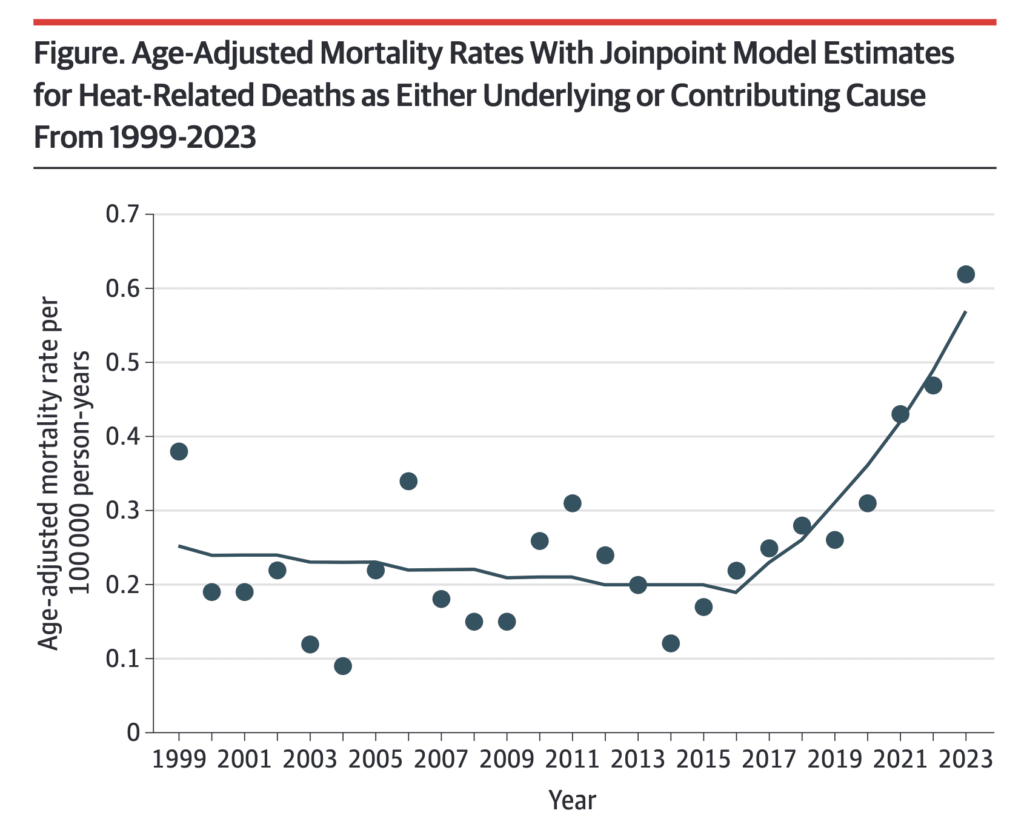
A previous Research Letter published in 2024 by the Journal of the American Medical Association found that annual heat-related deaths in the United States rose from 1,069 in 1999 to 2,325 in 2023—a 117 percent increase. It’s a trend “likely to continue,” the authors wrote, as climate change continues to drive up global temps.
In Texas, heat-related deaths also surged from 2020 to 2023, , according to official tallies, as Deceleration wrote in 2024. It was a response to a surge in global heat that hasn’t been experienced on the planet since modern humans began streaming out of Africa more than 100,000 years ago.
Deceleration has also reported on the chronic undercounting of such deaths, which the Occupational Safety and Health Administration under the Biden Administration described as a “vast undercount.”
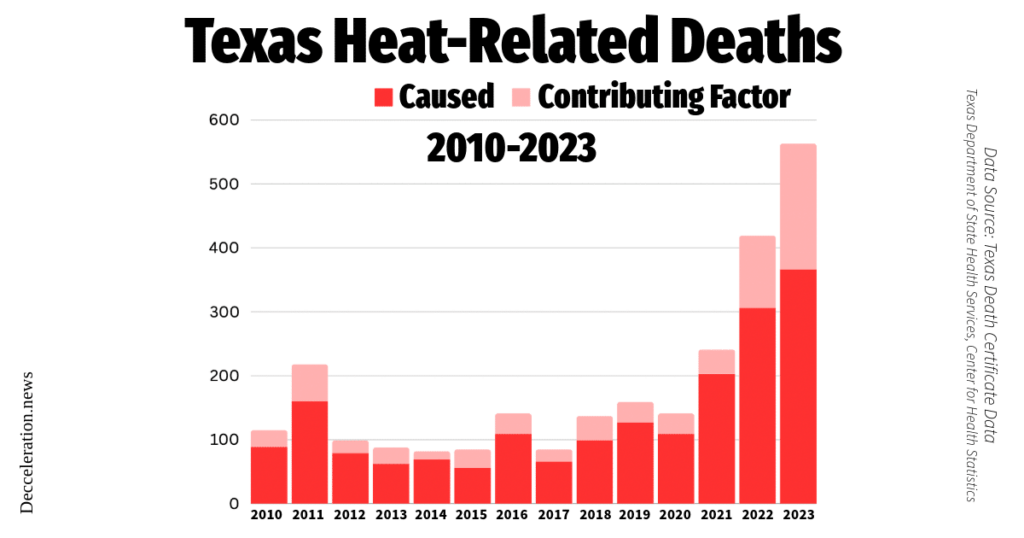
While the state of Texas logged 563 heat-related deaths in 2023, according to data released to Deceleration by the Texas Department of State Health Services via open-records request, this new report suggests there are huge gaps in reporting.
To get his results, Dessler, aided by a graduate assistant Jesse Rutt, ran three models to understand the likely range of heat-related deaths, as captured in their paper, “The True Cost of Heat: Evaluating Heat-Related Mortality Estimation Methods in Texas.”
They focused on summer months during the years 2010 to 2023.
All three methods suggested official numbers are significantly lower than the reality on the ground.
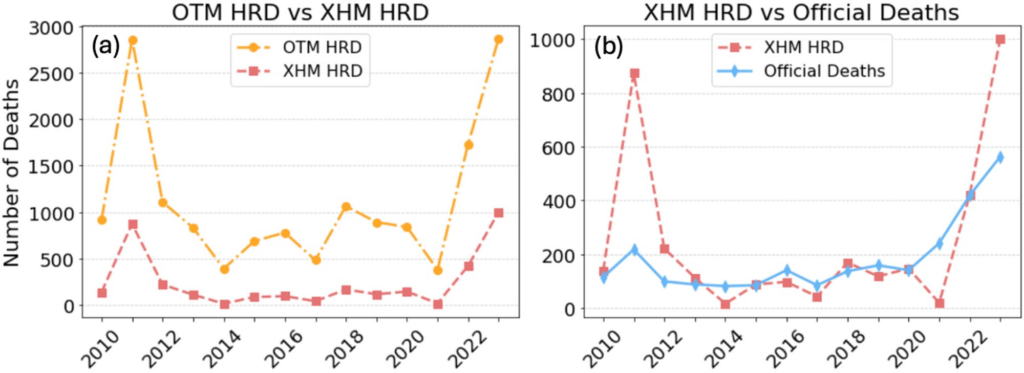
The pair found the bulk of unreported deaths likely occurred during periods of fairly typical summer heat. Using the common Optimal Temperature Method (OTM) of discovering heat-related deaths, they found that as many as 77 percent of all heat-related deaths occurred during periods of “moderate” heat, or 15,826 summertime deaths, roughly 1,130 summertime deaths per year.
Using a different model focused on extreme heat, the Extreme Heat Method (XHM), showed where deaths begin to surge. This model suggests 3,470 summertime heat-related deaths in Texas, or an average of 248 deaths per year. The spikes appear most clearly during the hottest years studied, 2011 and 2023, for example, where 873 deaths and 1,002 deaths manifest in the data, respectively.
“This means,” the pair write, “that 2.2% of all summer deaths were caused by moderate and extreme heat.”
That’s considerably more than the high of 563 deaths reported by the state in 2023.
The third model—the Excess Death Method (EDM)—explores increases in mortality over baseline, finding a 1.7 percent rise over what was seen during the middle 20th century.
Inhabitants of planet Earth have endured the consequences of what has amounted to a global experiment by profit-minded industrial interests. Year after year, an ever-growing accumulation of millions of tons of heat-trapping gases have been pumped into our atmosphere—primarily by engines, large and small, burning carbon-dense fossil fuels—while planet-cooling forests and natural spaces have been slashed and plundered.
While local, state, and federal governments in the United States were slowly cobbling together policies to reverse this trend, the Trump administration, riding a perhaps unprecedented financial campaign boost from fossil fuel interests, has chosen not to war against the climate crisis, but rather climate science.
Meanwhile, the climate crisis continues gathering strength.
The result has been a predictable corresponding global rise in heat, drought, and storms. Measuring that heat has been perhaps the simple part of the equation. Less straightforward has been calculating the harms, heat-related deaths in particular.
Here are some “ETs” recorded from around the U.S. the last couple of days, their consequences, and some extreme temperature outlooks, as well as any extreme precipitation reports:
Here is More Climate News from Monday:
(As usual, this will be a fluid post in which more information gets added during the day as it crosses my radar, crediting all who have put it on-line. Items will be archived on this site for posterity. In most instances click on the pictures of each tweet to see each article. The most noteworthy items will be listed first.)