The main purpose of this ongoing blog will be to track planetary extreme, or record temperatures related to climate change. Any reports I see of ETs will be listed below the main topic of the day. I’ll refer to extreme or record temperatures as ETs (not extraterrestrials).😜
Main Topic: Trump Hates Renewables. The Iran War May Help Them.
Dear Diary. Every dark cloud has a silver lining, or so the old saying goes. This year’s first very dark cloud is Trump’s new Iranian war. The silver lining is the higher oil prices go because of that war the more renewable energy gets helped. For example, if gasoline prices go higher than three dollars a gallon here in the United States, electric vehicles will go up in demand. I bet people who already have EVs are snickering to the bank as gasoline prices rise.
Outside of the U.S. there will be higher prices for oil as well as liquified natural gas. This will put mor pressure on Europe and China to make a quicker transition to renewables.
This is not to write that I’m glad that renewables will probably be boosted because of the war. That’s a very poor excuse given the death and destruction that any war causes, not to mention that wars do cause much more carbon pollution than they prevent:
Here are more details from E&E News:

Trump hates renewables. The Iran war may help them.
By Christa Marshall, Corbin Hiar | 03/03/2026
Higher gas prices in Europe and the U.S. could create economic and political incentives for solar, wind, batteries and other clean technology.
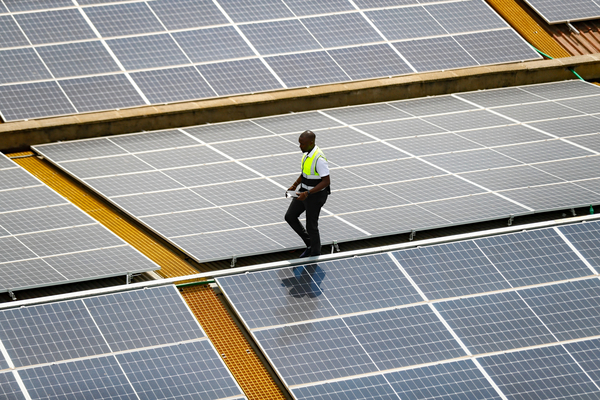
Solar power outside of the U.S. could be a beneficiary of volatile energy prices. Brian Inganga/AP
President Donald Trump’s decision to attack Iran could have surprising benefits for another target of his ire: the renewable energy industry.
Several index funds that include shares of U.S. clean energy companies rose Monday, following the American-Israeli strikes Saturday on one of the world’s largest oil and gas producing nations.
Invesco’s WilderHill Clean Energy ETF, for example, jumped 2.3 percent. That beat the broader S&P 500, which held steady as share prices in most global markets tumbled.
The scale of a boost for renewable energy companies could depend on how much damage the war causes to Middle East oil and gas infrastructure and how long the hostility imperils shipments of crude and liquefied natural gas, energy and security analysts said. It also hinges on the price of natural gas, which influences whether renewables are viewed as more economically attractive.
“Renewables offer a fundamentally lower level of commodity risk compared to imports of fossil fuels, and reminders of that benefit can boost stocks in that industry,” said Pavel Molchanov, a managing director at the investment bank Raymond James. That was true before the war, he added.
But the economic case for renewable companies and projects “are better today than they were 72 hours ago,” Molchanov said. “So that also feeds into investor appetite for clean energy stocks.”
The share price appreciation for clean energy funds came as natural gas prices inched higher in the U.S. and soared by as much as 50 percent in Europe due to Iran’s retaliatory strikes on LNG infrastructure in Qatar. Oil prices also increased in the U.S. and abroad due to damage sustained at a major Saudi Arabian refinery and fears about further lost capacity.
The price swings follow Trump’s rollback of federal subsidies for clean energy and electric vehicles, which supporters say can protect Americans from paying more on utilities or at the pump. If the trend continues, the president could rethink his opposition to wind, solar and EVs, according to Kevin Book, the managing director of the research firm ClearView Energy Partners.
“We would not yet rule out a pivot to clean energy on the basis of a pragmatic response to price increases from a supply shock,” said Book, who advises the Department of Energy on oil policy as a member of its National Petroleum Council. “But they’d probably draw from the Strategic Petroleum Reserve first.”
Paasha Mahdavi, an associate professor and energy expert at the University of California, Santa Barbara, said “there’s a clear positive sign for clean energy” after the strikes in Iran, adding the conflict could lead to more switching “away from the volatility and vicissitudes of fossil fuel markets.”
The effect is slated to be the most pronounced in the Middle East, Europe and Asia. Qatar’s state-owned energy company said it would halt production of LNG, a major global source of the fuel. The country exports gas through the Strait of Hormuz, which Iran said was closed Monday, rattling energy markets.
The squeeze on LNG supplies sets up a similar dynamic in Europe as in 2022 after Russia invaded Ukraine, Mahdavi said. At the time, renewable projects jumped sharply on the continent after Russia choked off its supply of gas, he said.
The year after the invasion, new solar power capacity in Europe increased from roughly 40 gigawatts to more than 60 gigawatts, for example.
In a research note Monday, BloombergNEF made a similar point, saying that if the disruption in Iran lasts, “it could push customers toward technologies like solar and batteries” in Europe.
The outlook for U.S. renewables is murkier due to the nation’s abundant reserves of natural gas. U.S. gas export facilities “are already maxed out,” making it less likely there’s a significant impact on gas prices domestically, said Enrique Gonzalez, an analyst at BloombergNEF.
Goldman Sachs said in a research note that there is “little upside risk” for U.S. gas prices from the Iranian conflict. That in turn could minimize any pricing benefit for renewables.
The longer the conflict goes on, the more that domestic wind and solar projects could see a boost, Mahdavi said.
Yet it’s uncertain how much solar power might benefit in Europe this time around, as the market is “saturated” and affected by plunging power prices during the daytime, according to BloombergNEF.
Increased uptake of stationary batteries and electric vehicles that charge during the day “could reverse this trend and allow further solar to be added,” it said.
As for wind, Wood Mackenzie analyst Endri Lico said most ongoing projects in the Middle East are typically gigawatt-scale developments that have already received their equipment, making short-term geopolitical disruptions unlikely. The U.S. wind industry also receives many of its components domestically.
If the war helps push interest rates higher, it could wreak havoc for capital-intensive energy projects, including renewable ones. Offshore wind in Europe “is still trying to recover from the disruption” of higher rates after the Russian invasion of Ukraine, BloombergNEF said.
Here are some “ETs” recorded from around the U.S. the last couple of days, their consequences, and some extreme temperature outlooks, as well as any extreme precipitation reports:
Here is More Climate News from Wednesday:
(As usual, this will be a fluid post in which more information gets added during the day as it crosses my radar, crediting all who have put it on-line. Items will be archived on this site for posterity. In most instances click on the pictures of each tweet to see each article. The most noteworthy items will be listed first.)