The main purpose of this ongoing blog will be to track planetary extreme, or record temperatures related to climate change. Any reports I see of ETs will be listed below the main topic of the day. I’ll refer to extreme or record temperatures as ETs (not extraterrestrials).😜
Main Topic: Winter Sea Ice in the Arctic Ties a Record Low
Dear Diary. Yesterday I shared many charts and statistics via Sam Carana indicating how badly our climate was unraveling. Today let’s concentrate on just one of these facets- Arctic sea ice. This isn’t the first time we have delved into Arctic sea ice extent, but the first time this year. What’s alarming is that some forecasters think that we could see open waters across the Arctic this summer for the very first time in modern human history going back tens of thousands of years.
All this while we have less available ways to measure sea ice because of Trump:
Apparently, we tied with 2012 for the lowest winter extent of Arctic ice on record. I remember that year well because of the hot spring and summer that had numerous all-time hot records. March 2012 and March 2026 have been eerily similar with astounding heat records. Stay tuned to see if all of this is mere coincidence or if low ice extent can be tied to very warm conditions across the contiguous United States.
Here are more details from the New York Times:
Winter Sea Ice in the Arctic Ties a Record Low – The New York Times
Winter Sea Ice in the Arctic Ties a Record Low
Ice plays a vital role in reflecting away planet-warming sunlight. The Arctic is warming much faster than most other parts of the world.
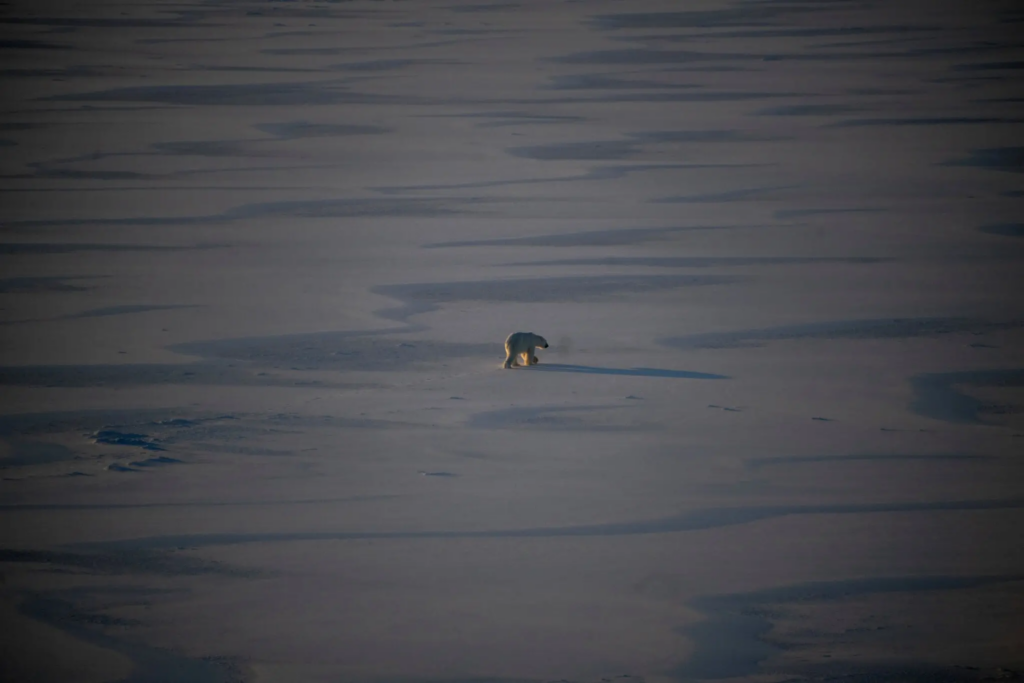
The disappearing ice also affects wildlife habitat. A polar bear on Norwegian sea ice last April. Credit…Olivier Morin/Agence France-Presse — Getty Images


Graphics by Harry Stevens
March 26, 2026
Wintertime sea ice in the Arctic has tied last year’s record low, the National Snow and Ice Data Center said on Thursday.
Sea ice in polar regions acts like a planetary air-conditioner by reflecting away the sun’s heat. It also provides habitat to animals and regulates ocean conditions.
Each summer in the Northern Hemisphere, as temperatures rise in the Arctic, sea ice melts and then freezes back in winter. The scale of this refreezing is critically important because it is a leading factor influencing how much ice can remain unmelted during the summer.
Ice is vanishing worldwide as humans burn fossil fuels for energy and emit greenhouse gases. But it’s disappearing particularly quickly in the Arctic, which is warming four times as fast as the rest of the planet.
Only 5 percent of the oldest, thickest sea ice recorded in the 1980s has survived to the present day. In the same amount of time, summertime sea ice cover has been halved, shrinking by some 12 percent per decade.
Arctic sea ice ties record low for this time of year
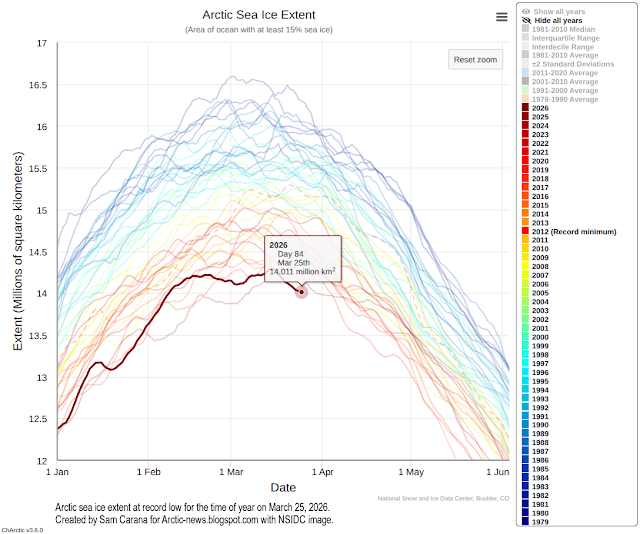
The image above, adapted from NSIDC, shows that on March 25, 2026, the Arctic sea ice extent was 14.011 million km², the lowest extent on record for the time of year.
Right now is when sea ice should be near a yearly peak, said Walt Meier, a senior research scientist at the National Snow and Ice Data Center at the University of Colorado Boulder. Last year, the smallest amount of new winter sea ice formed since record keeping began in 1979, and this year tied that low.
Not every year brings a record, he said. But this year is relatively extreme, he said. Based on overall trends, there’s the possibility that, by 2040, an area the size of the continental United States could go from being completely covered in sea ice to ice-free each summer, Dr. Meier added.
However, he said, exactly when and where ice might vanish is somewhat uncertain because of the variability in year-to-year weather patterns.
This year, scientists are bracing for a hot summer. Signs indicate that an El Niño, a pattern of warm water in the Pacific Ocean that occurs a few times each decade and that tends to heat up parts of the globe and amplify ice loss, is forming.
Sea ice is politically significant, too. As it dwindles, previously impassable parts of the Arctic Ocean have become open to shipping, presenting economic opportunities. For northern countries, including the United States, which has Arctic territory in Alaska, increasingly accessible oceans are also an emerging national security concern.
The Trump administration has made large cuts to climate research. Last October, the National Snow and Ice Data Center announced it would suspend and reduce several of its sea ice analysis services and tools, like monthly reports, because funding had not been renewed.
At the other end of the planet, where summer is drawing to close, Antarctic sea this year fared notably better than previous ones and ranked at the 16th-lowest yearly minimum in the 48 years since satellite records began.
Sachi Kitajima Mulkey covers climate and the environment for The Times.
Harry Stevens is a Times reporter and graphics editor covering climate change, energy and the natural world.
More:
Here are some “ETs” recorded from around the U.S. the last couple of days, their consequences, and some extreme temperature outlooks, as well as any extreme precipitation reports:
Here is More Climate News from Monday:
(As usual, this will be a fluid post in which more information gets added during the day as it crosses my radar, crediting all who have put it on-line. Items will be archived on this site for posterity. In most instances click on the pictures of each tweet to see each article. The most noteworthy items will be listed first.)