The main purpose of this ongoing blog will be to track planetary extreme, or record temperatures related to climate change. Any reports I see of ETs will be listed below the main topic of the day. I’ll refer to extreme or record temperatures as ETs (not extraterrestrials).😜
Main Topic: Where Flowers and Leaves Are Emerging Early After Record-Warm March
Dear Diary. No doubt about it, March 2026 was by far the warmest March for the lower 48 states in U.S. history. Over the next week I will be presenting as our main topic of the day some eyepopping statistics from last month.
Obviously, flora has responded to this record warmth that was near continental wide. The Washington Post has done a great job depicting the geography of early spring bloomers in the following article:
See how early flowers are blooming and leaves are emerging in your area – Washington Post
By Ben Noll, John Muyskens and Naema Ahmed
April 2, 2026
After the most unusually warm month on record across the United States, the trees and flowers have taken notice.
Temperatures were a whopping 7 degrees above average across the country during March, and it was shockingly toasty in the West, where temperatures were summerlike.
That means flowers are blooming in the Mid-Atlantic and Central states, and you may notice pollen wafting through the air — depending on where you live.
According to data from the USA National Phenology Network (USANPN), leaves have emerged two to four weeks earlier than normal in many Central and Western states — breaking records — with about 190 million people across the country so far experiencing an early start to spring, based on the behavior of lilac and honeysuckle.
Theresa Crimmins, director of USANPN, said that there had been some “crazy early” starts to spring in the West, with reports of flowering oak trees in western Oregon, lilac leaves emerging in south-central Wyoming and flowering shrubs near Denver.
With cherry blossoms now in full bloom in D.C., many northern cities — from Detroit to New York and Boston — are on the verge of seeing spring leaves and increasing seasonal allergies.
Where leaves are emerging
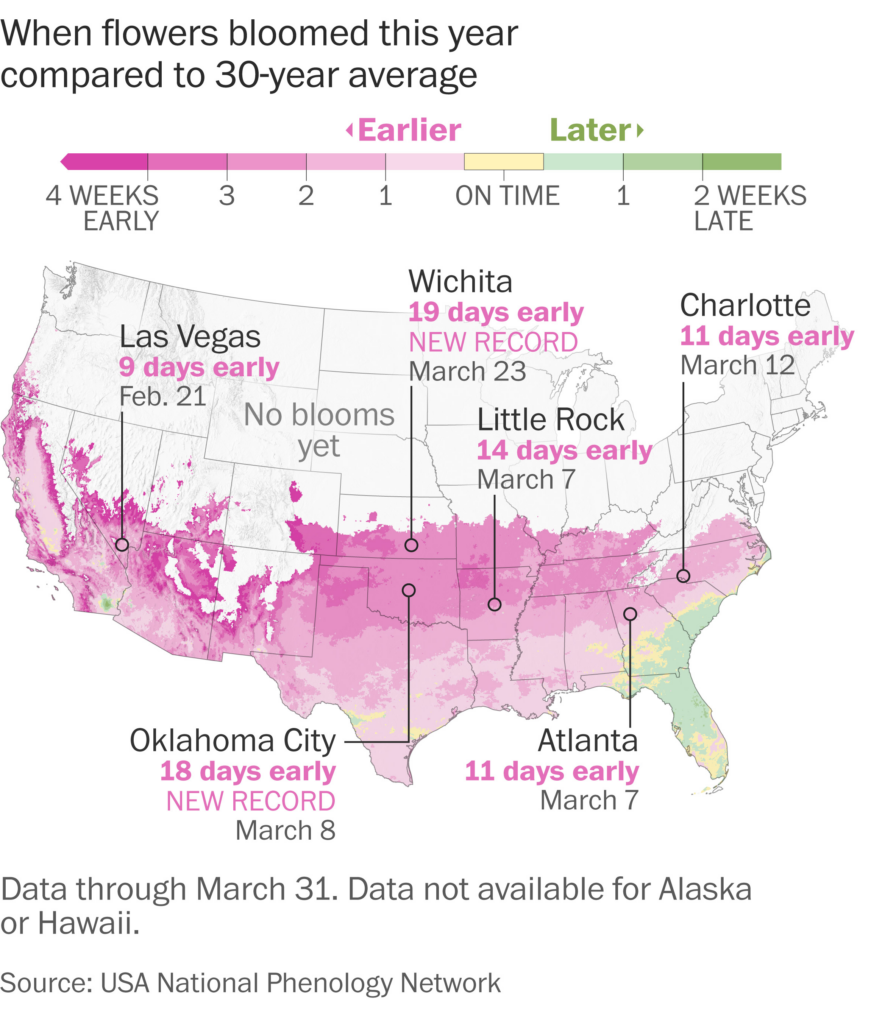
Meteorological spring started March 1. The astronomical season started March 20. But there’s a third option: The season as decreed by the plants. They don’t follow any calendar and instead leaf out when it’s warm enough.
The first emergence of leaves can be estimated by temperatures since the start of the year. A certain amount of warmth needs to accumulate before leaves appear. This warmth is typically measured through a metric called growing degree days.
In Florida, first leaf typically happens in mid- to late January. Meanwhile, it usually takes until mid- to late April in Maine.
This season, leaves have popped out earlier than normal across wide swaths of the country, including the West, the Rockies, the Plains and the Midwest — consistent with very unusual March heat.
Leaf-out occurred at least two weeks earlier than normal in parts of 14 states, considering statewide medians. These states include Wyoming, Colorado, Nebraska, Montana, Idaho, Kansas, Oregon, Nevada, South Dakota, Utah, Ohio, Indiana, Iowa and Illinois. That list will probably soon grow to include North Dakota, Minnesota, Wisconsin and Michigan.
It was the earliest leaf-out on record near the Rocky Mountains and in parts of the central Plains from Kansas to South Dakota — where leaves locally emerged 30 to 50 days earlier than normal — as well as in a section of the Gulf Coast from eastern Texas to southern Alabama.
In the Carolinas, leaves emerged about a week later than normal this year, linked to a cold, snowy winter in the East. The process was also slower than normal in eastern Virginia by about two weeks in some spots.
The stretch from Milwaukee to Detroit and Buffalo is on the verge of seeing spring leaves — several days ahead of schedule. In Boston, first leaf typically occurs on April 3. It will probably be within a few days of that average this year.
Where flowers are blooming
Map showing when flowers have bloomed in 2026 relative to a normal year. The following places are highlighted: Wichita: 19 days early on March 23 (new record); Oklahoma City: 18 days early on March 8 (new record); Little Rock: 14 days early on March 7; Atlanta: 11 days early on March 7; Charlotte: 11 days early on March 12; Las Vegas: 9 days early on Feb. 21. Data through March 31.
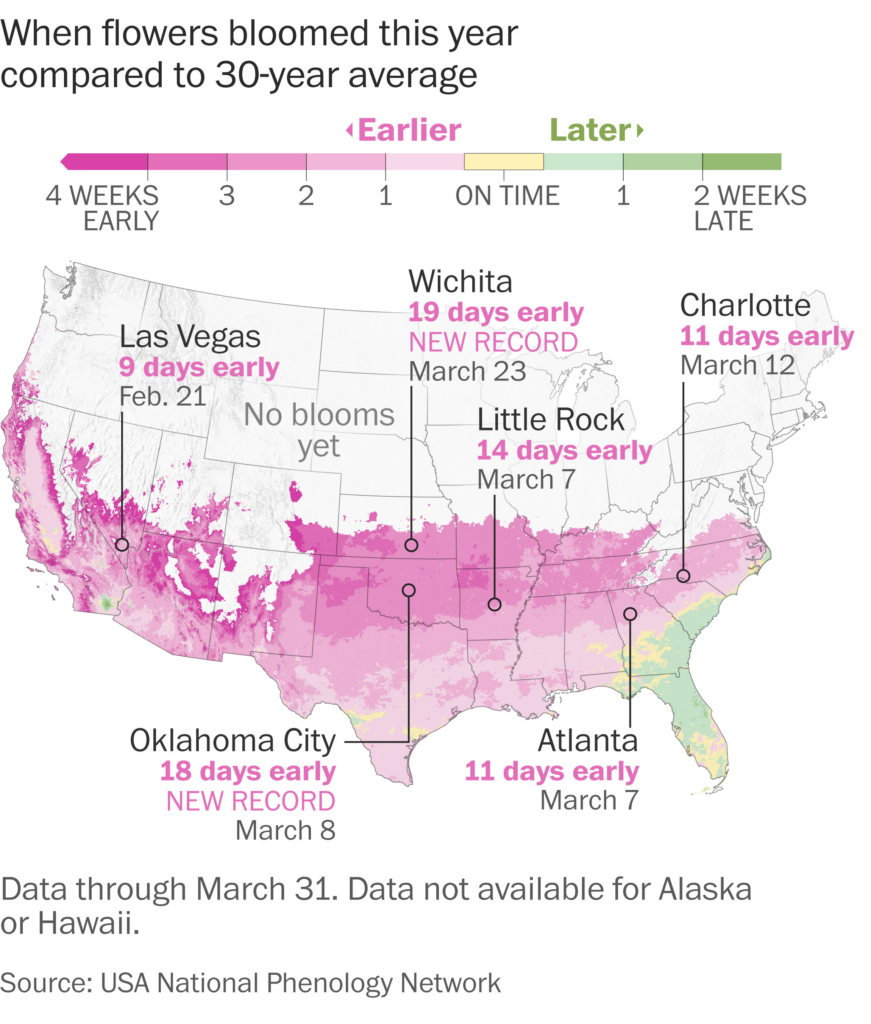
Lilac and honeysuckle tend to bloom about a month after their leaves come out. Right now, that’s happening from California to the Carolinas and Virginia — mostly well ahead of schedule.
In the nation’s capital, cherry blossoms can appear earlier than lilac and honeysuckle flowers because different species respond to heat differently — cherries bloom before leafing, unlike those indicator plants.
Meanwhile, in Death Valley, California, there’s been a rare super bloom of wildflowers due to plentiful rain and warm conditions.
“The blooming of flowers is an important seasonal milestone for insects and other pollinators, which depend on pollen or nectar for food. It’s also of great importance to farmers and other agricultural producers,” wrote the National Oceanic and Atmospheric Administration.
The agency added that “if warm winters or springs cause early flowering in peach or other fruit trees, it can make them especially vulnerable to damage from a single late-season frost or freeze.”
In North Carolina, where flowers recently bloomed, weather documentarian Mark Sudduth described “clouds of pollen” wafting through the air last week. It was the worst he could recall, he said, covering his car mere hours after it had been washed.
Following recent abnormal heat and record spring growth, spells of unseasonably cold conditions are expected across the Intermountain West and Plains this week and weekend — along with accumulating snow in some areas.
Crimmins said that frost typically isn’t devastating to leaves, but it can set them back a few weeks. She added that new research suggests that this setback can extend into the following year, resulting in delayed growth activity.
However, she mentioned that a higher impact is typically seen when flower tissues are damaged by frost because they don’t usually regenerate in the same season. Cherry and plum trees flower before they show their leaves, which means the flowers are the first parts to get exposed to potentially damaging conditions. If all blooms are damaged in one event, that can mean little to no chance for fruit production.
“We’ve seen massive crop losses in recent years when this combination of events has occurred,” Crimmins said.
How exceptional March warmth played a role
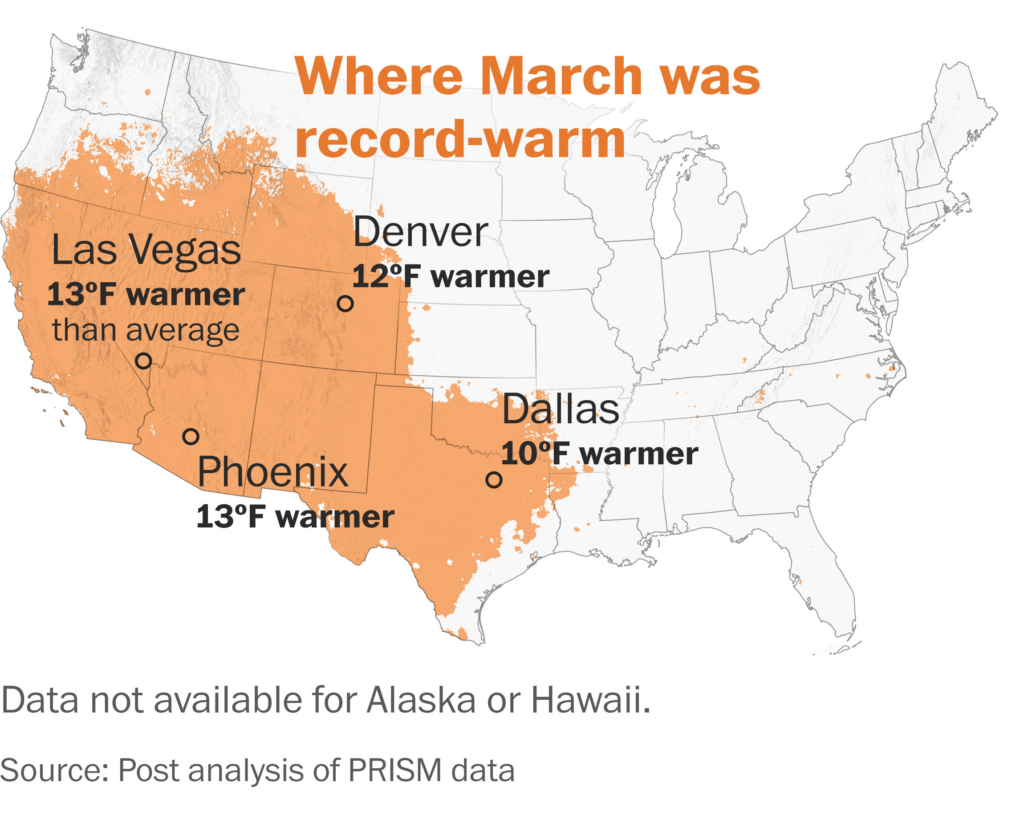
Large swaths of the U.S. — from the West to the southern Plains — experienced their warmest March on record, considering average temperatures.
Parts of the Southwest had temperatures that were more than 15 degrees above average for the month. Only small portions of northern Minnesota, North Dakota and Washington state experienced below-average temperatures. The rest of the country was warmer than average.
This will probably culminate in the warmest March on record for the country and one of the warmest months compared with the average overall since at least 1981. Since then, just two other months featured temperature departures from average of around 7 degrees in the U.S.: March 2012 and January 2006.
Such large deviations from the norm — in temperatures, leaf emergence and flower blooms — are becoming more frequent as the climate warms.
About this story
Spring leaf emergence and flower bloom data was sourced from USANPN. That data is based on accumulation of heat energy that is highly correlated with spring plant growth and development. Anomalies were computed by comparing this year’s conditions with historical averages from 1991 to 2020. To determine the earliest and latest leaf-out and bloom, data from 1981 to 2026 was considered. Temperature data since 1981 was sourced from PRISM/Oregon State University, and anomalies were calculated relative to 1991 to 2020 averages.
Here are some “ETs” recorded from around the U.S. the last couple of days, their consequences, and some extreme temperature outlooks, as well as any extreme precipitation reports:
Here is More Climate News from Friday:
(As usual, this will be a fluid post in which more information gets added during the day as it crosses my radar, crediting all who have put it on-line. Items will be archived on this site for posterity. In most instances click on the pictures of each tweet to see each article. The most noteworthy items will be listed first.)