The main purpose of this ongoing blog will be to track planetary extreme, or record temperatures related to climate change. Any reports I see of ETs will be listed below the main topic of the day. I’ll refer to extreme or record temperatures as ETs (not extraterrestrials).😜
Here is a new feature for this blog, which I will add daily. This is the latest inciteful Green News Report from my friends Desi Doyen and Brad Friedman at Progressive Voices. Hit ‘continue reading,’ listen, then hit return to see my daily topics:
Dear Diary. The good news is that Heatwave Bluestone, that I’ve dubbed for an Oklahoma oil and gas company, will moderate after the 4th. The bad news is that dangerous conditions will persist through the nation’s big 250th birthday with many celebrations being marred by health heat emergencies.
For example, in my own hometown of Atlanta the 10K Peachtree Road Race held each morning of the 4th could be called off due to dangerous conditions. If it does happen there probably will be more heat related issues than usual with some racers needing medical treatment.
Heatwave Bluestone is on the cusp of being a historic CAT4 since records being set are close to all-time records. For more on that here is one of today’s Washington Post article: (For graphics that I did not include, hit the following link.)
Peak of heat reaches Mid-Atlantic as many records fall across East – The Washington Post
Peak of heat reaches Mid-Atlantic as many records fall across East
See where it reached a blistering 105 degrees on Thursday and where it could happen again on Friday.
July 3, 2026 at 6:28 a.m. EDT
By Ben Noll and Sarah Kaplan
From the Midwest to the East Coast, high temperature records have been broken or tied across 21 states since Wednesday, and the peak of the heat is still to come for the Mid-Atlantic and Southeast.
Heat alerts from the National Weather Service remained in effect for 105 million people early Friday.
Here are some of the most notable temperature records set on Thursday:
- 105 degrees in Newark
- 104 degrees in New York (LaGuardia Airport)
- 103 degrees in Baltimore; Wilmington, Delaware; Poughkeepsie, New York; and Atlantic City
- 102 degrees in D.C. and Frederick, Maryland
- 101 degrees in Boston
It reached 100 degrees in New York’s Central Park and 103 degrees in Philadelphia on Thursday, with both cities tying their daily temperature record and surging into the triple digits for the first time since 2011. In Boston, it reached the triple digits for the first time since 2002.
In D.C., the lowest temperature reported through 6 a.m. Friday was 84 degrees — which would tie the city’s highest minimum temperature on record, as long as it doesn’t drop below 84 degrees for a full 24-hour period.
(red heat warnings : orange heat advisories)
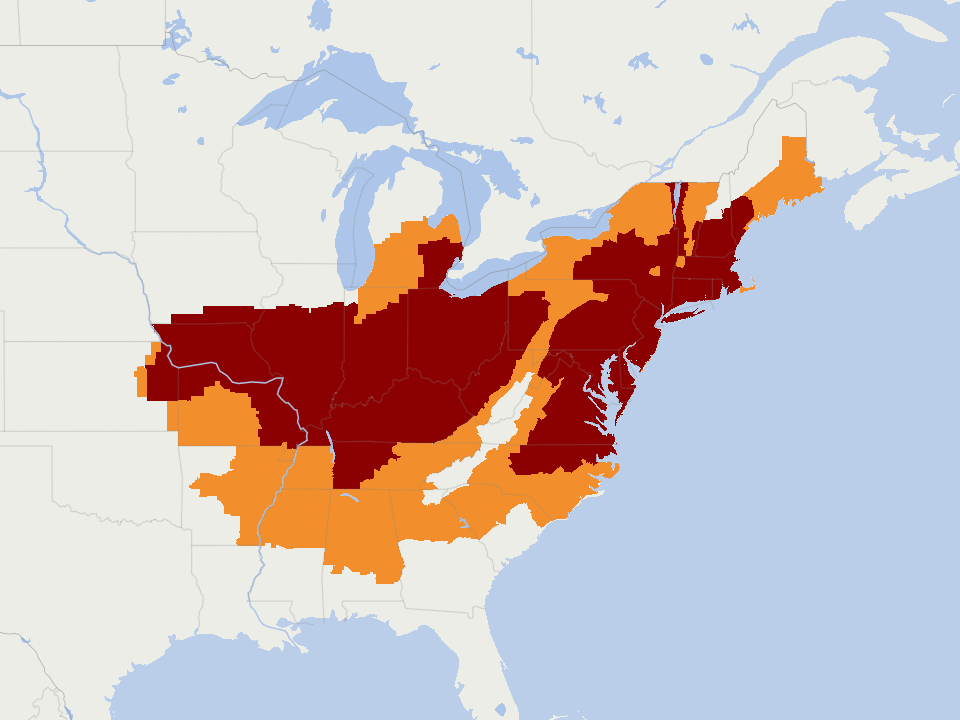
But this isn’t just a heat wave. It’s also a humidity wave.
On Thursday morning, peak humidity in the stretch from New York to D.C. was about the same as notoriously humid places such as Miami, New Orleans and Houston.
During the day, the country’s highest heat index values — accounting for high temperatures and humidity — were recorded in Virginia. That’s where the heat index reached 121 degrees in Farmville, about 50 miles west of Richmond, and 118 degrees in Leesburg. However, it’s alsopossible that humidity sensors at these locations were reading a bit too high, as performance can degrade at extremely high temperatures.
The extreme heat is being exacerbated by the lack of cooling at night. It was still a remarkable 94 degrees at 12 a.m. Friday at New York’s LaGuardia Airport — the highest midnight temperature there on record. Although this heat was probably boosted by the urban environment, it was also a record-breaking 86 degrees at midnight in the rural mid-Hudson Valley, about 60 miles north of the city.
In New York’s Central Park, the temperature only dipped to 84 degrees early Friday. That may go into the weather record books as a tie for the city’s warmest night as long as it doesn’t drop below 84 degrees on Friday evening.

Peak humidity is forecast to reach extreme levels for around 82 million Americans through Saturday. (Ben Noll/The Washington Post; NOAA)
And there’s more to come.
Across the Mid-Atlantic, Friday will probably be the hottest day of the stretch, with temperatures surging up to around a brutal 105 degrees.
The weather service is forecasting highs of 104 degrees in Baltimore and 103 in Philadelphia and the nation’s capital.
It will also be extremely hot on Saturday, but the heat dome will be decreasing in strength, leading to more afternoon clouds and a chance for gusty evening thunderstorms. Those storms will probably clear in time for late evening fireworks.
Farther south, triple-digit heat will linger across the Carolinas through Monday, where Raleigh may experience four straight 100-degree days — including a peak of 105 on Saturday.
But in the Northeast and parts of the Mid-Atlantic, a stormy pattern packed with drenching rain and thunderstorms will quell the heat from Sunday to Tuesday — and could even bring a risk for flash flooding.
Higher humidity adding to heat stress risks
The torrid weather that has engulfed the northeastern U.S. this week is so severe that scientists said Friday it would be “virtually impossible” in a world without human-caused warming.
Using a metric called wet bulb globe temperature (WBGT), which combines measures of heat and humidity, researchers at the World Weather Attribution network found record-smashing conditions for a swath of North America stretching from Minnesota to Maine and from Virginia to Ontario. Considering forecast data between July 1 and July 4, daytime WBGTs in this region were up to 28 degrees Celsius — several degrees higher than the average for the last three decades and a level that can lead to a moderate-to-high threat for heat stress, depending on the part of the country that it’s occurring in.
At this level of heat and humidity, research shows, strenuous physical activity can be dangerous even for young and healthy people.
“On America’s 250th birthday, our study gives a clear reality check,” lead author Theodore Keeping, a climate scientist at Imperial College London, said in a statement. “The climate the country has today is fundamentally different to the one it had when the Founding Fathers signed the Declaration of Independence.”

By Ben Noll Ben Noll is a meteorologist passionate about explaining the why behind the weather, extreme events and climate trends. He has expertise in data analysis, supercomputer-driven graphics and forecasting weather worldwide. follow on X@BenNollWeather

By Sarah Kaplan Sarah Kaplan is a climate reporter covering humanity’s response to a warming world. follow on X@sarahkaplan48
Here are some “ETs” recorded from around the U.S. the last couple of days, their consequences, and some extreme temperature outlooks, as well as any extreme precipitation reports:
Here is More Climate News from Friday:
(As usual, this will be a fluid post in which more information gets added during the day as it crosses my radar, crediting all who have put it on-line. Items will be archived on this site for posterity. In most instances click on the pictures of each tweet to see each article. The most noteworthy items will be listed first.)