The main purpose of this ongoing blog will be to track planetary extreme, or record temperatures related to climate change. Any reports I see of ETs will be listed below the main topic of the day. I’ll refer to extreme or record temperatures as ETs (not extraterrestrials).😜
Here is a new feature for this blog, which I will add daily. This is the latest inciteful Green News Report from my friends Desi Doyen and Brad Friedman at Progressive Voices. Hit ‘More info,’ listen, then hit return to see my daily topics:

Green News Report with Brad Friedman & Desi Doyen
Episode: 10/15/2026 — More info…
Dear Diary. Today I am presenting some new climate research with a twist. Apparently further global warming for the next decade or two will change the Indian Ocean’s circulation and other factors such that it will become one of the better ocean basins for absorbing our excess CO2. As most know, the Earth’s oceans absorb more CO2 than any other big cabin sync on the planet. This does not mean that our anthropogenic global warming problem is solved, merely that the Indian Ocean will be able to better shoulder the load of carbon uptake better than other ocean basins. Oh…and this process won’t delay further global warming.
Here is more form Phys.org:
Warming could help make the Indian Ocean a stronger climate buffer
October 18, 2026 feature
Warming could help make the Indian Ocean a stronger climate buffer
by Hannah Bird, Phys.org
edited by Sadie Harley, reviewed by Robert Egan
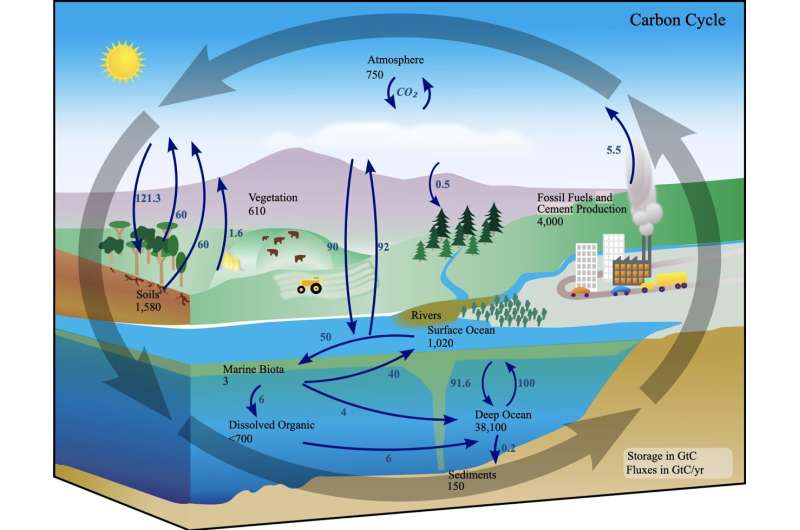
Diagrammatic representation of the global carbon cycle. Credit: Wikimedia Commons/ PD-USGov-NASA.
The world’s oceans help slow climate change by absorbing carbon dioxide (CO₂) from the atmosphere, but how much they take up can vary throughout the year. New research, published in Geophysical Research Letters, suggests these seasonal patterns are changing across the Indian Ocean, potentially affecting how it helps to regulate Earth’s climate.
CO₂ moves continuously between the ocean and the atmosphere. When seawater absorbs more CO₂ than it releases, the ocean acts as a carbon sink, storing some of the greenhouse gas that would otherwise remain in the atmosphere and contribute to global warming. But the exchange also works in reverse: The ocean can release dissolved CO₂ back into the air.
This balance is influenced by several factors, including water temperature, winds and ocean circulation. These processes change throughout the year, with seasonal shifts in temperature, winds and the movement of water altering how quickly CO₂ enters or leaves the ocean. Cooler water can generally hold more dissolved CO₂ than warmer water, favoring absorption from the atmosphere, while warming can encourage the gas to escape. However, the outcome also depends on how much CO₂ is already dissolved in the water and how ocean currents bring carbon-rich water to the surface.
According to the Global Carbon Budget 2024, the ocean absorbed around 26% of total human-caused CO₂ emissions between 2014 and 2023. However, research suggests its capacity to absorb additional carbon has shown little growth since 2016, partly because of increased climate variability. Understanding how the ocean’s carbon exchange changes over different timescales is therefore important for predicting how it will respond to continued warming.
Four decades of change
To investigate these changes, Dr. Apurva Padamanbh Joshi, of the Indian National Center for Ocean Information Services, and colleagues analyzed data from 1980 to 2019 to examine how seasonal CO₂ exchange had evolved across the Indian Ocean.
They found that seasonal variation increased by 48% in the equatorial Indian Ocean and 23% in the southern Indian Ocean, meaning the contrast between different parts of the year became more pronounced in these regions.
In the Arabian Sea, however, seasonal variation decreased by 14%, indicating a smaller difference between seasonal highs and lows in carbon exchange. The Bay of Bengal showed a more modest increase in seasonal variation of around 7%.
The findings reveal that the Indian Ocean is not responding to changing climate conditions uniformly, with the timing and intensity of carbon exchange shifting across the region.
The researchers also found that the average release of CO₂ into the atmosphere decreased in the Arabian Sea, Bay of Bengal and equatorial Indian Ocean, while CO₂ absorption increased in the southern Indian Ocean. This distinction is important because a change in seasonal variation does not necessarily mean a region is absorbing more carbon overall.
What drives the differences?
In the equatorial and southern Indian Ocean, changes in the difference between CO₂ levels in surface water and the overlying atmosphere played a major role. This difference helps determine the direction and strength of the movement of CO₂ between the two.
In the Arabian Sea and Bay of Bengal, wind speed played an important part. Winds help gases cross the boundary between the ocean and the atmosphere, so changes in wind conditions can influence how much CO₂ is exchanged and how that exchange varies throughout the year.
Previous research has identified similar increases in seasonal CO₂ exchange in parts of the Pacific and Atlantic oceans. The new findings suggest that changes in seasonal carbon exchange are not confined to one ocean, highlighting the importance of understanding how these patterns are evolving around the world.
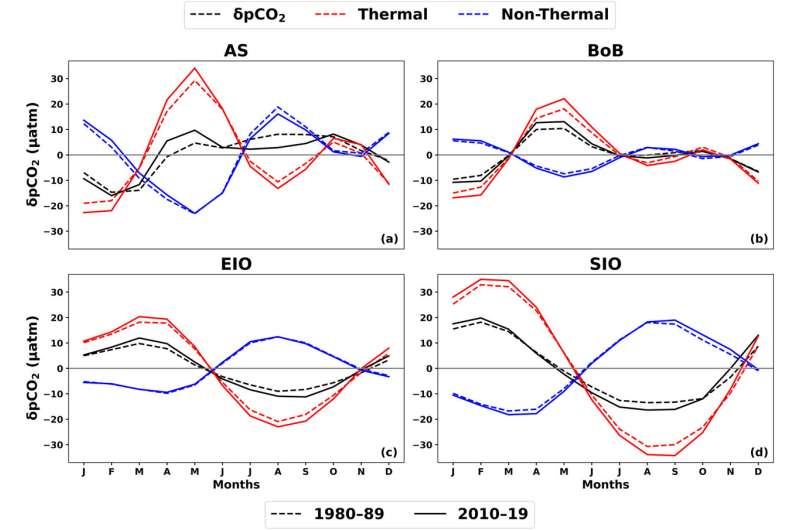
Changes in surface CO₂ levels and the factors driving them across four Indian Ocean regions—the Arabian Sea (AS), Bay of Bengal (BoB), Equatorial Indian Ocean (EIO) and Southern Indian Ocean (SIO)—during the 1980s and 2010s. Black lines show CO₂ changes, while red and blue lines represent the effects of temperature and non-temperature related factors, respectively. Dashed lines represent the 1980s and solid lines the 2010s. Credit: Joshi et al, 2026.
What this means for climate change
The findings offer a more detailed picture of how the Indian Ocean’s role in the global carbon cycle is changing. They do not show that the entire ocean is becoming better at absorbing CO₂, but they do suggest that the seasonal processes governing carbon exchange are being reshaped.
Changes in seasonal CO₂ exchange could also have consequences for marine ecosystems. When seawater absorbs CO₂, it becomes more acidic, reducing the availability of carbonate ions that corals and other organisms need to build their skeletons and shells.
Repeated climate-driven extremes in seasonal conditions could add pressure to sensitive marine environments, potentially disrupting species distributions, biodiversity and ecosystem productivity. That distinction matters for climate predictions.
Estimates based only on annual averages could miss changes in when the ocean absorbs or releases CO₂, making it harder to understand the processes behind its overall carbon balance. Although marine ecosystems can often recover from normal seasonal fluctuations, repeated extremes may delay recovery, potentially prolonging the effects on vulnerable environments.
The study examines historical changes rather than directly predicting what will happen as global temperatures continue to rise. Further research is needed to establish how these evolving seasonal patterns will affect the Indian Ocean’s long-term capacity to store carbon.
Therefore, as human activities continue to release CO₂ into the atmosphere, understanding these changes will help scientists assess how reliably the ocean can continue to act as a natural buffer against global warming.
Written for you by our author Hannah Bird, edited by Sadie Harley, and fact-checked and reviewed by Robert Egan—this article is the result of careful human work. We rely on readers like you to keep independent science journalism alive. If this reporting matters to you, please consider a donation (especially monthly). You’ll get an ad-free account as a thank-you.
A. P. Joshi et al., Climate Change Induced Seasonal Amplification of the Indian Ocean CO2 Sink, Geophysical Research Letters (2026). DOI: 10.1029/2026gl123472
Publication details
Journal information: Geophysical Research Letters
Key concepts
Here are some “ETs” recorded from around the U.S. the last couple of days, their consequences, and some extreme temperature outlooks, as well as any extreme precipitation reports:
Here is More Climate News from Sunday:
(As usual, this will be a fluid post in which more information gets added during the day as it crosses my radar, crediting all who have put it on-line. Items will be archived on this site for posterity. In most instances click on the pictures of each tweet to see each article. The most noteworthy items will be listed first.)