The main purpose of this ongoing blog will be to track planetary extreme or record temperatures related to climate change. Any reports I see of ETs will be listed below the main topic of the day. I’ll refer to extreme or record temperatures as ETs (not extraterrestrials).😜
Main Topic: Private Companies Have Raised Millions to Block the Sun. What Could Go Wrong?
Dear Diary. I wholeheartedly agree with Dr. Michael Mann on this one. Geoengineering to cool the planet is not a good idea. Carbon capture is too costly and can’t be scaled enough to make a big dent in atmospheric CO2 levels. Putting vast amounts of iron fillings into the seas to absorb more carbon would have consequences for the ocean’s food chain.
Then there is the matter of diming the sun schemes or rather blocking incoming solar radiation to cool the planet. These schemes are also costly and could have unseen consequences. Better to keep fossil fuels from going into the atmosphere in the first place via a fast switch to all electric transportation and devices run by renewable energy.
Here are many details from the Washington Post:
These companies want to block the sun to cool the planet – The Washington Post
Private companies have raised millions to block the sun. What could go wrong?
Proponents of the controversial climate solution say start-ups can develop a potentially world-changing technology faster than plodding university scientists.
12/03/2025 at 5:00 a.m. EST

(Illustration by Laura Padilla Castellanos/The Washington Post; iStock)

For as little as $1, you can dim the sun — just a tiny bit — to save the world from climate change.
At least, that’s the promise sold by a California start-up called Make Sunsets. Your dollar will pay for founder Luke Iseman to drive a Winnebago RV into the hills half an hour outside Saratoga, California, to release a balloon loaded with sulfur dioxide, an air pollutant normally spewed by volcanic eruptions. He and his 1,000 paying customers hope the balloon will burst in the stratosphere, releasing particles that will block sunlight and cool the planet.
Iseman’s sun-blocking activities — which aren’t officially approved by any government on Earth, but aren’t illegal under California law — are an example of a controversial tactic called “solar geoengineering.” It has been the subject of many science fiction stories and conspiracy theories and at least one U.S. spy report warning that it could spark real-world wars.
And now it’s becoming a private industry. Make Sunsets has raised more than $1 million from investors and sold more than $100,000 worth of “cooling credits” to customers this year. A better-funded competitor, Stardust, has raised $75 million to develop a more sophisticated geoengineering method it says will be ready to launch by the end of the decade — although its founders vow they won’t deploy their technology unless a government hires them to do so.
The companies have sparked debate about the role private firms should play in tinkering with the global climate. Proponents say start-ups can develop a potentially world-changing technology faster than plodding university scientists; in recent years, academics studying geoengineering have tried to do basic outdoor equipment tests in Sweden and California only to face pushback and cancel their plans.
“They stop. They give up,” said Maex Ament, a venture capitalist and Stardust investor. “If I’m an entrepreneur at heart, no, there is no ‘I’ll give up. Next topic.’ I’ll solve this problem, without compromising safety. There’s a different mindset.”
Opponents say profit-seeking companies have no business developing a technology designed to affect everyone on Earth, which may have unintended consequences for global weather patterns and could kill people by raising air pollution and cancer rates.
“I do not trust the private sector to make good decisions for people,” said Shuchi Talati, founder of the nonprofit Alliance for Just Deliberation on Solar Geoengineering. “The whole move-fast-and-break-things ethos — I’ve seen it, and it hasn’t gone particularly well for society.”
Most governments have no specific geoengineering regulations — although a patchwork of laws and international treaties on air pollution and weather modification may apply. Tennessee, Louisiana and Florida have banned the practice, and further bans have been proposed in 34 U.S. states, at the federal level and in Mexico. The Environmental Protection Agency said it’s investigating Make Sunsets and “conducting an internal review of any current authorities that can be utilized to halt this activity.”
Meanwhile, private geoengineering companies have few rules to follow.
“Governments need to either clearly ban such activities, or they need to come up with … guardrails within which these kinds of activities can happen,” said Janos Pasztor, a former U.N. official and retired head of the Carnegie Climate Governance Initiative who worked on geoengineering issues. “Their heads are still in the sand.”
Going rogue
People have proposed many ways to bounce sunlight away from Earth to lower temperatures, including sprinkling reflective particles into the stratosphere, making clouds shinier and launching giant space mirrors into orbit.
These methods are supposed to be cheaper and faster than rewiring the world to run on clean energy and removing tons of carbon dioxide from the air, and much cheaper than the cost of climate catastrophe. Halving the rate of global warming for 15 years by dusting the stratosphere with sulfur dioxide would cost about $2.25 billion per year, according to a 2018 estimate from researchers at Yale and Harvard.
Theoretically, rogue billionaires could afford to at least start changing the climate on their own. That’s the premise of the science fiction novel “Termination Shock,” which inspired Iseman to found Make Sunsets in 2022.
It doesn’t turn out well in the book. But if you’re a billionaire and you’d like to put a lot of sulfur in the stratosphere without consulting anybody, Iseman said he’d be happy to help.
“I am getting goose bumps just thinking about how awesome that would be,” he said. “If every country in the world bans this, and a billionaire comes to me and says, ‘Here’s a boat with a flag of convenience that’s not going to enforce that ban. … I want to take credit if people like it and have plausible deniability if they don’t. Go.’ You know, I can think of no better way to spend the next several years.”
There are a few people willing to defend independent geoengineers, including Andrew Lockley, a British researcher formerly affiliated with University College London. He ran his own field test in 2022, releasing a balloon carrying 400 grams of sulfur dioxide, cheekily named the Stratospheric Aerosol Transport and Nucleation (SATAN) project. He also co-wrote a 2023 paper arguing that, if governments fail to solve climate change, people may have a right to dim the sun themselves, so long as they do proper planning and monitoring.
“I would not be able to reasonably criticize their decision,” Lockley said. “If Elon [Musk] says he’s starting tomorrow, well that just frees up my weekends.”
But most geoengineering experts reject this swashbuckling approach. Deployment decisions should be left to governments, and scientists should study the risks and benefits so elected leaders and civil society can make informed choices, said David Keith, the founding faculty director of the Climate Systems Engineering initiative at the University of Chicago.
Make Sunsets has released just over 240 pounds of sulfur dioxide this year — well short of the millions of tons a year it would take to change global temperatures. Reaching that scale would require thousands of flights per year from specialized planes and at least the quiet tolerance of governments deciding to look the other way, said Gernot Wagner, a climate economist at Columbia Business School and a co-author on the 2018 study on the costs of geoengineering.
“There is no Silicon Valley venture capitalist who is able to do this, full stop. Even the billionaire who has hundreds of billions of dollars is running out of money sooner or later,” Wagner said. “But there are dozens of countries out there whose military air force budget alone could cover this. That’s what I’m really, really worried about: Not every one of these countries might have a democratically elected government acting in the best interest of the planet.”
Keeping secrets
If a country decides to dim the sun, Stardust would like to be the company they call.
Founded in 2023 by Yanai Yedvab and Amyad Spector, nuclear physicists who met in an Israeli national lab, and particle physicist Eli Waxman, the start-up’s 25 staff scientists are developing a new reflective particle — which they say won’t make people sick or thin the ozone layer, unlike sulfur dioxide — and the technology to sprinkle it into the stratosphere and monitor where it goes.
“Our mission is to develop a safe and responsible and practical manner to cool the planet, an end-to-end solution that we expect will be ready in the next few years and cost 1,000 times cheaper than any other alternative,” Yedvab said.
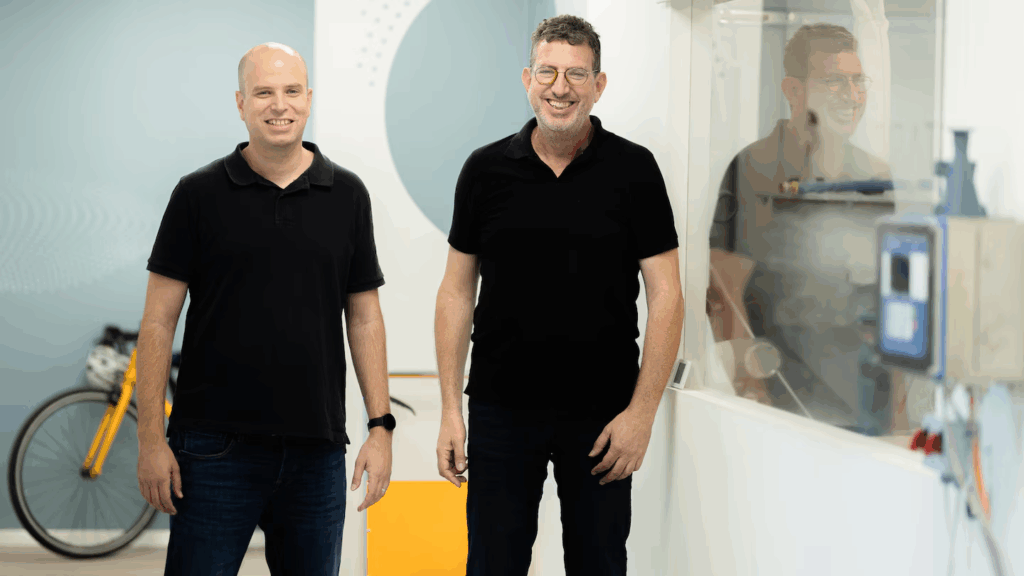
Amyad Spector (left) and Yanai Yedvab at Stardust’s contained particle dispersion technology facility in Israel. (Roby Yahav/Stardust)
Many geoengineering experts have criticized Stardust for its secrecy. The company hasn’t released any information about its new, patent-pending particle. It hasn’t published a long-promised code of conduct detailing how it will carry out tests, whom it will work with and how it would deploy its technology. Politico reported that Stardust has been secretly lobbying Congress; Stardust’s lobbying firm blamed its failure to disclose on a clerical error.
“They’ve gone about it in every wrong way possible,” Talati said. “They’ve kind of run under the radar for the last couple years. They’ve made no efforts around engaging with the public. They’ve made no efforts around transparency.”
Yedvab says the company will publish scientific papers at the beginning of next year detailing its particle and the results of its indoor experiments once they clear peer review. They’re putting the finishing touches on the code of conduct, and they’ve filed their legally required lobbying disclosures. He said Stardust will only work with governments that “have adequate regulatory frameworks” and aren’t “likely to engage in irresponsible deployment.”
But even that may not satisfy scientists who are skeptical Stardust can support the bold claims it has made about its particle. Yedvab said the particle can be inhaled “without any safety hazards.” Keith, the head of the University of Chicago geoengineering program, called that “total, unadulterated bulls—.”Ask The Post AIDive deeper
Any particle that falls from the stratosphere will react with gases and glom onto other particles along the way, creating unforeseen health risks, Keith said. The idea that Stardust could study the full effects of its still-secret particle and declare it risk-free in a few years “is just a joke,” Keith said.
Stardust plans to use the $60 million it raised in October to start a new phase of testing next year. Yedvab said they won’t release their particle into the atmosphere yet, but eventually they will do outdoor tests. By then, he said he hopes there will be clear regulations to follow.
Making money
Many critics of Make Sunsets and Stardust say there could be a role for private companies to develop and sell high-altitude planes, particle-spraying devices, atmospheric monitoring tools or other technology that would be useful for geoengineering. But they worry that if a company’s main source of revenue isgeoengineering, it will have a strong profit motive to cool the planet, even if it isn’t in the world’s best interest.
“The investors are going to want something out of the money that they put in,” said Daniele Visioni, an assistant professor of earth and atmospheric sciences at Cornell University.
Stardust’s investors say they’re willing to lose money if governments decide not to pursue geoengineering.
“Stardust is either something that doesn’t return capital or it’s one of the most important companies in the world,” said Finn Murphy, who runs a $30 million venture capital fund and made his biggest investment yet in Stardust. “This only works if you get an international coalition of countries to buy into this being the right solution, and I just don’t think you get there by haphazardly deploying.”
Iseman, the Make Sunsets founder, takes the opposite approach. Although his company is losing money, he said he’s “one meaningful AI data center offset contract away from being highly profitable.”
Profit is important, because if the company makes money, “then we can continue indefinitely, and then we can scale,” he said. “You think this is weird and loud now? Wait until it’s bringing in a couple million dollars, or several hundred million and has a measurable impact on global climate. Then things will get really interesting.”
“I don’t know if we’ll get there, but someone will,” Iseman added. “Whether you love us or hate us, we’ve let the genie out of the bottle in some small way.”
By Nicolás Rivero Nicolás Rivero joined The Washington Post as a climate solutions reporter in 2023. Previously, he covered climate change for the Miami Herald and Quartz. follow on X@NicolasFuRivero
Here are some “ETs” recorded from around the planet the last couple of days, their consequences, and some extreme temperature outlooks, as well as any extreme precipitation reports:
Here is More Climate News from Thursday:
(As usual, this will be a fluid post in which more information gets added during the day as it crosses my radar, crediting all who have put it on-line. Items will be archived on this site for posterity. In most instances click on the pictures of each tweet to see each article. The most noteworthy items will be listed first.)