The main purpose of this ongoing blog will be to track planetary extreme, or record temperatures related to climate change. Any reports I see of ETs will be listed below the main topic of the day. I’ll refer to extreme or record temperatures as ETs (not extraterrestrials).😜
Main Topic: More Concerns About Permafrost
Dear Diary. With all the excess surface heat occurring around the Northern Hemisphere, there are more concerns about permafrost melting. That would be a tipping point we can’t fix in the future no matter how much we as a species stymie carbon pollution. According to most experts the permafrost tipping point hasn’t been tipped yet, so we need to continue to curtail the burning of fossil fuels.
Another climate scientist named Prof Gustaf Hugelius is concerned about permafrost given high temperatures across the Arctic. Here is his take from the Guardian (for graphics that I did not repost, hit the following link):
Tipping points: on the edge?Environment
The threatening thaw: climate professor on heatwave risks to tipping point of permafrost
Prof Gustaf Hugelius warns wildfires could accelerate release of methane and carbon as vast regions approach irreversible thresholds

The world’s vast permafrost regions contain three times more carbon than all living vegetation and are at risk of thawing and emitting more greenhouse gases. Composite: Guardian Design/Getty
Thu 20 Aug 2026
Heatwaves and wildfires are not just scorching forests, they are adding to the tipping point risks in the world’s vast permafrost regions, which contain three times more carbon than all the living vegetation on Earth.
This is a major concern for Gustaf Hugelius, a professor at the Bolin Centre of Climate Research at Stockholm University, Sweden, and a leading authority on the risks from thawing tundra and peatlands. In this Q&A, he explains why the world should pay attention.

What is permafrost?
Permafrost is ground that is frozen all year round. It is found mostly in Russian Siberia, Canada, Alaska and parts of Europe. The permafrost region is massive, covering 20m sq km, which is five times the size of the EU.
Why is permafrost a climate concern?
Permafrost stores 1,500 gigatons of carbon, which is three times more than all the living vegetation on Earth, including every single tree in the Amazon. It’s a really huge amount so even small changes to this system can cause big changes in the atmosphere.
How can it reach a tipping point?
Most often permafrost has been frozen for thousands of years and contains a lot of old plant remains. This means a lot of carbon is essentially locked in a freezer. But as humans warm the climate by burning gas, oil and coal, the permafrost starts to thaw and those plants are exposed to microbes, which eat the organic matter and then release carbon dioxide and methane. This enters the atmosphere and produces even more warming. This process can become self-reinforcing.
Can it not just refreeze later?
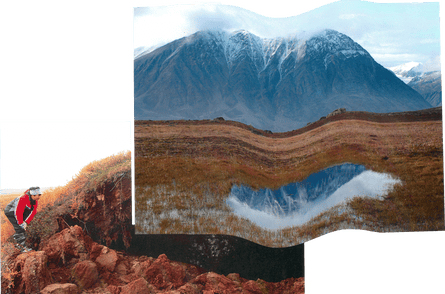
No, because the thaw of the tundra creates a fundamentally different landscape. There is a lot of pure ice below the ground’s surface. When that melts, the water drains away and the surface collapses. This can create lakes, wetlands or river gullies. These new land forms, which are called thermokarsts, have a completely different hydrology that changes the thermal conductivity of the soil as well as snow conditions in winter. Once you pass the permafrost’s threshold and the ice has gone and the landscape has changed, it is not going to come back for hundreds of years. On a human timescale, those systems have then effectively tipped into a system that will keep emitting carbon for decades or centuries.

Thermokarsts can tip land into a system that will keep emitting carbon for decades or centuries. Composite: Guardian Design/Supplied
Could the whole system tip suddenly?
Not at a global level. The permafrost region is too big for the full system to go over a threshold at the same time – unless global heating reaches 6C, which will hopefully not happen now. But, as the thaw progresses, there will be many local tipping points that happen in succession. This has started, with some places already passing irreversible tipping points. This adds to the stress on the climate system and by the end of the century the permafrost will become a big emitter in its own right.
How much greenhouse gas could be released from the permafrost this century?
We could lose 200 to 300 gigatons of CO2 equivalents if the world warms by between 1.8C and 3.6C by the end of the century. That is many more times than the current emissions of the EU. In even higher warming scenarios, the amount could be close to what the US or even China is emitting today.
Are there even bleaker predictions than these?
A couple of scientific papers forecast very high fluxes of methane, but those extreme scenarios are now considered unrealistic. The release from permafrost thaw is not expected to exceed all human emissions this century, but the broad assumption is that this is a very serious problem, which is worsening the global challenge to reduce emissions.
What difference does it make if the permafrost releases methane rather than CO2?
Methane is about 30 times more potent as a greenhouse gas, though only in the short term because it breaks down more quickly over 10 to 15 years. That makes it a strong and immediate concern and for future generations. Carbon dioxide, by comparison, is less potent but it lingers much longer, which makes it a bigger threat on the timescale of centuries.
What factors determine whether permafrost releases methane or CO2?
It depends on whether the thaw leads to a dry or wet environment. If the exposed landscape is dry – like bare rocks or soil – the microbes will be able to oxidise the carbon in the previously frozen plants into CO2. But if the new landscape is a wetland or a lake, then microbes will not have access to oxygen so they produce methane. One of the biggest research challenges we face is figuring out how much of the thawing permafrost is going to get wetter and how much is going to get drier.
How much permafrost loss is already baked into the climate system?
There is a time lag of decades between the climate warming and the permafrost thawing. This is because it is insulated in many parts of the tundra or boreal forest by vegetation and a thick layer of peaty soil that delays the thaw impact. On the negative side, this means that some areas of permafrost are already doomed, such as in northern Sweden and northern Finland. Even if we could stabilise the climate today, several million square kilometres of permafrost, mostly along the southern fringes of its range, is going to disappear because we exceeded its threshold a decade or more ago. On the plus side, if we could pull the temperature down again, there are large areas where the thaw might never happen. The Siberian and Canadian permafrost can largely stay intact if we are successful in UN climate negotiations.

Researchers study the ground beneath grassland. Composite: Guardian Design/Supplied
What changes have we seen?
Since my first long expedition in 2007 in the Russian Arctic, I’ve seen more and more evidence of rapid permafrost thaw. What is most clear is the increasing frequency of strong fires and really warm summers in Siberia and Canada. The interactions between these weather extremes and the fires is accelerating the thaw. That is very concerning. After one very warm summer, you see new lakes in the following years.
Are there benefits from thawing permafrost?
There may be a few small benefits, such as widening agricultural frontiers and opening up mineral resources, but they don’t in any way balance out the negative impacts. The permafrost thaw will actually make it much more difficult to access resources in the Arctic because the ground will become more unstable. That will make it more expensive and difficult to extract anything. Infrastructure in Canada and Alaska will be affected, but Russia will be hit the hardest. Half of Russia’s oil and gas comes from permafrost areas, which are not going to be working well in a couple of decades. Russians are also starting to realise they will not be able to expand agriculture into permafrost areas for a very long time because you cannot suddenly grow food on soils that are forested. So the economic damage of permafrost thaw will be enormously higher than the economic benefits.
What can be done?
Unfortunately, there are no feasible geoengineering solutions on a broad scale. The only way to limit the thawing of millions of square kilometres is to reduce emissions rapidly. We need to act urgently. For every degree of global warming that we limit, we save 4m sq km of permafrost from thawing and releasing greenhouse gases. The greater our action to reduce emissions, the easier the challenge becomes. And vice versa. This is a feedback loop: the more we disturb the Earth’s system, the more it will emit by itself which will make the challenge all the more dire.
How much scientific uncertainty is there?
The fact is this is a big problem. It is virtually certain that a large magnitude of CO2 and/or methane will be released. We’re certain about the processes and the feedback. Global warming is up to four times higher in the Arctic than the global mean and we are also virtually certain this will accelerate. What is less clear is the precise rate of change and whether we will enter wetter or drier pathways, which will determine how much methane or CO2 is released.
How do you feel about your research?
Even in isolation, it is really concerning. Then there is a growing realisation that permafrost is just one of many tipping point processes that are irreversible. The damage we are doing now will mean the Earth keeps emitting greenhouse gases for centuries. So it’s not just my kids, it’s five, six, seven, 10 generations of humans that will have to deal with the problems that we’re creating now. To me, this is an obvious truth so it is frustrating that we cannot communicate the urgency of what we know well enough to prompt action. I don’t think humanity will be wiped out, but so many people will suffer enormously and unnecessarily because of these cascading effects coming together. That’s concerning and really, really sad.
Here are more “ET’s” recorded from around the planet the last couple of days, their consequences, and some extreme temperature outlooks, as well as any extreme precipitation reports:
Here is More Climate News from Friday:
(As usual, this will be a fluid post in which more information gets added during the day as it crosses my radar, crediting all who have put it on-line. Items will be archived on this site for posterity. In most instances click on the pictures of each tweet to see each article. The most noteworthy items will be listed first.)