The main purpose of this ongoing blog will be to track planetary extreme, or record temperatures related to climate change. Any reports I see of ETs will be listed below the main topic of the day. I’ll refer to extreme or record temperatures as ETs (not extraterrestrials).😜
Main Topic: Three Key Near-Term Actions Could Bend the Global Warming Curve Below 2°C
Dear Diary. Using the old adage that actions speak louder than words, I do have some good news in this Saturday. There are three major actions that society can do to prevent global temperature averages from rising above the prescribed we dare not cross level of +2.0°C above preindustrial conditions. Here are the three from the following article I am using for our main subject today:
Key findings
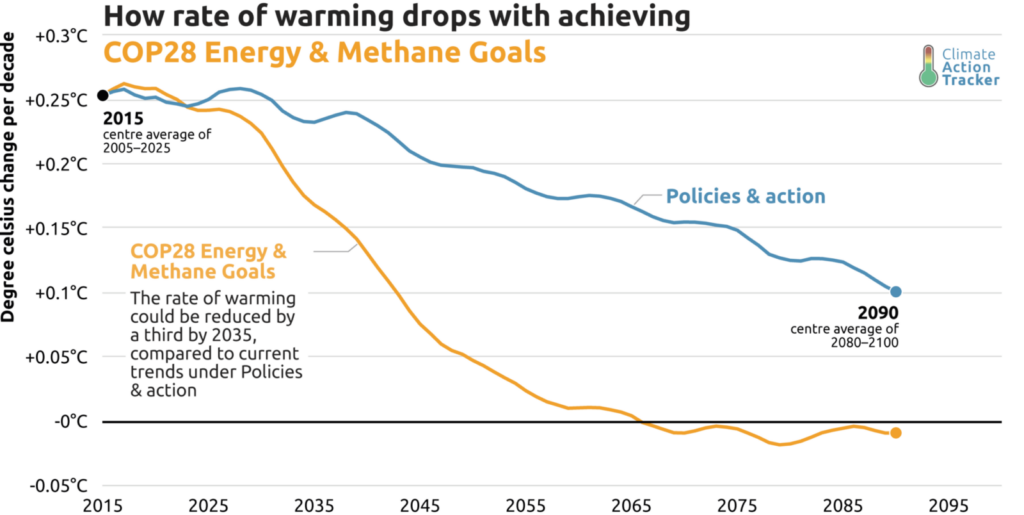
- Tripling renewables, doubling energy efficiency and cutting methane by 2030 and beyond would cut warming rate by a third in ten years, and halve it by 2040.
- It would cut projected warming this century significantly (about 0.9˚C from 2.6˚C to 1.7˚C).
- Scaled up financial support to achieve this will be needed for many poorer countries.
- Rapidly reducing the rate of warming is critical for adaptation.
Notice that this prescription for our climate ills does not include cutting CO2 emissions from scuttling coal fired power plants or ditching internal combustion engines for electric vehicles. Doing so will flatten the curve even more. Of course, what is prescribed here will still be a heavy lift, so heavy that I seriously doubt much of this medicine will be taken until it is too late. We will see.
Here are more details from Climate Analytics:
Climate Analytics | Three key near-term actions could bend the…
19 November, 2025
Three key near-term actions could bend the warming curve; bringing projected warming below 2°C
Authors
Climate Analytics: Sofia Gonzales-Zuñiga, Sarah Heck, Neil Grant, Claudio Forner, Bill Hare, Sally Dacie, Zarrar Khan, Marie-Charlotte Geffray
NewClimate Institute: Ana Missirliu, Janna Hoppe, Louise Jeffery, Frederic Hans, Niklas Höhne
Key findings
- Tripling renewables, doubling energy efficiency and cutting methane by 2030 and beyond would cut warming rate by a third in ten years, and halve it by 2040.
- It would cut projected warming this century significantly (about 0.9˚C from 2.6˚C to 1.7˚C).
- Scaled up financial support to achieve this will be needed for many poorer countries.
- Rapidly reducing the rate of warming is critical for adaptation.
At COP 28 in Dubai, 2023, as part of the first Global Stocktake (GST1) discussion, the world’s governments negotiated and agreed a clear set of 2030 energy and methane goals that aligned with limiting warming to 1.5°C. These included tripling renewable energy capacity, doubling the rate of energy efficiency improvements, and cutting methane emissions.
Key findings
- Tripling renewables, doubling energy efficiency and cutting methane by 2030 and beyond would cut warming rate by a third in ten years, and halve it by 2040.
- It would cut projected warming this century significantly (about 0.9˚C from 2.6˚C to 1.7˚C).
- Scaled up financial support to achieve this will be needed for many poorer countries.
- Rapidly reducing the rate of warming is critical for adaptation.
At COP 28 in Dubai, 2023, as part of the first Global Stocktake (GST1) discussion, the world’s governments negotiated and agreed a clear set of 2030 energy and methane goals that aligned with limiting warming to 1.5°C. These included tripling renewable energy capacity, doubling the rate of energy efficiency improvements, and cutting methane emissions.
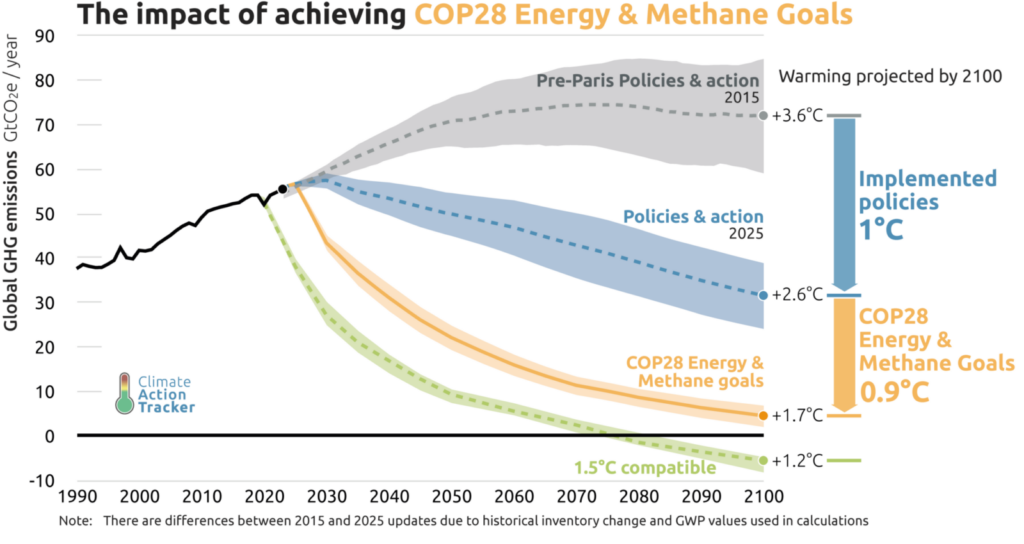
These actions would bring projected 21st century warming below 2°C. The outlook improves significantly (by about 0.9°C), almost as much as the entire 1°C improvement in the global warming outlook seen over the ten years since the Paris Agreement was adopted in 2015, and would be a major step towards keeping the 1.5° limit in sight.
Unlike any previous improvements in targets and policies under the Paris Agreement, the implementation of these measures would quickly begin to slow the rate of warming from about 0.25° per decade at present, rather than under current policies which would see a slight acceleration by 2030.
Halving the rate of warming in the near term would give communities a realistic chance to cope with rising climate impacts, and, with adequate international climate finance, begin to “catch up” and close the adaptation gap.
This analysis underscores a clear imperative: the accelerated expansion of renewable energy, expansion of electrification and the associated phase-out of fossil fuels are indispensable to achieving the Paris goal. Delivering on these agreed targets would not only narrow the emissions gap but also lay the foundation for a resilient, low-carbon global economy. The action agenda of the COP30 Presidency represents a key space to mobilise commitment in the delivery of these goals.
If the G20 were to implement the three goals…
When looking at the impact of individual G20 countries implementing the COP 28 goals for renewable energy, energy efficiency and methane, we find that they would deliver total emissions reductions of around 11 GtCO₂e by 2030 and 14 GtCO₂e by 2035, compared to current policy projections.
- Tripling renewable energy within the G20 would account for roughly 40 % of total emissions reductions. Expanding renewables is the backbone of the energy transition as it delivers dual benefits: displacing fossil fuels directly and powering electrification across sectors, which in turn drives greater energy efficiency.
- Doubling energy efficiency would contribute another 40% of the G20’s total reductions, almost half of which through the electrification of energy end use sectors.
- Methane mitigation would deliver a further 20%, providing rapid, near-term benefits. These percentages would be roughly the same for the extrapolation at the global level.
Explore the Climate Action Tracker
Here are some “ETs” recorded from around the planet the last couple of days, their consequences, and some extreme temperature outlooks, as well as any extreme precipitation reports:
Here is More Climate News from Saturday:
(As usual, this will be a fluid post in which more information gets added during the day as it crosses my radar, crediting all who have put it on-line. Items will be archived on this site for posterity. In most instances click on the pictures of each tweet to see each article. The most noteworthy items will be listed first.)