The main purpose of this ongoing blog will be to track global extreme or record temperatures related to climate change. Any reports I see of ETs will be listed below the main topic of the day. I’ll refer to extreme or record temperatures as ETs (not extraterrestrials).😜
Main Topic: Earth Was Hit By 55 Billion-Dollar Weather Disasters In 2025
Dear Diary. During January of each year experts tally up damages from extreme weather across the planet that occurred the prior year. Due to climate change the Earth had more than its share of heatwaves, droughts and floods last year. Tallies will only get higher unfortunately due to our long-term carbon pollution.
Dr. Jeff Masters has done a great job looking at climate damage data from 2025, which I’m reposting for our main topic today:
Earth was hit by 55 billion-dollar weather disasters in 2025 » Yale Climate Connections
Earth was hit by 55 billion-dollar weather disasters in 2025
The world endured its costliest wildfire on record in 2025, its sixth-deadliest heat wave, and four floods or storms that caused at least 1,000 deaths.

by Jeff Masters January 26, 2026

Daniel Evans of Great Britain puts ice on his head during a break in play at a Wimbledon tennis match. A summer heat wave in Europe that killed more than 24,000 people was 2025’s deadliest weather event. (Photo by Mike Hewitt/Getty Images)
The planet was besieged by 55 billion-dollar weather disasters in 2025, insurance broker Gallagher Re said in its annual report issued Jan. 21. The total damage wrought by weather disasters in 2024 was $277 billion; 45% of those costs were covered by insurance. The 2025 damages were 25% lower than the 10-year inflation-adjusted average of $367 billion.
A separate report issued Jan. 20 by insurance broker Aon put the total damage wrought by weather disasters in 2024 at $242 billion, with 47 billion-dollar weather disasters. Billion-dollar weather disasters cause about 76% of the total damages wrought by weather disasters, according to Steve Bowen of Gallagher Re.
The primary reason for the below-average total cost in 2025 was the absence of a landfalling U.S. hurricane for the first time since 2015. Gallagher Re’s report emphasized that nevertheless, “The persistent trend of a high volume of billion-dollar-plus global events highlights the urgent need for greater climate financing to mitigate, adapt and prepare against more expensive disasters.”
The report’s authors also called for stronger building codes, noting that “A 2019 study by the US National Institute of Building Sciences (NIBS) found that adopting building codes can translate to $11 saved for every $1 invested. Building to a modern code (either through new construction or retrofitting) was found to only add 1% to construction costs, relative to 1990 values.”
Severe convective storm events (including wind, flood, hail, and tornado damage from thunderstorms) in 2023, 2024, and 2025 cost global insurers a combined $208 billion in today’s dollars, of which $176 billion (85%) has occurred in the U.S. This peril is now a dominant annual loss driver for the industry.
U.S. sees its third-highest number of billion-dollar weather disasters: 23
As discussed in our Jan. 13 post, 2025 brought 23 weather-related U.S. disasters that each topped at least $1 billion in damage, according to the U.S. Billion-Dollar Weather and Climate Disasters website. The site was adopted by Climate Central last October after NOAA, its original creator, discontinued it in May 2025. Adam Smith, who had served as lead NOAA scientist on the project over the last 15 years, continues to lead the project at its new home at Climate Central, where he is now senior climate impacts scientist.
The U.S. billion-dollar disasters of 2025 caused a total of 276 direct fatalities. Their estimated cost, according to Climate Central, was $311 billion (USD 2026). This puts the year in eighth place among the 46 years of data after adjusting for inflation. The year’s tally of 23 billion-dollar events was the third-highest in the 46-year database.
Using different accounting methods, Gallagher Re and Aon tallied 28 and 27 U.S.-billion-dollar weather disasters for 2025, respectively.
Read: The role of climate change in the catastrophic 2025 Los Angeles fires
Costliest weather event of 2025: the Los Angeles fires
The costliest event of the year by far was a series of cataclysmic wildfires that ravaged more than 57,000 acres (89 square miles) across the Los Angeles area in early January. As reported by Climate Central, the total direct losses were estimated at $61 billion, making it the 10th-costliest weather disaster in world history. Most of the damage was caused by the massive Palisades and Eaton fires, which were the two most expensive wildfires in world history, with $37 billion and $28 billion in losses, respectively, according to Gallagher Re. That $65 billion combined damage total was modestly higher than Climate Central’s $61 billion estimate.
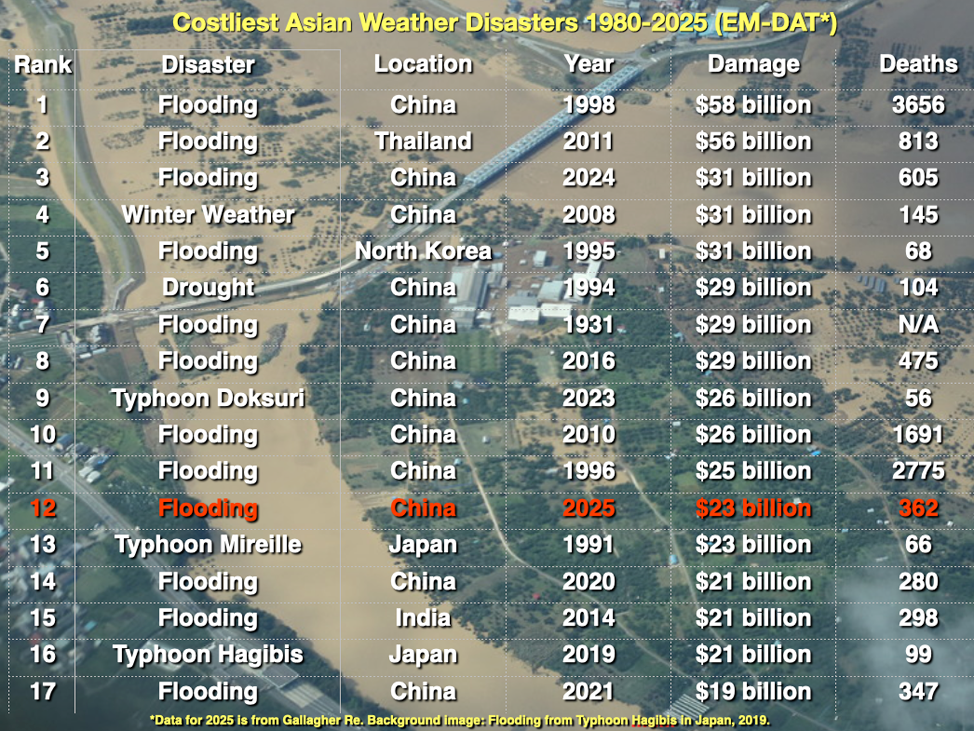
Figure 1. The top 17 most costly weather events in Asia, after adjusting for inflation. Data is from Gallagher Re for 2025, and from EM-DAT for prior years.
The second-costliest weather disaster of 2025 was seasonal flooding in China that did $23 billion in damage and killed 362 people. This was China’s 10th-costliest weather disaster on record, and Asia’s 12th-costliest.
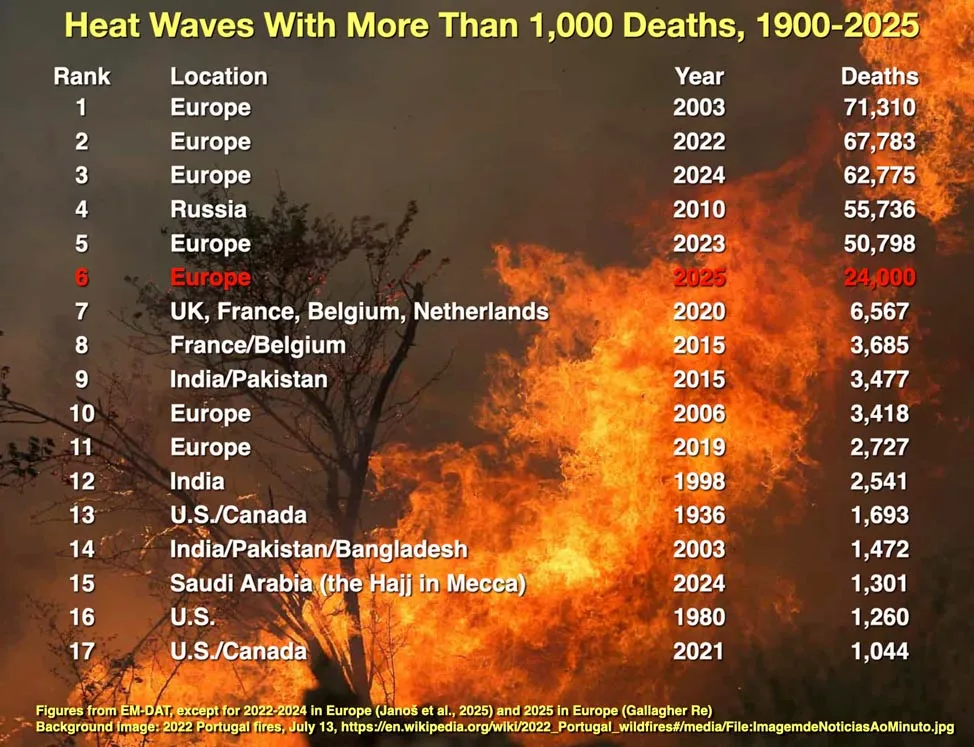
Figure 2. The deadliest heat waves in world history.
Deadliest weather disaster of 2025: European heat wave kills more than 24,000
Earth’s third-hottest year on record caused more than 24,000 deaths during a summer heat wave in Europe. This ranks as the sixth-deadliest heat wave in world history.
The deadliest storm of 2025 was Tropical Cyclone Senyar, which killed 1,482 people in Indonesia, Thailand, and Myanmar. In addition, seasonal monsoon floods in India and Pakistan killed 1,200 and 1,077 people, respectively, and a landslide in Sudan killed 1,000 people.
Read: Warming world, deadly problem: Heat-related deaths are surging
Drought losses well below average in 2025
According to Aon, drought caused approximately $13 billion in losses globally in 2025, well below the 2000-2024 average of $40 billion per year. The most expensive drought occurred in Brazil, with about $5 billion in losses. Brazil has suffered $139 billion in drought-related losses over the past 30 years, and Aon said “high drought conditions could endanger roughly 54% of global coffee crops by 2050.”
In the U.S., drought caused $2.4 billion in economic losses and $1.2 billion in crop insured losses in 2025. Both figures are well below their long-term averages and among the lowest annual totals recorded in the 21st century.
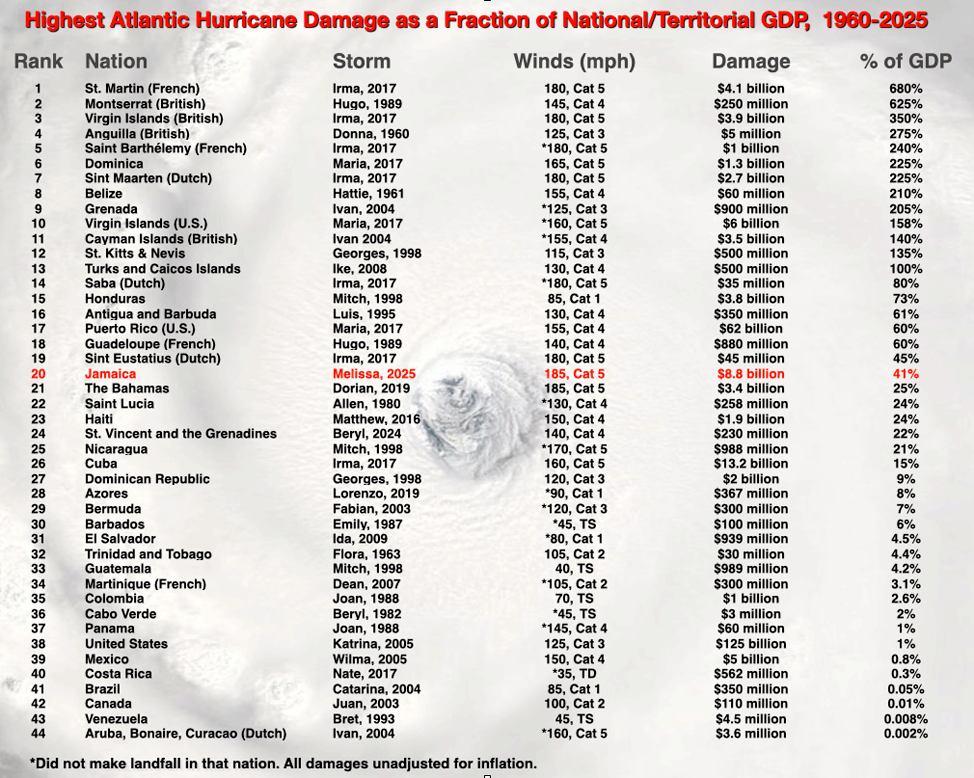
Figure 3. The costliest Atlantic hurricane relative to GDP for each nation/territory, 1960-2025. Dollar amounts are unadjusted for inflation. Strength of the hurricane is given for landfall in that nation; Hurricane Mitch (1998) was a Cat 5 offshore of Honduras and Guatemala when it did much of its damage in those nations. GDP data is unreliable in many places before 1990. (It may be that Martinique’s costliest hurricane relative to GDP was Hugo in 1989, but no reliable GDP data exists that year.)
Two nations suffered their costliest weather disasters on record in 2025
Using statistics from Gallagher Re for 2025 and EM-DAT for years before 2025, two nations or territories suffered their most expensive weather disasters on record in 2025: Jamaica and Sri Lanka. For comparison, four nations or territories had their most expensive weather-related natural disaster in history (relative to GDP) in 2024, and seven did so in 2023. Note that these tallies will be considerably different using Aon or Gallagher Re disaster figures, which can differ from EM-DAT’s by a factor of two. Gallagher Re’s database is generally superior to EM-DAT’s but is not publicly available.
Jamaica: Mighty Category 5 Hurricane Melissa made landfall in October in southwestern Jamaica with 185 mph (300 kph) winds, tying for first place as the strongest landfalling hurricane on record anywhere in the Atlantic. Melissa killed 54 people in Jamaica, and a rapid damage assessment from the World Bank indicated an economic loss in Jamaica of $8.8 billion, 41% of the country’s 2024 gross domestic product. Jamaica’s previous costliest weather disaster was Category 4 Hurricane Gilbert of 1988, which inflicted damages of $1 billion ($2.7 billion 2025 USD), 26% of its GDP at the time.
Sri Lanka: Slow-moving Cyclone Ditwah dumped prodigious amounts of rain over Sri Lanka in late November and early December, causing catastrophic flooding that killed 643 people and caused $4.1 billion in damage. This was equivalent to 4% of the nation’s GDP. Sri Lanka’s previous most expensive weather disaster (adjusted for inflation) was flooding in 2016 that cost $1.6 billion and killed 203 people. Only two previous tropical cyclones have been deadlier in Sri Lanka: Cyclone 04B in 1978 (1,500 killed) and the Rameswaram Cyclone of December 1964 (1,000 killed).
Bob Henson contributed to this post.
Dr. Jeff Master’s “Earth was hit by 55-billion-dollar weather disasters in 2025“ was first published on Yale Climate Connections, a program of the Yale School of the Environment, available at: http://yaleclimateconnections.org. This work is licensed under a Creative Commons Attribution-Noncommercial-No Derivative Works 2.5 license (CC BY-NC-ND 2.5).
Here are more “ET’s” recorded from around the planet the last couple of days, their consequences, and some extreme temperature outlooks, as well as any extreme precipitation reports:
Here is More Climate News from Tuesday:
(As usual, this will be a fluid post in which more information gets added during the day as it crosses my radar, crediting all who have put it on-line. Items will be archived on this site for posterity. In most instances click on the pictures of each tweet to see each article. The most noteworthy items will be listed first.)