The main purpose of this ongoing blog will be to track planetary extreme, or record temperatures related to climate change. Any reports I see of ETs will be listed below the main topic of the day. I’ll refer to extreme or record temperatures as ETs (not extraterrestrials).😜
Main Topic: 1.5 Million Acres Have Already Burned This Year Across the U.S., Nearly Triple The 10 Year Average.
Dear Diary. It’s both heartening and disheartening to see so many other websites like mine pop up across the blogosphere concerning climate change since guyonclimate.com came online in 2017. More scientific voices (including those from podcasts) are needed to address the climate crisis. Yet the very fact that more voices are needed means that we as climate people are losing the messaging war, and the world continues to heat up as carbon gets released into the atmosphere too much despite renewable energy battles that have been won.
The Hotshotwakeup informs us that wildfires are already becoming a problem across the U.S. in March, which makes sense given that we are experiencing historic Heatwave Artex across most of the U.S.
This is the earliest I have named a major heatwave. Artex has dried out brush enough to induce many conflagrations. Here are details from their post:
1.5 Million Acres Have Already Burned This Year, Nearly Triple The 10 Year Average.
1.5 Million Acres Have Already Burned This Year, Nearly Triple The 10 Year Average.
New starts at a 20-year high…. Nebraska pops two more large fires.
Mar 26, 2026
With all the press about snowpacks being at decades-low levels, you would think we should start seeing wildfire numbers reflect that trend.
We definitely are.
We haven’t even had the chance to dip our toes into the puddles left from April showers, and we might not even get the chance to do so. Fire activity and fire starts are already well above the 10-year average, with the Southwest not even fully activated or engaged yet.
The Nebraska fires, of course, added to this spike in acres burned, but you can’t ignore those acres, and you absolutely cannot ignore the number of fires that have started. To date, 14,932 fires have started across the United States… This is the highest amount since 2006.
A 20-year high.
The 10-year average for new fire starts this time of year is 7,951… we are nearly double that figure. A pretty staggering trend, and some early signs that human-caused fires are accelerating with these conditions of minimal snowpack.
Acres burned have also exceeded the 10-year average, in fact, nearly tripling that number. So far, 1.49 million acres have burned compared to the 10-year average of 555,335 acres. The fires in Nebraska would have some saying those numbers are skewed, but in reality, these are trends we must look at.
These were HISTORIC wildfires in Nebraska.
And just as Nebraska was getting back to normal, two more large wildfires started late yesterday and burned tens of thousands of acres more. Rocky Mountain CIMT Team 1 has assumed command of those new fires.
“Two new fires started overnight Wednesday in Grant County northeast of the Morrill Fire. The Ashby Fire, which started near the community of Ashby and is approximately 60,000 acres, quickly spread southward and has burned into the area already burned by the Morrill Fire northeast of the Crescent Lake National Wildlife Refuge. The Minor Fire, south of the community of Hyannis and approximately 15,000 acres, is moving southward toward Arthur County and the Morrill Fire.
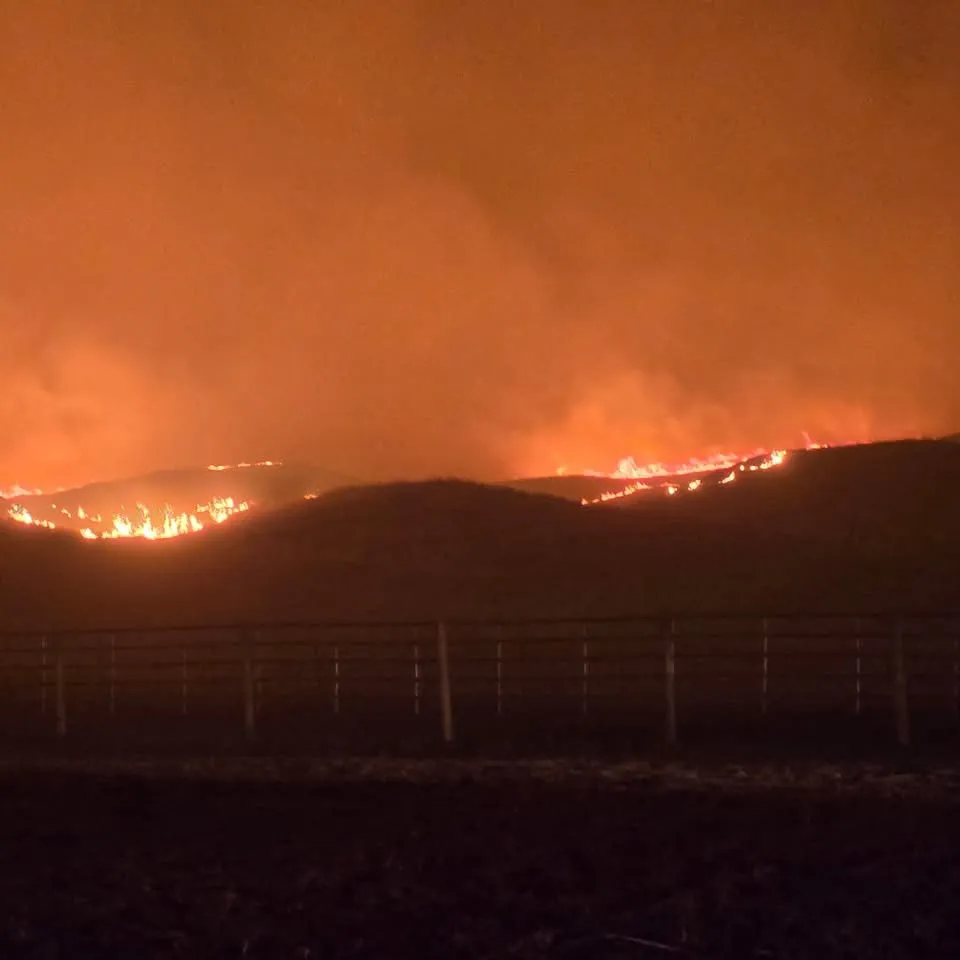
Crook County Fire: Nebraska, last night.
Around 1 a.m. MDT Thursday, the incident mobilized initial-attack resources. They are actively engaged, assisting local volunteer fire departments and Nebraska State Fire Marshal’s Wildland Incident Response and Assistance Team. At Nebraska Governor Jim Pillen’s request, Rocky Mountain Complex Incident Management Team (CIMT) 1 is assisting with both the Ashby and Minor Fires.
Very strong winds from the north all day Thursday will likely challenge firefighters despite cooler, moister conditions. To assist with the suppression of the Ashby and Minor Fires, Rocky Mountain CIMT 1 has ordered numerous engines and other resources; additional aerial resources will also be arriving Thursday to assist the suppression effort. Four Nebraska and Iowa National Guard Black Hawk helicopters are working the Ashby Fire, and three single-engine air tankers are working the Minor Fire.
While the United States hasn’t yet completely smashed wildfire records, we are in record-breaking territory… if the trend continues.
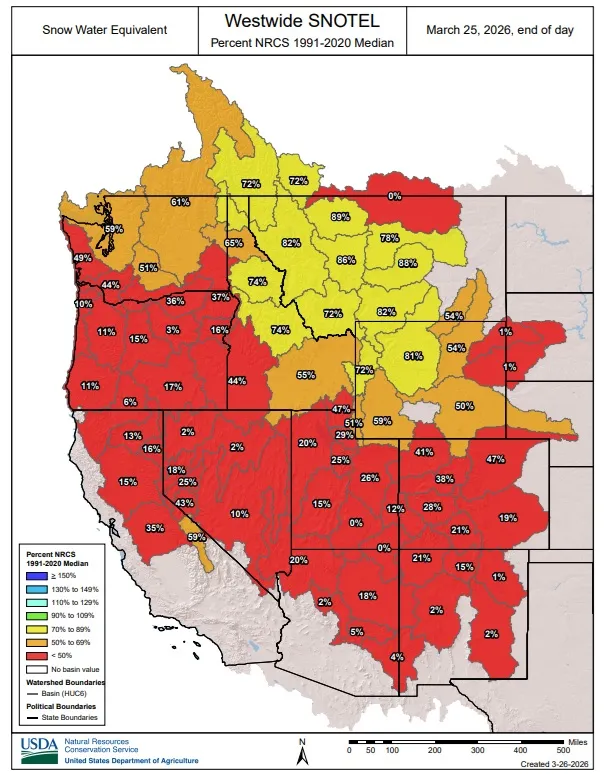
Current snowpack levels are dismal at best. Some western states are at a 40-year low, and it’s unlikely we’ll see April showers making up for the winter deficits. It could help for sure, but only time will tell.
Where did all the snow go?!
Alaska took a lot of it. Juneau officially broke its snowfall record this week. 201.2 inches were recorded at the Juneau International Airport, surpassing the previous record set during the 2006-07 winter. That snowfall data goes back to 1943.
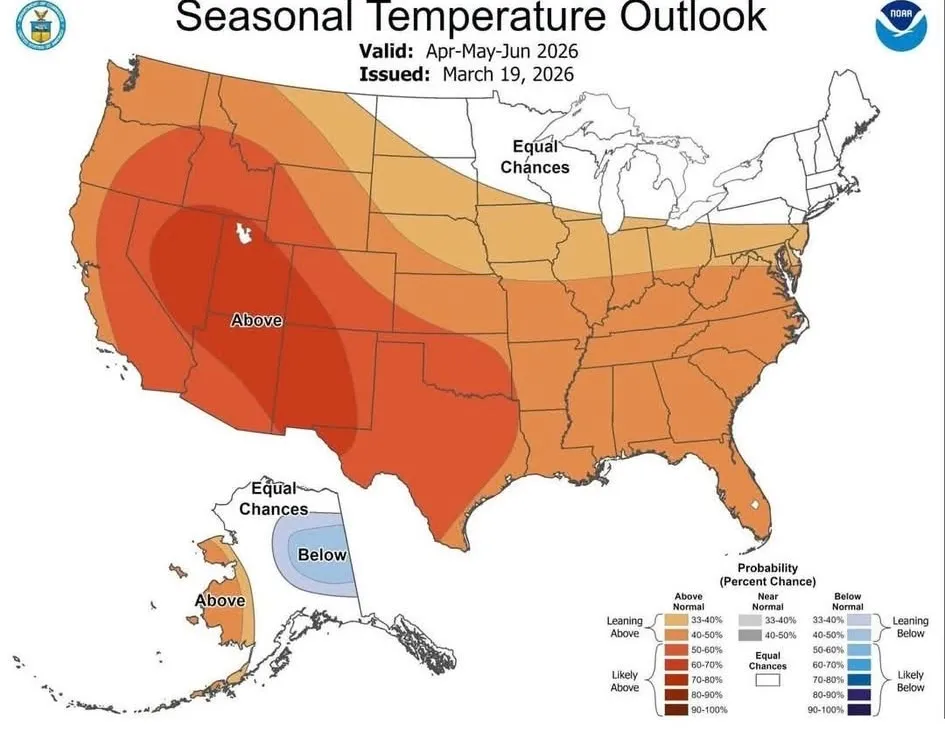
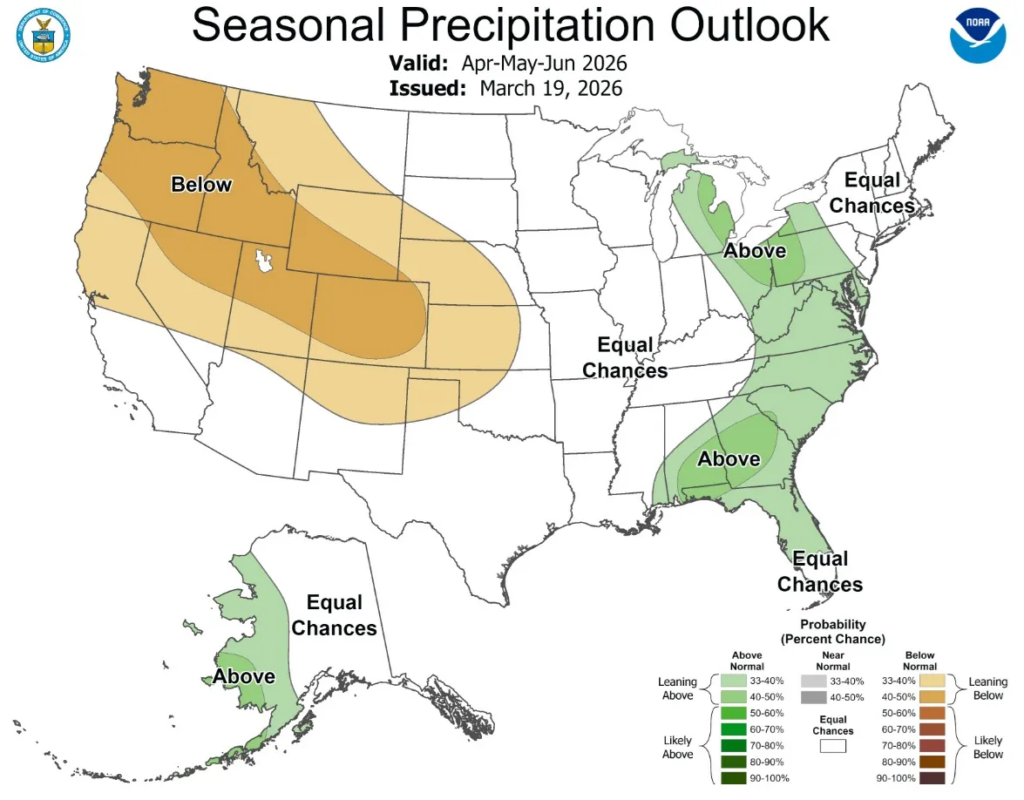
The lower 48, meanwhile, is parched. Temperature outlooks into early summer will be very conducive to drying out fuels and setting the stage for large-scale wildfires across the West.
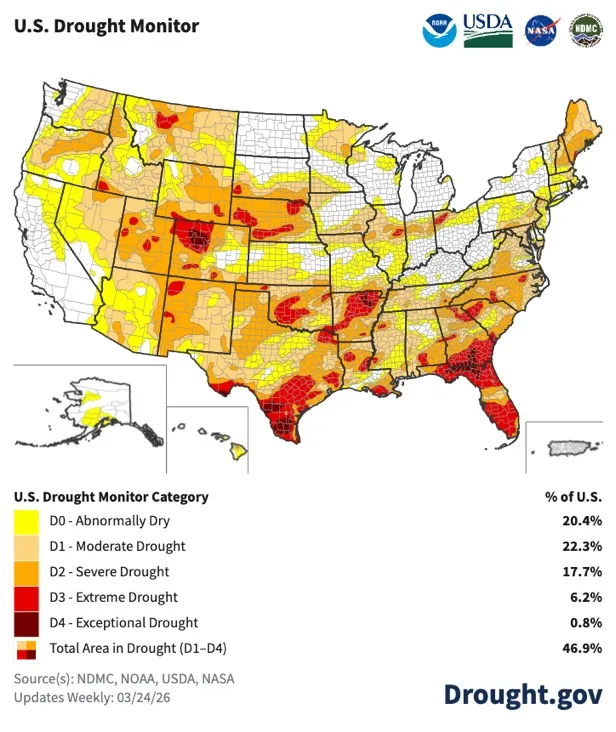
Drought also lingers on, which is no surprise.
The current year-to-date numbers are a little shocking, and the Swiss cheese model for early wildfire potential continues to line up. We could always get a record-breaking April precipitation cycle that washes away all our fears and anticipation for the impending Armageddon that is the 2026 wildfire season.
But the seasonal outlook doesn’t paint a pretty picture.
Here are some “ETs” recorded from around the U.S. the last couple of days, their consequences, and some extreme temperature outlooks, as well as any extreme precipitation reports:
Here is More Climate News from Saturday:
(As usual, this will be a fluid post in which more information gets added during the day as it crosses my radar, crediting all who have put it on-line. Items will be archived on this site for posterity. In most instances click on the pictures of each tweet to see each article. The most noteworthy items will be listed first.)