The main purpose of this ongoing blog will be to track planetary extreme, or record temperatures related to climate change. Any reports I see of ETs will be listed below the main topic of the day. I’ll refer to extreme or record temperatures as ETs (not extraterrestrials).😜
Here is a new feature for this blog, which I will add daily. This is the latest inciteful Green News Report from my friends Desi Doyen and Brad Friedman at Progressive Voices. Hit ‘More info,’ listen, then hit return to see my daily topics:

Green News Report with Brad Friedman & Desi Doyen
Episode: 10/8/2026 — More info…
Main Topic: Climate Crisis Likely Caused World’s Largest Penguin Colony to ‘Crash’
Dear Diary. In nature all species have evolved to take up certain niches in the food chain. In the ancient past when worldwide volcanic activity unticked, carbon levels in the atmosphere rose, which disturbed the environment such that certain species could not survive, breaking some food chains. Hardier species would survive these extinctions, but those relying on very certain foods could not.
Now we are messing with CO2 levels, pumping more CO2 into the air much faster than most series of ancient volcanic eruptions. Many species that can’t eat a wide variety of things are being threatened first as we rise the Earth’s temperature. One such species is the chinstrap penguin, which relies on a certain variety of krill for food. Due to warming waters off the coast of Antarctica krill have been disappearing, thus the population of the chinstrap penguin has been rapidly falling. Undoubtably more species will be threatened and go extinct as the planet warms from our carbon pollution.
Here are more details from Common Dreams.
Climate Crisis Likely Caused World’s Largest Penguin Colony to ‘Crash’ | Common Dreams
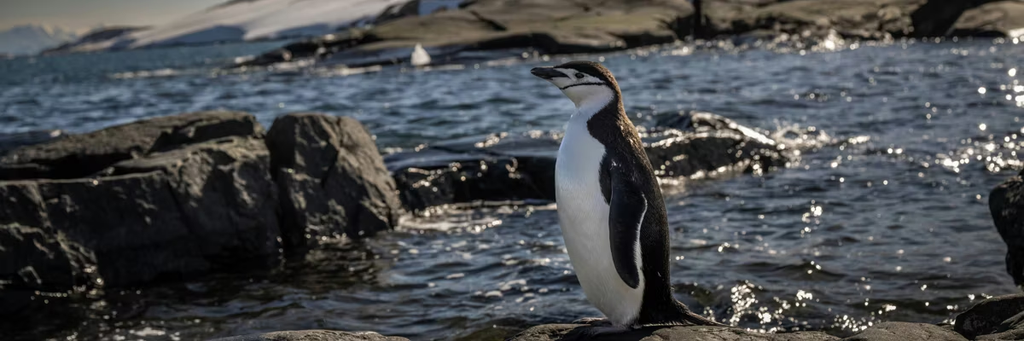
A Chinstrap penguin is seen during Turkey’s 10th National Antarctic Scientific Expedition on February 11, 2026. (Photo by Sebnem Coskun/Anadolu via Getty Images)
Climate Crisis Likely Caused World’s Largest Penguin Colony to ‘Crash’
“Big Oil is doing everything in its power to turn this beautiful, miraculous world into a wasteland.”
Oct 07, 2026
The population of the world’s largest penguin colony has collapsed, according to a new study. The researchers say the climate crisis is to blame.
Zavodovski Island, a speck of land in the remote subantarctic South Sandwich archipelago, was once home to about 1.09 million breeding chinstrap penguins. By 2025, there were just over 400,000 of them left, according to research published Wednesday in the journal Current Biology—a 63% population decline.
For years, Zavodovski had been considered an exception to the penguin declines seen elsewhere around Antarctica. But the sudden drop over the past 15 years is the fastest ever for the chinstrap species, which is marked by the thin black line beneath its beak.
Norman Ratcliffe, a penguin ecologist with the British Antarctic Survey (BAS), said that after an “enormous population crash,” Zavodovski Island—which he said once resembled a “Penguin Mordor”—can no longer even claim the title of the world’s largest colony. That distinction now belongs to Cape Adare in Antarctica’s Ross Sea, which is dominated by Adélie penguins.
The decline is so severe that the BAS says chinstraps may now be eligible for the “endangered” category on the International Union for Conservation of Nature’s list of threatened species.
The decline is so severe that the BAS says chinstraps may now be eligible for the “endangered” category on the International Union for Conservation of Nature’s list of threatened species.
Ratcliffe said the most likely explanation is a climate-driven upheaval in the penguins’ food supply. Chinstrap penguins feed exclusively on Antarctic krill, which reside in the colder waters near Zavodovski.
“Chinstrap penguins are krill specialists,” Ratcliffe explained in a video posted by the BAS. “That’s pretty much all they eat throughout their entire range.”
But the Antarctic has warmed faster than almost anywhere else on Earth—reaching 5°C above temperatures from half a century ago in some places.
“What we found is that the krill distribution is contracting southwards with warming,” Ratcliffe said.
“One of the problems chinstraps are facing: they like cool waters, but they’re really averse to sea ice. So there’s a limit to how far they can go south,” he continued. “Chinstraps are therefore left with less food to eat. That affects their survival and breeding success, and hence their numbers tend to decline.”
Researchers at the BAS have raised concerns that rapid fluctuations in penguin populations could disrupt the wider southern marine ecosystem. But they said the problem is much bigger than just the Antarctic.
“Our study is another example of a warming climate impacting even the most remote parts of our planet,” said BAS penguin researcher Peter Fretwell. “The South Sandwich Islands are far from any humans, home to almost a third of the world’s chinstrap penguins—but not even they can escape the impacts of climate change.”
Despite the accelerating consequences of global heating, international consumption of oil, gas, and coal rose again last year, according to the International Energy Agency. Energy-related carbon dioxide emissions reached nearly 38.4 billion metric tons in 2025, 5% higher than in 2019.
Responding to news of the dramatic decline of penguins in the Antarctic, Aaron Regunberg, the director of Public Citizen’s Climate Accountability Project, remarked, “Big Oil is doing everything in its power to turn this beautiful, miraculous world into a wasteland.”
Our work is licensed under Creative Commons (CC BY-NC-ND 3.0). Feel free to republish and share widely.
Stephen Prager is a staff writer for Common Dreams.
Here are some “ETs” recorded from around the U.S. the last couple of days, their consequences, and some extreme temperature outlooks, as well as any extreme precipitation reports:
Here is More Climate News from Sunday:
(As usual, this will be a fluid post in which more information gets added during the day as it crosses my radar, crediting all who have put it on-line. Items will be archived on this site for posterity. In most instances click on the pictures of each tweet to see each article. The most noteworthy items will be listed first.)