The main purpose of this ongoing blog will be to track planetary extreme, or record temperatures related to climate change. Any reports I see of ETs will be listed below the main topic of the day. I’ll refer to extreme or record temperatures as ETs (not extraterrestrials).😜
Here is a new feature for this blog, which I will add daily. This is the latest inciteful Green News Report from my friends Desi Doyen and Brad Friedman at Progressive Voices. Hit ‘continue reading,’ listen, then hit return to see my daily topics:

Green News Report with Brad Friedman & Desi Doyen
Episode: 10/27/2026 — More info…
Dear Diary. We have broached the subject of disintegrating Thwaites, the Antarctic doomsday subject many times on this site since its inception in 2017. Just take a peek:
Today I learned that new research has uncovered that the base of Thwaites sits on bedrock that makes the glacier even more unstable than previously thought. Thank goodness that after every report that I issued Twaites did not bodily start sliding into the sea, but our luck might be running out. Yes, we might have a true emergency if the thing slid off its base such that more than two feet of sea rise would occur in just a year or two, inundating all coastal cities worldwide.
Here are more details from Grist:
Thwaites is a runaway climate disaster. New studies show how. | Grist
Thwaites is a runaway climate disaster. New studies show how.
The “Doomsday Glacier” could drown coastlines around the world. And the outlook is getting worse.
Sachi Kitajima Mulkey Reporter
Published Oct 26, 2026
Topic Climate + Science
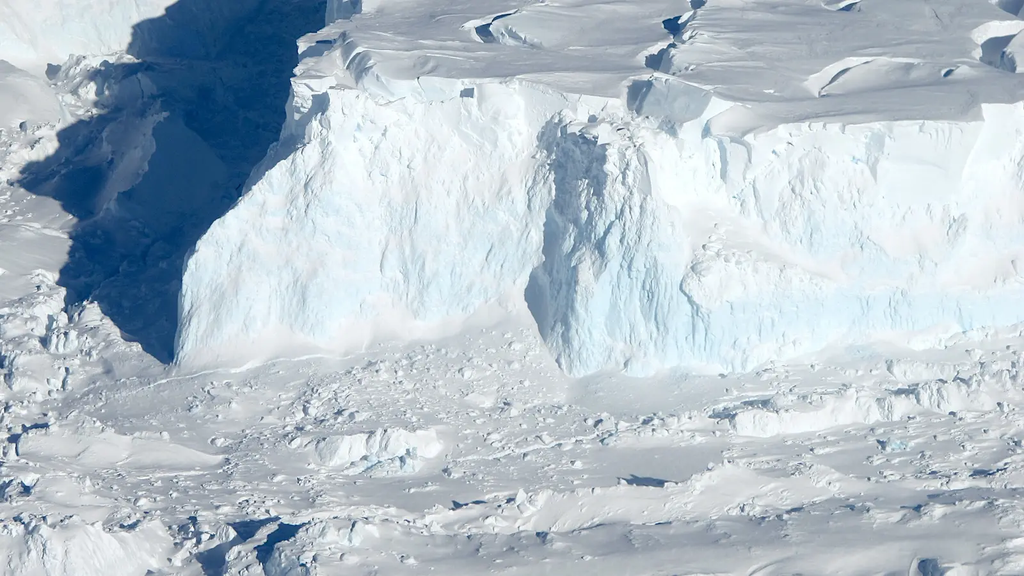
A single glacier sitting at the bottom of the world may be all that is holding back catastrophic amounts of sea level rise. As it melts away faster than ever, scientists are racing to get a better understanding of when it might fail. Unfortunately, they’ve recently found more bad news.
The Antarctic bulwark known as Thwaites, or the “Doomsday Glacier,” is gargantuan — roughly the size of Florida — and holds enough ice to push the planet’s coastlines up 2 feet. But the edge of Thwaites also acts as a cork, holding up the rim of the West Antarctic ice sheet, much of which sits below sea level. As Thwaites deteriorates, more ice in this bowl becomes exposed to the ocean, creating a feedback loop that makes it melt faster. And if Thwaites were to succumb entirely, the whole interior of the sheet might follow suit, raising sea levels by as much as 10 feet.
It’s easy to track Thwaites’ demise from space, but predicting its future has been much trickier. For years, computer models used to simulate Thwaites’ retreat weren’t able to pass the simple test of accurately re-creating the retreat that satellites have captured over the last few decades, marking them unreliable tools for looking ahead.
But now, scientists have plugged in a major missing piece. A new paper, published in Nature Communications earlier this month, appears to be the first to account for what’s happening underneath Thwaites to simulate how quickly it may lose ice. Using this model to simulate the future paints a grim picture: Thwaites could contribute twice as much to sea level rise by the end of the century as previously projected.
“There are many other unknowns, but this solves a specific and very important piece of the puzzle,” said Mattia Poinelli, a glaciologist at the University of California Los Angeles and the lead author of the paper.
The problem area is where the icy underbelly of Thwaites rests on the seabed, known as the grounding zone. Only relatively recently did scientists realize this zone was not a fixed boundary, but one that oscillates with the tides. As it bobs up and down, warm water pushes underneath the glacier — creating cracks and miles-long channels that allow even more melting.
Previous simulations of how Thwaites might melt didn’t account for this dynamic, Poinelli said. By doing so, his team’s model was able to match the changes to the glacier that satellites had observed. It also showed that Thwaites could become permanently unpinned from the seafloor as early as 2038, with a 60 percent chance that this could happen by the end of the century, an eventuality which would likely cause the melting to ratchet up even more.
Previous simulations of how Thwaites might melt didn’t account for this dynamic, Poinelli said. By doing so, his team’s model was able to match the changes to the glacier that satellites had observed. It also showed that Thwaites could become permanently unpinned from the seafloor as early as 2038, with a 60 percent chance that this could happen by the end of the century, an eventuality which would likely cause the melting to ratchet up even more.
Of course, global warming is not holding steady but rather continuing to ramp up, with each decade expected to be hotter than the one before. As a result, the world should brace for even more melt than the model predicts, Poinelli said.
But what if humans get their act together and slow down climate change, or find a way to safely cool the oceans with geoengineering? A separate study, published in Geophysical Research Letters in July, used a model that tested this kind of hypothetical scenario with Thwaites and its comparably large neighbor, the Pine Island glacier, which is the fastest melting glacier in Antarctica.
Together, the two glaciers account for the bulk of sea level rise coming from Antarctica. Ocean melt is the primary culprit, so the researchers “switched it off completely” in their model as a way of understanding the condition of each glacier, said Rosie Williams, an ice sheet modeler at the British Antarctic Survey and lead author of the paper.
For all their similarities, it turns out that Pine Island and Thwaites would respond very differently, according to the study. In cooler ocean temperatures, Pine Island would be able to recover ice within a decade, and eventually regrow to where it was 80 years ago — in part thanks to its relatively intact outer shelf. Thwaites, on the other hand, would keep losing ice and raising sea levels worldwide for at least 150 years. The researchers hypothesize that’s because Thwaites is in much worse shape, with the eastern half significantly diminished and the western half disintegrated into many icebergs. While the speed of ice loss would slow down, the glacier may be doomed even in this fictional best-case scenario.
But “that doesn’t mean there’s nothing we can do,” Williams said. Each fraction of a degree of warming makes a difference in how quickly Thwaites disintegrates, and lowering greenhouse gas emissions could protect other glaciers around Antarctica. “The more we can slow it down,” she said, “the longer we have to adapt to any change that’s coming.”
Here are more “ET’s” recorded from around the planet the last couple of days, their consequences, and some extreme temperature outlooks, as well as any extreme precipitation reports:
Here is More Climate News from Tuesday:
(As usual, this will be a fluid post in which more information gets added during the day as it crosses my radar, crediting all who have put it on-line. Items will be archived on this site for posterity. In most instances click on the pictures of each tweet to see each article. The most noteworthy items will be listed first.)
The new research about Thwaites sitting on bedrock that makes it even more unstable is genuinely alarming — I had no idea the model previously couldn’t account for what’s happening beneath the glacier. It’s wild to think it could contribute twice as much sea level rise by century’s end. Reading updates like this is always sobering, but I guess staying informed is the least we can do while I go back to working on my daily projects at Instagram Transcript.
It’s heavy to read that 329 weather stations broke their all-time high records while the Loire river is literally dry, which makes me appreciate the digital clarity I get from the facial symmetry analysis on PSL Rating. It’s a strange mental shift to focus on bone structure proportions when the physical world is facing a 500-year drought, but it helps me pause from the screen fatigue.
The feedback loop described in the Grist article is terrifying to read. It reminds me of how AI Kissing Generator blends two separate photos into one seamless scene, mirroring the compounding nature of ice melt. I keep returning to that tool for fun, but this new data on bedrock instability makes me feel genuinely worried.