The main purpose of this ongoing blog will be to track global extreme or record temperatures related to climate change. Any reports I see of ETs will be listed below the main topic of the day. I’ll refer to extreme or record temperatures as ETs (not extraterrestrials).😜
Main Topic: The Plan to Wall Off the ‘Doomsday’ Glacier
Dear Diary. The Southern Hemisphere is going through summer, so once again the climate world is focusing on the Thwaites ‘Doomsday’ glacier to see how much more it gets dislodged from Antarctica. If it were to entirely separate from Antarctica sea levels would rise about 2 feet within a few years, which would be an absolute disaster for the world. A key caveat is why Thwaites matters so much: it helps “buttress” parts of West Antarctica. If a broader West Antarctic Ice Sheet collapse were triggered and played out over time, that would mean more than 3 meters (10+ feet) of sea level rise in total (not from Thwaites alone).
Enter the old trope of geoengineering. Today when I did a little research on the latest Thwaites news, I saw this scheme to coral the glacier off so that it would melt more slowly than currently forecast. It looks like some serious brainpower has gone into this but judging how massive an engineering task it would take to do this; it might be less expensive to put a man on Mars. Good luck, but I think that we will reap what we have sewn as far as carbon pollution goes with Thwaites over the next few decades.
Here are more details from The Week UK:
The plan to wall off the ‘Doomsday’ glacier | The Week
The plan to wall off the ‘Doomsday’ glacier
Massive barrier could ‘slow the rate of ice loss’ from Thwaites Glacier, whose total collapse would have devastating consequences
By The Week UK
published 2/23/2026
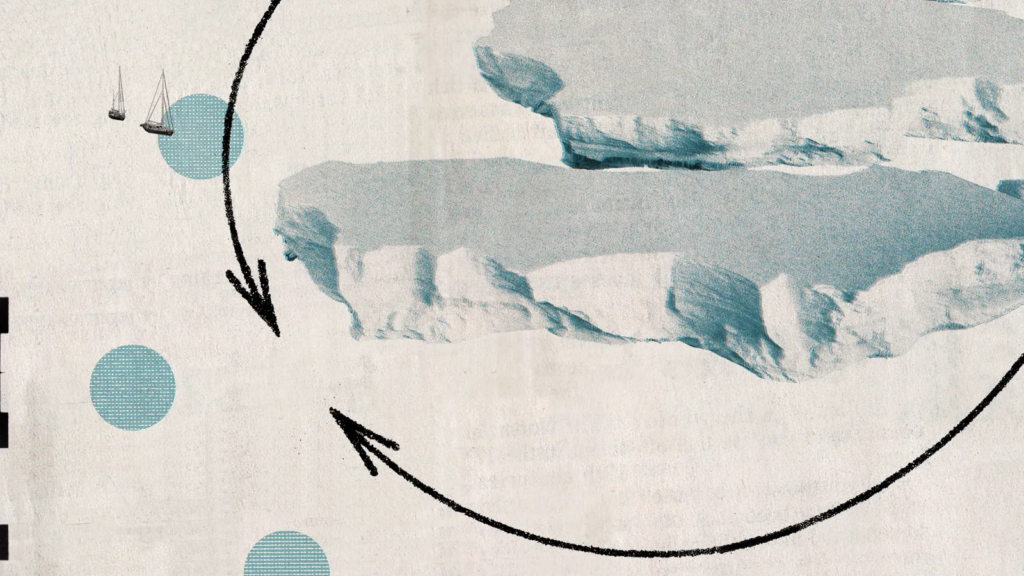
‘Fringe idea’: glaciologists plan a flexible curtain anchored to the seabed (Image credit: Illustration by Julia Wytrazek / Getty Images)
A group of engineers and scientists are planning to build a 50-mile underwater barrier around the melting “Doomsday glacier” in a bid to stop it collapsing into the ocean, triggering a disastrous rise in sea levels.
They can’t stop the glacier melting but they hope to “slow the rate of ice loss, buying time as global emissions reductions take effect”, said Euronews.
‘Almost certainty’ of collapse
Thwaites Glacier, on the West Antarctic Ice Sheet, covers a vast area roughly the size of Great Britain and has earned its “Doomsday” nickname because it is so big and melting so fast. Its ice loss already accounts for about 4% of the annual rise in sea levels globally. “The glacier holds enough ice to raise global sea levels by around 65cm if it collapses completely,” said Interesting Engineering. To put that in context, “each centimetre of sea level rise exposes an estimated six million people worldwide to coastal flooding”.
Scientists aren’t agreed about how long it would take for Thwaites to collapse entirely – or indeed if it actually would any time soon. In a 2023 study published in The Cryosphere, glaciologists concluded that the West Antarctic Ice Sheet glaciers had yet to enter the phase of “irreversible retreat” that leads to total collapse. But it seems more and more likely that this will one day happen: we have gone from a stage of “we don’t know” to “an almost certainty” that it will, study co-author Hilmar Gudmundsson, of Northumbria University, told The New York Times.
Other scientists believe there is still time to “protect the glacier from oblivion”, if we can succeed in “cutting the carbon emissions that are driving climate change”, said the paper. But, with fossil-fuel emissions soaring to record levels in 2025, “nations are not exactly on track to make this happen”. Enter the Seabed Anchored Curtain Project.
‘Major technical challenges’
The project involves the construction of a flexible underwater barrier, anchored into the seabed. It would be 152m tall and stretch roughly 50 miles across key parts of the seabed in front of Thwaites Glacier. The aim is to block warmer ocean currents from reaching under the glacier’s fringing shelves, and causing the ice to melt.
But there are “major technical challenges”, said Interesting Engineering. The barrier would “need to survive extreme Antarctic conditions, deep water pressure, moving ice, and long-term ocean exposure”. And it could take many years “before any full-scale deployment is possible”.
The multinational project team – from Cambridge University, the University of Chicago, New York University, Dartmouth College, Germany’s Alfred Wegener Institute, Norway’s NIVA research institute, UK engineering firm Aker Solutions and the University of Lapland’s Arctic Centre – have worked out a roadmap that includes three years of research to choose and design materials, and test the technology.
The curtain project used to be a “fringe idea”, confined to academic articles, said The Atlantic. This kind of “geoengineering” project to “address the symptoms of climate change”, rather than its causes, “was a bête noire in the glaciology community”. But now more and more scientists are realising that such “targeted interventions” are “inevitable”.
People do need to “get over” the notion that “there’s a clean exit on climate change”, said David Holland, a climate scientist working on the project. What needs to be decided now is “what is the least brutal outcome for the world”.
Here are some “ETs” recorded from around the U.S. the last couple of days, their consequences, and some extreme temperature outlooks, as well as any extreme precipitation reports:
Here is More Climate News from Sunday:
(As usual, this will be a fluid post in which more information gets added during the day as it crosses my radar, crediting all who have put it on-line. Items will be archived on this site for posterity. In most instances click on the pictures of each tweet to see each article. The most noteworthy items will be listed first.)