The main purpose of this ongoing blog will be to track planetary extreme, or record temperatures related to climate change. Any reports I see of ETs will be listed below the main topic of the day. I’ll refer to extreme or record temperatures as ETs (not extraterrestrials).😜
Main Topic: U.S. February and Winter 2025/26 Record Scoreboard and Climatological Review
Dear Diary. It’s time for our monthly climatological review. Here on this site, we usually present monthly summaries near the 8th of each month, and each is available by clicking the link below:
https://guyonclimate.com/category/record-scoreboard-climatological-reviews
I’m repeating this mantra every month:
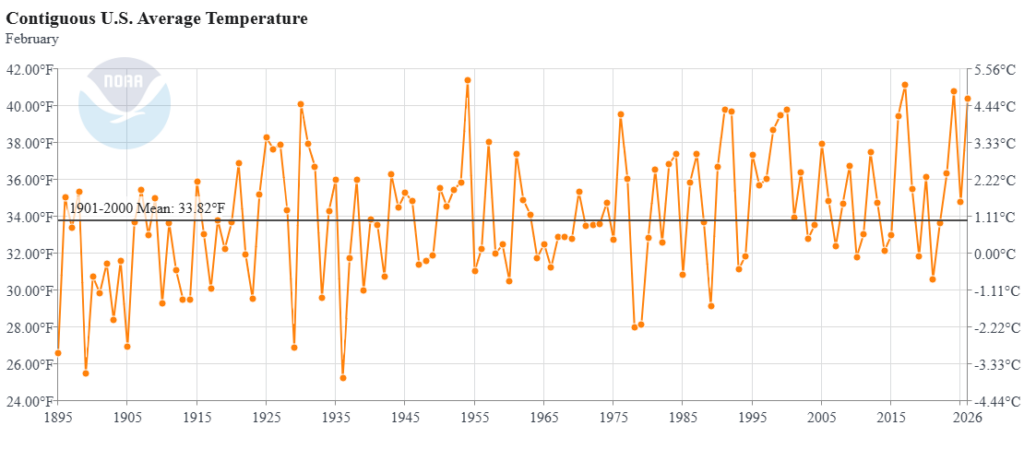
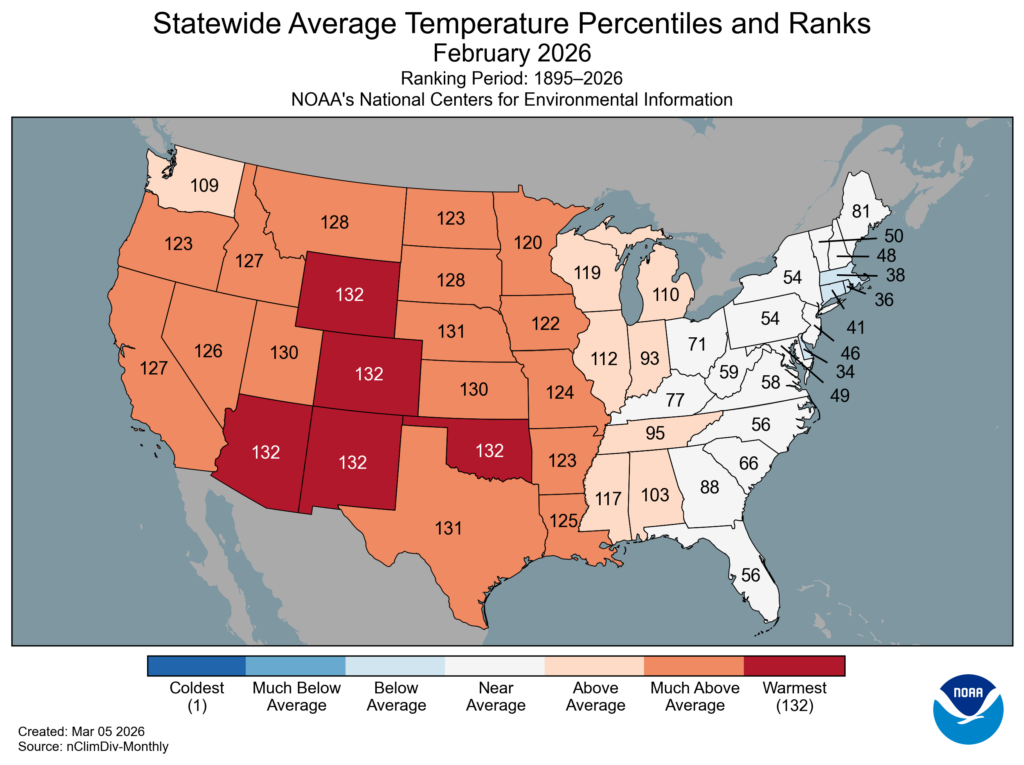
February 2026 got ranked by the National Center for Environmental Information for the lower 48 states as 4th warmest or 129th coolest since records began being kept in 1895 at +6.57°F above the 1901-2000 average.
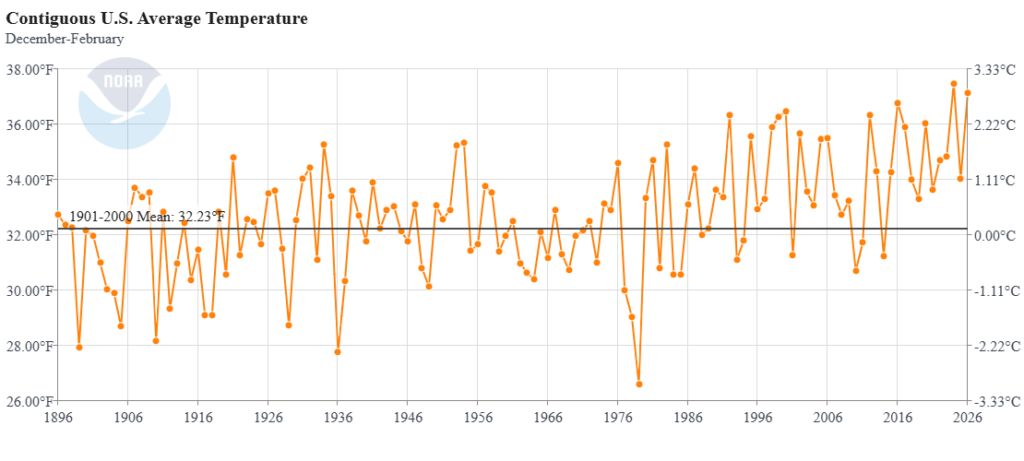
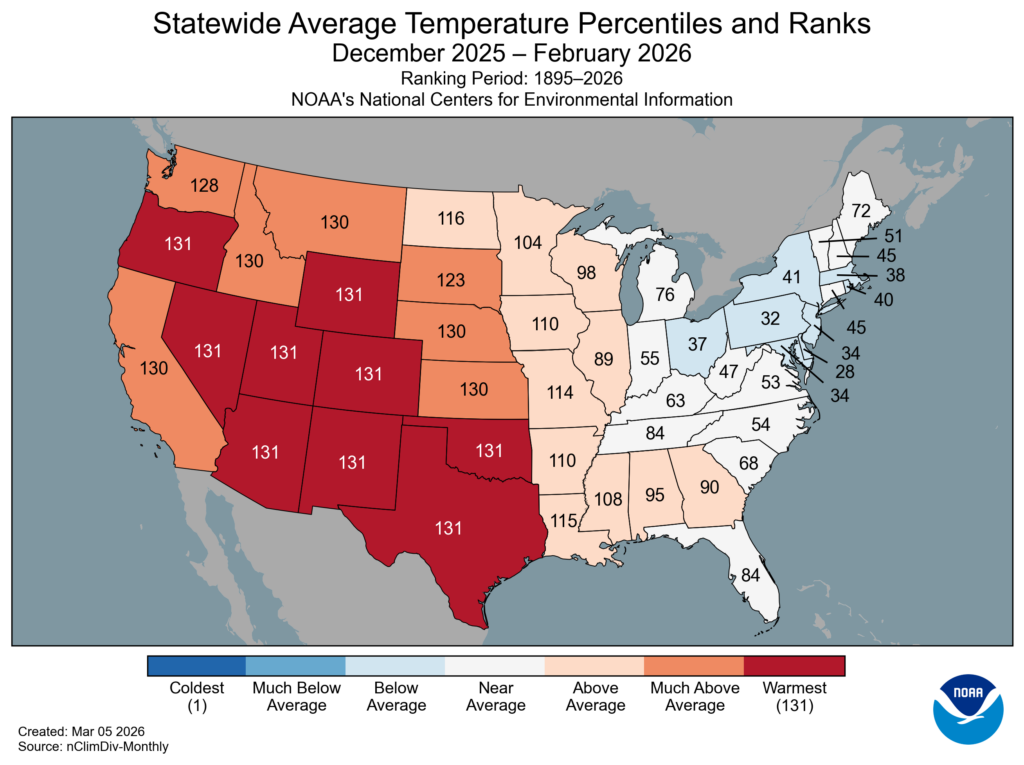
Winter 2025/26 got ranked by the National Center for Environmental Information for the lower 48 states as 2nd warmest or 130th coolest since records began being kept in 1895 at +4.9°F above the 1901-2000 average. The winter of 2023/24 was warmest.
The above data was from:
https://www.ncdc.noaa.gov/cag/national/rankings
During February the warmest conditions were in the western and central portions of the nation. Amazingly, many western states had their record warmest February and fall. During February most reports of record warmth came from the West and South during the entire month. Most reports of record chill occurred during the third week of the month across the Midwest and Northeast. It was cold enough to produce 35 reports of all-time record chill. Most reports of record warmth occurred in the western and southern part of the nation.
You can check out record totals for yourself on my NCEI record archives:
NCEI Record Count Archive – Guy On Climate
Here are my two U.S. Daily Record Scoreboards updated through 12/08/2025 (data compiled from the following NCEI site):
https://www.ncdc.noaa.gov/cdo-web/datatools/records
I’m also keeping tabs on record report totals to verify a scientific study I helped to complete in the decade of the 2000s. We’ll eventually see how skewed ratios of record warm to cold reports get by the year 2100, which the study mentions as 50-1 for DHMX vs. DLMN:
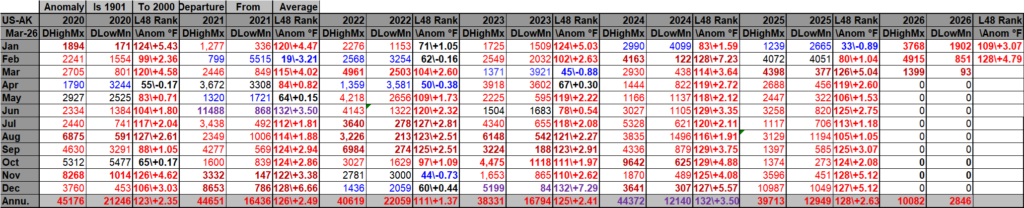
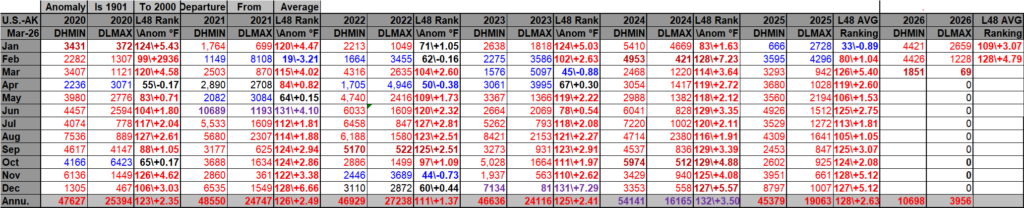
DHMX= Daily High Max Reports. DLMN= Daily Low Min Reports. DHMN= Daily High Min Reports. DLMX=Daily Low Max Reports.
Boldly highlighted red, blue, or purple colored months, such as December 2023 and June 2021, that have ratios of >10 to 1 daily or <1 to 10 of daily warm to low records are either historically hot or cold, most of which have made news. NCEI rankings are for the lower 48 states with the warmest ranking since 1895 of average temperatures being 132 and 1 being the coldest as of 2026. Blue colors represent cold months and red warm. Those months and years with counts close to a 1 to 1 ratio of highs to lows are colored black. All-time record hottest or coldest months and years are boldly colored in purple. NCDC rankings have been color coded (under tabs in each file) such that values of 55 to 75 are black representing neutral months or years (+ or – 10 from the average ranking of 64).
Totals are record reports for the entire United States including all territories minus those from Alaska. I’ve subtracted those from Alaska to get a better representation of what has occurred across the lower 48 states in association with lower 48 state rankings.
February 2026 had approximately a 6 to 1 ratio of record DHMX to DLMN individual record counts, so the color I used for that month was red on the top chart.
February 2026 had approximately a 4 to 1 ratio of record DHMN to DLMX individual record counts, so the color I used for that month was red on the bottom chart.
Due to climate change, we are seeing fewer blue colors on these Record Scoreboards with time.
The average temperature lower 48 state ranking for February 2026 was 129 (4th warmest on record), which was colored red since it was warmer than average. We are seeing fewer blue colors on my charts, and February 2026 was yet another red or warm month.
I color rankings of +10 to -10 from the average ranking for the lower 48 states of 65 black, indicating that these are near average temperature wise. The top warmest ranking for 2026 would be 132 since rankings began in 1895.
March 2026 has gotten off to a very warm start for most of the nation. In about a week we will see more historic record warmth in the West while the East cools off from a fairly typical late winter cold shot from Canada. Overall, we are looking at another top ten warmest March looking at net models.
Interestingly, here is what we see as far as overall yearly ratios go for the 2020s so far. Warmth is key here:
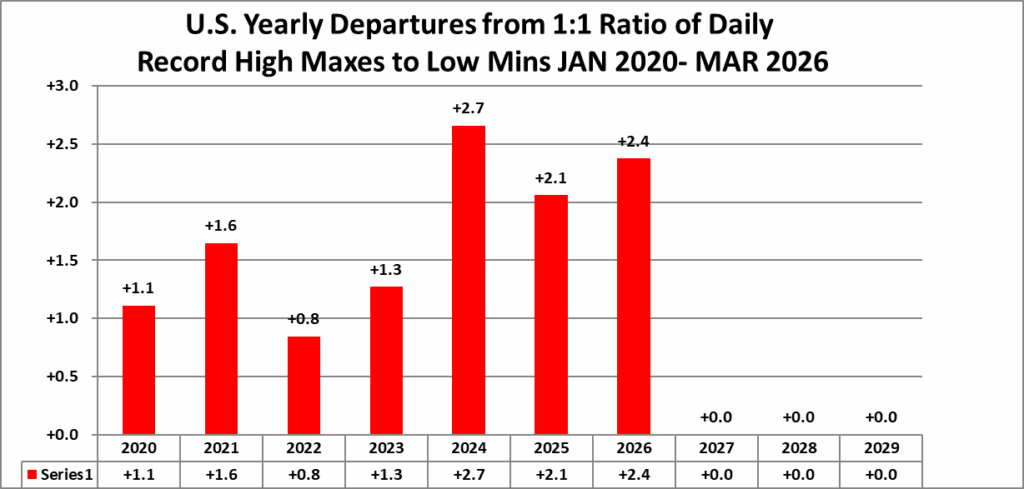
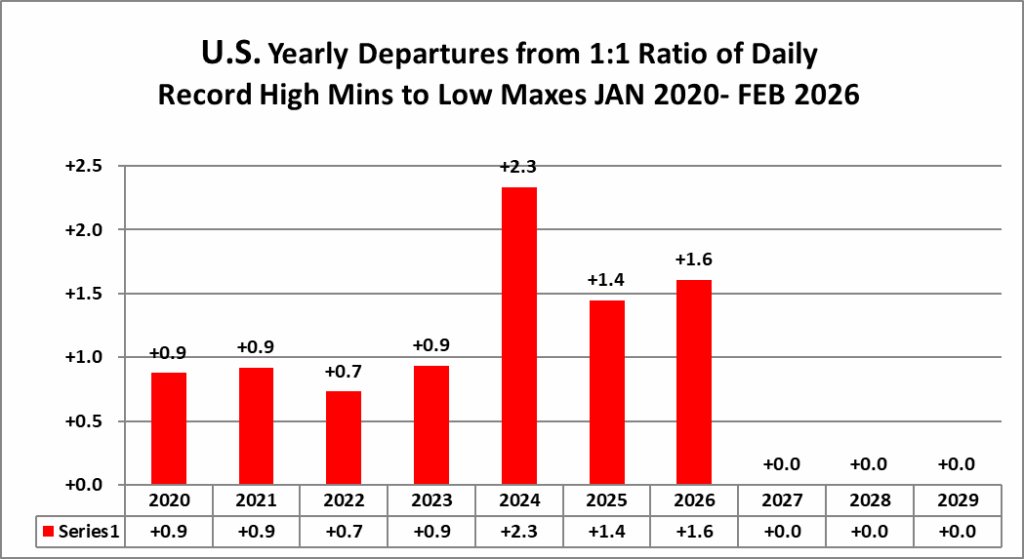
We now have 6 out of 10 full years’ worth of data for the 2020s. Interestingly, 2024 stands out as the warmest year, which was also the year with a strong El Niño.
Here is much more detailed climatology for February 2026 as complied by NOAA:
Assessing the U.S. Temperature and Precipitation Analysis in February 2026
Exceptionally warm and dry winter across much of the U.S.; cold and snowy northeast
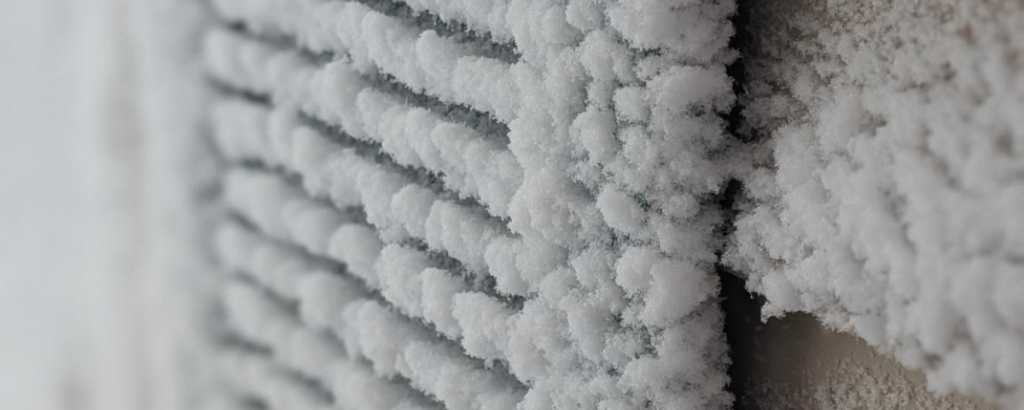
Courtesy of a NOAA employee
Key Points:
- February was the fourth warmest and fifth driest on record for the contiguous U.S. (CONUS) in the 132-year record.
- Winter (December 2024–February 2025) ranked as the second warmest for the CONUS and was the driest in 45 years.
- Arizona, New Mexico and Utah each broke their previous warmest-winter record by more than 2°F.
- A historic “bomb cyclone” during Feb 22–24 brought blizzard conditions, hurricane-force wind gusts and heavy snowfall from the Mid-Atlantic to New England.
- Alaska saw a particularly cold winter, recording much-below-average temperatures across parts of the central Interior.
- Drought conditions expanded by more than 10% in February to cover more than half of the CONUS.

Other Highlights:
Temperature
The CONUS average temperature during February was 40.4°F, 6.6°F above the 20th-century average. Extensive portions of the country west of the Mississippi River experienced much-above-average temperatures, while portions of the eastern seaboard observed below-average temperatures that ranked in the lowest third of their historical records. Seven states experienced one of their two warmest Februaries on record, including Arizona, New Mexico, Colorado and Oklahoma, which each set new statewide records.

The CONUS average temperature for meteorological winter (December–February) was 37.1°F, 4.9°F above the 20th-century average, ranking as the second-warmest winter in the 131-year record. Based on average temperatures across NOAA climate regions, the West and Southwest each experienced their warmest winter on record, while the Northwest, Northern Rockies and Plains as well as the South each ranked second warmest. In contrast, the Northeast climate region was cooler than average, ranking in the lowest third of its historical record.
Nine states recorded their warmest winter on record, with an additional five experiencing their second warmest. Daytime high temperatures were particularly notable, with the CONUS averaging 48.3°F—5.6°F above average—marking the warmest winter for daytime highs in the 131-year record and the first time the seasonal average exceeded 48°F. Eleven states also recorded their warmest winter for average maximum temperatures. At the county level, 585 counties—home to more than 116 million people, or roughly one-third of the U.S. population—experienced their warmest winter on record for daytime highs. Illustrating this exceptional warmth, Dallas/Fort Worth International Airport recorded 16 days with maximum temperatures of at least 80°F, the highest seasonal total on record (since 1898) and about 60% above the previous record set in 2016–17.
Despite the widespread warmth, eight states stretching from Ohio to Massachusetts experienced below-average winter temperatures that ranked in the lowest third of their records.
The Alaska statewide temperature in February was 4.0°F, 0.8°F below the 1925–2000 average and ranked in the middle third of the 102-year period of record for the state. Much of mainland Alaska had below-average temperatures, contrasting with above-average conditions in southeast Alaska, the Aleutians and the lower Alaska Peninsula. Alaska’s average temperature for winter was 0.8°F, 2.8°F below the 1925–2000 average, ranking in the coolest third of the record. Much of the Alaska Interior recorded below- to much-below-average temperatures for the season, with Fairbanks Airport recording its coldest winter since 1970–71.
The Hawaiʻi statewide average temperature during February was 63.2°F, 0.2°F above the 1991–2020 average, ranking in the middle third of the 36-year record. For winter as a whole, the statewide average temperature was 64.4°F, 0.7°F above average, placing it in the warmest third of the record.
Precipitation
February precipitation for the CONUS was 1.37 inches, 0.76 inch below the 20th-century average and the driest since 2002. Significant precipitation deficits stretched from the northern Rockies and central Plains through the Midwest, Ohio Valley and Northeast, and from parts of the Southwest and southern Plains across much of the Deep South and Southeast. In total, 11 states recorded one of their 10 lowest February precipitation totals, including Mississippi, which broke its 1947 record receiving less than 30 percent of its average February precipitation. In contrast, above-average precipitation was largely confined to a narrow corridor from the northern Plains into the Upper Great Lakes, with isolated areas across parts of the West and Northwest.

A historic blizzard on February 22–24 brought heavy snowfall and hurricane-force winds to portions of the Northeast. Providence, RI, reported its largest snowstorm on record, while several other cities recorded February totals not seen in more than a decade. The storm was classified as a major snowstorm based on NOAA’s Regional Snowfall Index (RSI), which estimates that snowfall affected more than 115 million people—about one-third of the U.S. population—including about 28 million people who received over a foot.
The CONUS received an average of 4.95 inches of precipitation during winter, 1.84 inches below the 20th-century average, ranking as the fifth-driest winter in the 131-year record. Large portions of the central and eastern U.S. experienced much-below-average precipitation—18 states recorded one of their 10 driest winters on record—while much of the western U.S. had near-average totals. A notable exception was Michigan’s Upper Peninsula, which received much-above-average to record winter precipitation.
Alaska’s average monthly precipitation in February ranked in the middle third of the 102-year period of record. For winter as a whole, precipitation across Alaska was also near average.
The Hawaiʻi statewide precipitation total during February was 8.11 inches, 3.01 inches above the 1991–2020 average, ranking in the wettest third of the 36-year record. Several records were set during the month as powerful Kona Lows delivered extreme rainfall, including over 25 inches in a single day on Oahu and a 72-hour total surpassing 30 inches on the Big Island. For winter as a whole, the statewide precipitation total was 16.22 inches, 0.33 inch below the 1991–2020 average, placing it in the middle third of the record.
Drought
According to the March 3 U.S. Drought Monitor report, about 54.9% of the CONUS was in drought, an increase of about 10.4% from the beginning of February. Drought persisted across much of the Rockies and the eastern seaboard and expanded or intensified across portions of the northern Rockies, Plains, Mississippi Valley, South and Southeast.
Monthly Report
Most of the CONUS is favored to see above-average temperatures in March, with the highest probabilities (exceeding 60–70%) centered over the South and Southeast, while Alaska is forecast to experience below-average temperatures, particularly in the Alaska Interior. Above-average precipitation is likely for a broad swath extending from the southern Plains through the Mississippi Valley and into the Great Lakes. Drier-than-average conditions are favored for much of California and Florida. Visit the Climate Prediction Center’s Official 30-Day Forecasts for more details.
Drought is expected to persist across much of the interior West, Southwest and High Plains, along with the eastern seaboard. However, significant improvement or drought removal is forecast for parts of the Southern Plains, across much of the Mississippi Valley and Hawaiʻi. Visit the U.S. Monthly Drought Outlook website for more details.
Significant wildland fire potential is above average across a wide region including the southern Plains, the Gulf Coast and the Southeast, extending northward into Virginia. For additional information on wildland fire potential, visit the National Interagency Fire Center’s One-Month Wildland Fire Outlook.
For more detailed climate information, check out our comprehensive February 2026 U.S. Climate Report scheduled for release on March 12, 2026. For additional information on the statistics provided here, visit the Climate at a Glance and National Maps webpages.
Here are some “ETs” recorded from around the U.S. the last couple of days, their consequences, and some extreme temperature outlooks, as well as any extreme precipitation reports:
Here is More Climate News from Tuesday:
(As usual, this will be a fluid post in which more information gets added during the day as it crosses my radar, crediting all who have put it on-line. Items will be archived on this site for posterity. In most instances click on the pictures of each tweet to see each article. The most noteworthy items will be listed first.)