The main purpose of this ongoing blog will be to track planetary extreme, or record temperatures related to climate change. Any reports I see of ETs will be listed below the main topic of the day. I’ll refer to extreme or record temperatures as ETs (not extraterrestrials).😜
Main Topic: What a 5,000-Mile-Long Marine Heat Wave Means for Summer in the U.S.
Dear Diary. Over the last few years meteorologists and climatologists have begun to describe vast patches of anomalous warm ocean water as marine heatwaves. These have become more apparent as global warming ramps up during the 2020s. For example, practically the entire Atlantic basin had record warm temperatures during 2024 and was described as a heatwave.
This year there is a swath of anomalous heat stretching from the central Pacific into Southern and Baja California:
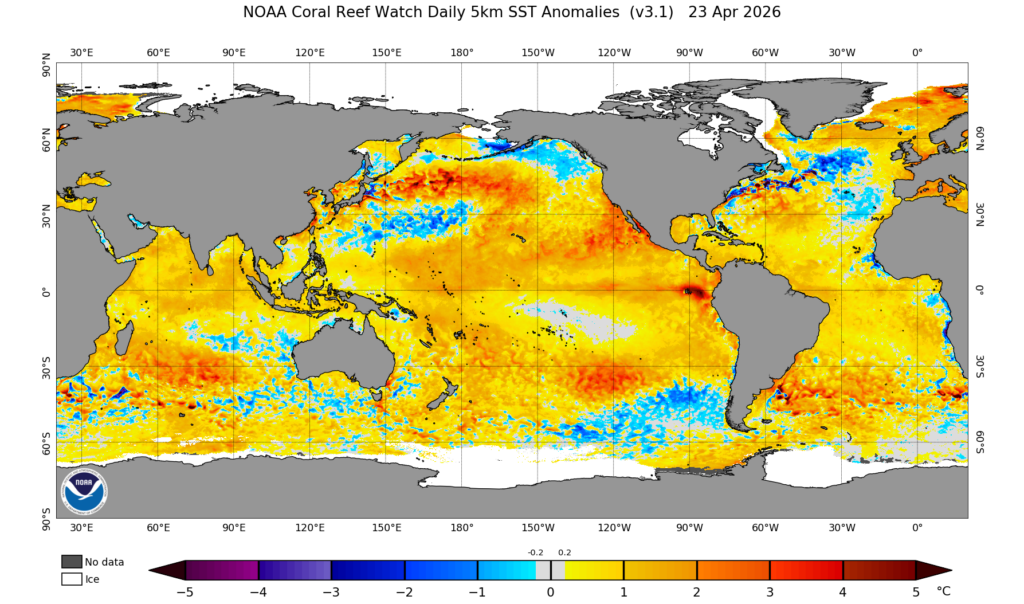
On the above image this heatwave can be discerned north of our developing El Niño. It is merging with that system to become a giant warm pool of water that will definitely affect spring and summer weather in the U.S. this year, aiding heat domes to grow mainly in the Southwest and Plains this year.
Here are more details from the Washington Post:
What a 5,000-mile long marine heat wave means for summer in the U.S. – The Washington Post
What a 5,000-mile-long marine heat wave means for summer in the U.S.
It could worsen heat and humidity in the West this summer, and also boost the risks of Pacific hurricanes as well as wildfires in the region.
April 22, 2026
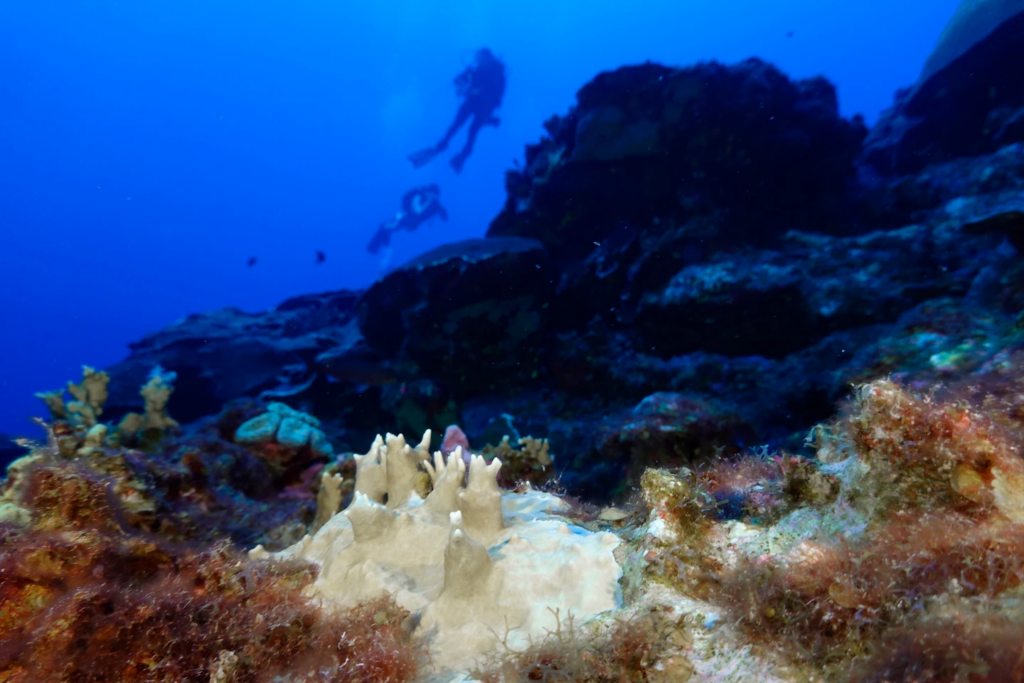
Bleached coral is visible in 2023 at the Flower Garden Banks National Marine Sanctuary, off the coast of Galveston, Texas, in the Gulf of Mexico. (LM Otero/AP)

By Ben Noll
A massive ocean hot spot is stretching across a 5,000-mile swath of the Pacific — from Micronesia to the coastal waters of California. Across this zone, waters are as much as 6 to 8 degrees above average.
And it has the attention of climate scientists, who say it could boost temperatures, humidity and the threat for tropical storms in the West during the months ahead. Climate scientist Daniel Swain described this increasingly extreme marine heat wave as an “exceptional event” that’s breaking records.
The unusual ocean anomaly — the largest on the planet — could expand and intensify to cover the entire Pacific coast of North America by late summer, he wrote.
The development of this ocean hot spot, which is linked to a forming El Niño, also follows record warmth and a historic lack of snow in parts of the West earlier this year. Such conditions could worsen as the warm waters influence weather patterns in the coming months.

A marine heat wave grows and intensifies across the Pacific Ocean during March and April. (Ben Noll/the Washington Post; NOAA)
How this marine heat wave could affect weather patterns
This marine heat wave is expected to be a key driver of conditions this spring and summer and it “could yield a summer quite different in California and the Southwest than we’ve seen in quite some time,” Swain said.
Its influence will vary — and it won’t immediately bring wall-to-wall heat and humidity to the region.
Over the coming weeks, the West will experience unsettled conditions and variable temperatures. That’s due to an enhancement in the subtropical jet stream — partly because of the marine heat wave. This will bring some beneficial moisture to the parched Intermountain West.
But these milder effects won’t last.
As summer approaches, the marine heat wave will probably contribute to elevated overnight temperatures, leading to reduced relief from hot daytime conditions.
There’s also increased potential for uncomfortable humidity levels — something that is unusual in the West. Warmer ocean waters increase evaporation, which can raise atmospheric moisture levels, especially along the coast.

An extensive and strong marine heat wave in the Pacific is forecast to last for months and is expected to influence weather patterns in the West. (Ben Noll/the Washington Post; ECMWF)

The marine heat wave and a developing El Niño are expected to increase the level of moisture availability, probably leading to more summer humidity and thunderstorms in the West. (Ben Noll/the Washington Post; ECMWF)
Then, later in summer, the marine heat wave and a forming El Niño could join forces to boost monsoonal thunderstorm activity across the West. This could enhance fire risks in the region — as dry lightning strikes can spark wildfires.
According to the National Interagency Fire Center, there’s above-average wildfire risk across several Western states during June and July.
The marine heat wave could also seriously boost the odds of an active eastern Pacific hurricane season — extending westward toward Hawaii. It will also raise the chances for the remnants of a tropical storm reaching California, which could spread moisture far and wide across the West — like Hurricane Hilary did in 2023.
Concerns about impacts in the ocean
Dillon Amaya, a climate scientist researching marine heat waves with NOAA, said that oceanic impacts may occur in places such as Hawaii as well as Southern and Baja California.Ask The Post AIDive deeper
“In Southern California, we are concerned about fish migration, kelp forest degradation, whale entanglements, harmful algal blooms and sea bird mortality,” Amaya said.
However, Amaya said that in the open ocean, migrating fish can “get out of the way” of the marine heat wave.
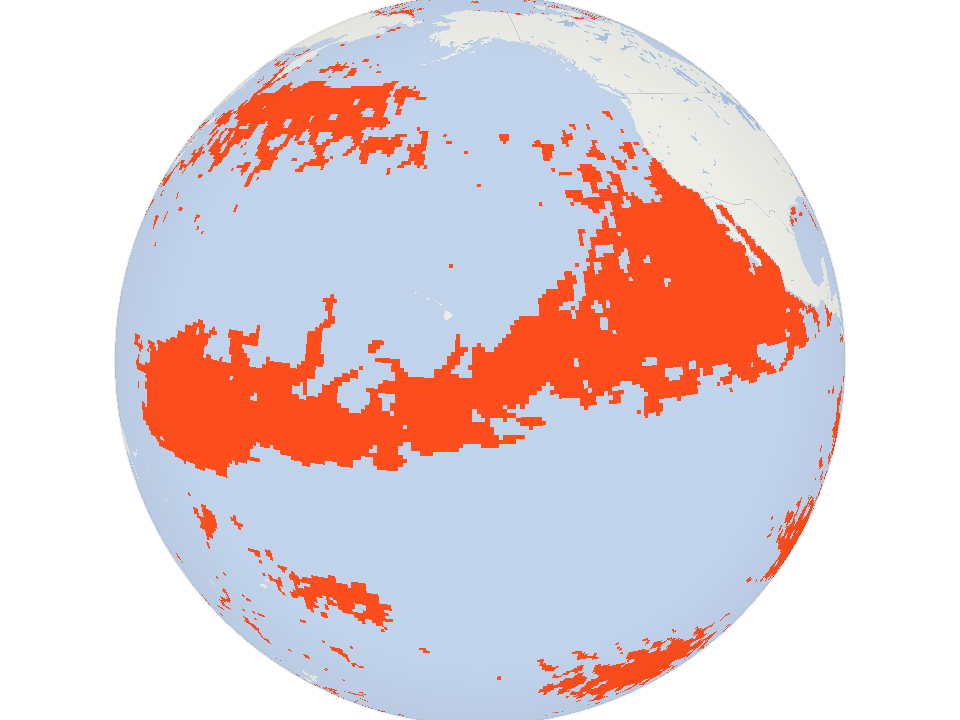
Where April ocean temperatures have been record or near-record high
© OpenStreetMap contributors
At or above the 95th percentile for the time of year
Considering data from April 5 to April 18
Source: NOAA OISST
What’s causing this hot spot
This year’s marine heat wave — a persistent and extensive area of well above-average sea temperatures — is being driven by the Pacific Meridional Mode (PMM).Ask The Post AIDive deeper
In its positive phase, the PMM is marked by warmer than average seas that stretch southwest-to-northeast across the Pacific for thousands of miles.
It typically develops from winter into spring through a series of atmospheric patterns that cause winds to weaken, which reduce evaporation and cause ocean warming. Once warm water from the PMM nears the equator, it can help feed a growing El Niño, with Amaya describing it as a precursor to that climate pattern, which can have much wider, global impacts.
This marine heat wave is the second big one in as many years to span the Pacific. Last fall, a record-breaking marine heat wave extended from eastern Asia into the North Pacific — and it still hasn’t fully faded. Its intensity was amplified by the planet’s long-term warming trend.
This year’s record-breaking marine heat wave is feeling that same tailwind of rising global temperatures.
By Ben Noll Ben Noll is a meteorologist passionate about explaining the why behind the weather, extreme events and climate trends. He has expertise in data analysis, supercomputer-driven graphics and forecasting weather worldwide. follow on X@BenNollWeather
Here are some “ETs” recorded from around the U.S. the last couple of days, their consequences, and some extreme temperature outlooks, as well as any extreme precipitation reports:
Here is More Climate News from Friday:
(As usual, this will be a fluid post in which more information gets added during the day as it crosses my radar, crediting all who have put it on-line. Items will be archived on this site for posterity. In most instances click on the pictures of each tweet to see each article. The most noteworthy items will be listed first.)