The main purpose of this ongoing blog will be to track planetary extreme, or record temperatures related to climate change. Any reports I see of ETs will be listed below the main topic of the day. I’ll refer to extreme or record temperatures as ETs (not extraterrestrials).😜
Here is a new feature for this blog, which I will add daily. This is the latest inciteful Green News Report from my friends Desi Doyen and Brad Friedman at Progressive Voices. Hit ‘continue reading,’ listen, then hit return to see my daily topics:

Green News Report with Brad Friedman & Desi Doyen
Episode: 10/6/2026 — More info…
Dear Diary. Record heatwaves like elections have consequences. In a region if these continue off and on for an entire summer leading to a record hot summer, many fatalities happen, drought affects agriculture, and then there are even longer-term effects. Which leads us to glacier retreat if said heatwave occurs in a mountainous area. Loss of glaciers often means loss of drinking water sources from such mountainous areas as the Himalayas and Andis.
One big glacier had a record melt in Switzerland this summer. Here is that story from the Economic Times:
Climate change, global warming threat looms as Switzerland’s largest glacier suffers biggest-ever melt in 2026 after record heatwave. What does this mean?
By Debjit Sinha, Global Desk Last Updated: 30 September, 2026
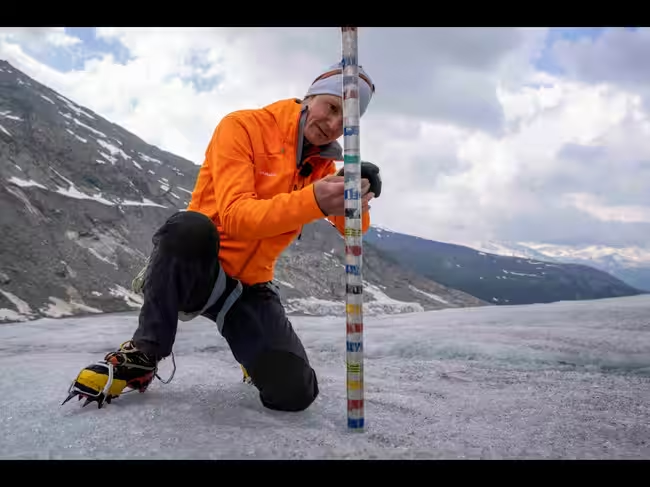
ETH (Swiss Federal Institute of Technology) glaciologist and head of the Swiss measurement network Glamos, Matthias Huss, checks the thickness of the Rhone Glacier near Goms, Switzerland, June 16, 2023. (AP Photo)
Switzerland’s largest glacier, Aletsch Glacier, suffered its biggest-ever melt this year as Swiss glaciers lost more than 5 per cent of their ice in 2026, a report by the Swiss Glacier Monitoring Network (GLAMOS) and the Swiss Commission for Cryosphere Observation of the Swiss Academy of Sciences showed on Thursday. Swiss glaciers are shrinking rapidly after suffering one of their worst years of ice loss during a record-breaking European heatwave.
The findings underscore the accelerating pace of glacier retreat as extreme melt years become routine. Over the past five years, Swiss glaciers have shed almost a fifth of their ice, the report showed, threatening future water supplies and raising questions about the long-term survival of Europe’s ice fields.
A combination of a winter with too little snow and record temperatures in the summer led to what Huss called “enormous” melting this year.
Worrying Situation
“Now we are in this new world, in this future, where glaciers are just melting away,” Matthias Huss, director of GLAMOS, said. “We are seeing extreme years almost every year now and this is really a worrying situation,” Huss said.
Still, the rate of ice loss has not yet quite reached the record highs of 2022, when dust clouds from North Africa settled on the snow and accelerated melting, Huss said.
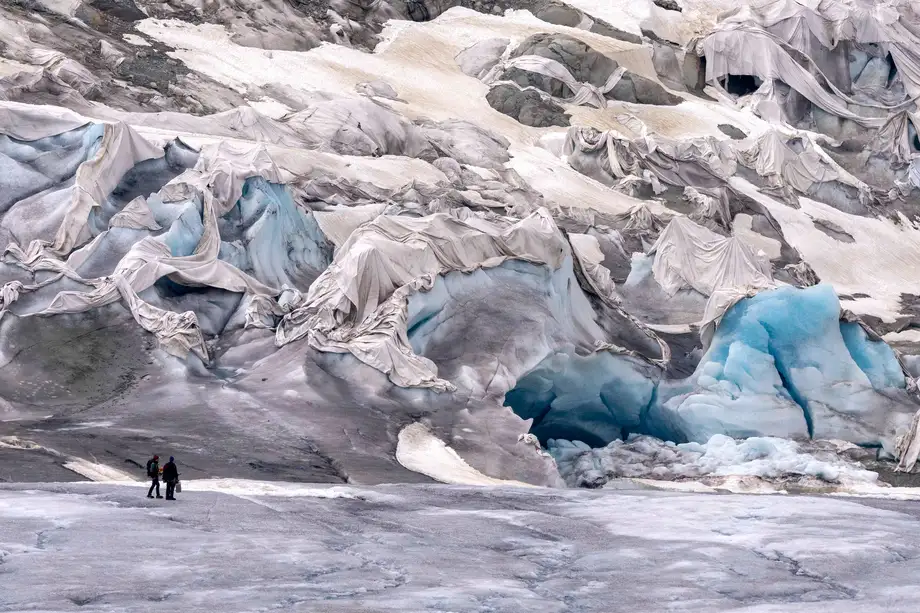
FILE — Team members of ETH (Swiss Federal Institute of Technology) glaciologist and head of the Swiss measurement network ‘Glamos’, Matthias Huss, arrive at the Rhone Glacier partially covered near Goms, Switzerland, June 16, 2023. (AP Photo/Matthias Schrader, File)
Switzerland’s Largest Glacier
Switzerland’s largest glacier, Aletsch Glacier, suffered its biggest-ever melt this year, while Glacier de Tsanfleuron lost more than four meters (13 feet) of average thickness. Huss said this would have been unthinkable a few years ago.
In total, the scientists estimate Swiss glaciers lost around 2.2 trillion litres of water between July and September alone, equivalent to more than four times the annual drinking water consumption of Swiss households.
That has one positive side effect: glacier melt contributes to easing summer water shortages.
But, as ice-covered areas shrink and glaciers become smaller, this benefit is decreasing, Huss said.
“It’s not that we’re surprised because we know how fast the glaciers are melting, but to see the colours of the mountains where there is no snow left, there are just these rocks,” Huss said. “It makes me sad.”
Here are some “ETs” recorded from around the U.S. the last couple of days, their consequences, and some extreme temperature outlooks, as well as any extreme precipitation reports:
Here is More Climate News from Wednesday:
(As usual, this will be a fluid post in which more information gets added during the day as it crosses my radar, crediting all who have put it on-line. Items will be archived on this site for posterity. In most instances click on the pictures of each tweet to see each article. The most noteworthy items will be listed first.)
https://bsky.app/profile/drpauldorfman.bsky.social/post/3mxbn3fu5us2x
https://bsky.app/profile/drjeffmasters.bsky.social/post/3mxckzmuxes2b