The main purpose of this blog will be to track planetary extreme, or record temperatures related to climate change. Any reports I see of ETs will be listed below the main topic of the day. I’ll refer to extreme or record temperatures as ETs (not extraterrestrials).😜
Main Topic: Wildfire Smoke Is a National Crisis, And It’s Worse Than You Think
Dear Diary. It’s now the middle of winter in the United States and Canada, so wildfires are not currently a problem. That wasn’t the case last January when the Paradise fire raged across Southern California. What will happen later in 2026 when record heat brought about by climate change raises its ugly head, drying out brush so that any spark will produce widespread conflagrations? Besides awful property damage and God forbid loss of life, if wildfires become very large as have recently happened across Canada, smoke will blanket skies and cause choking conditions across large areas on the ground.
Is wildfire smoke an increasing health threat due to climate change? You bet. I’m an asthmatic, so at times I have fought for breath due to allergies and bronchitis, so I have empathy for those caught in an area affected by smoke from wildfires. But it’s even worse than you might think. Here is more from Grist:
Wildfire smoke is a national crisis, and it’s worse than you think | Grist
Wildfire smoke is a national crisis, and it’s worse than you think
Greenhouse gas and particulate emissions from fires globally may be 70 percent higher than once believed.
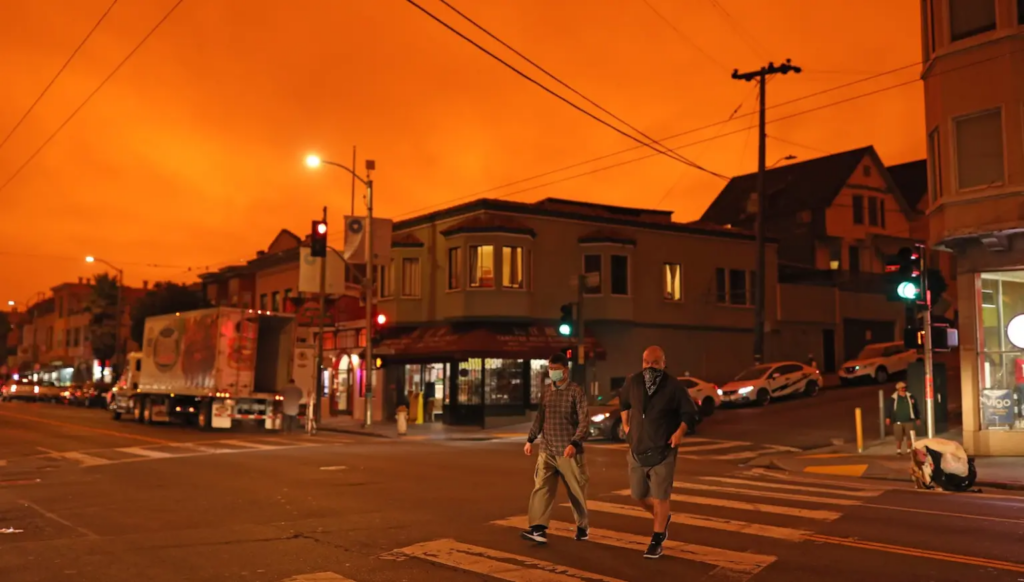
Santiago Mejia / The San Francisco Chronicle via Getty Images
Matt Simon Senior Staff Writer
Published Jan 02, 2026
Wildfire smoke is an emerging nationwide crisis for the United States. Supercharged by climate change, blazes are swelling into monsters that consume vast landscapes and entire towns. A growing body of evidence reveals that these conflagrations are killing far more people than previously known, as smoke travels hundreds or even thousands of miles, aggravating conditions like asthma and heart disease. One study, for instance, estimated that last January’s infernos in Los Angeles didn’t kill 30 people, as the official tally reckons, but 440 or more once you factor in the smoke. Another recent study estimated that wildfire haze already kills 40,000 Americans a year, which could increase to 71,000 by 2050.
Two additional studies published last month paint an even grimmer picture of the crisis in the U.S. and elsewhere. The first finds that emissions of greenhouse gases and airborne particles from wildfires globally may be 70 percent higher than once believed. The second finds that Canada’s wildfires in 2023 significantly worsened childhood asthma across the border in Vermont. Taken together, they illustrate the desperate need to protect public health from the growing threat of wildfire smoke, like better monitoring of air quality with networks of sensors.
The emissions study isn’t an indictment of previous estimates, but a revision of them based on new data. Satellites have spied on wildfires for decades, though in a somewhat limited way — they break up the landscape into squares measuring 500 meters by 500 meters, or about 1,600 feet by 1,600 feet. If a wildfire doesn’t fully fill that space, it’s not counted. This new study increases that resolution to 20 meters by 20 meters (roughly 66 feet by 66 feet) in several key fire regions, meaning it can capture multitudes of smaller fires.
Individually, tinier blazes are not producing as much smoke as the massive conflagrations that are leveling cities in the American West. But “they add up, and add up big time,” said Guido van der Werf, a wildfire researcher at Wageningen University & Research in the Netherlands and lead author of the paper. “They basically double the amount of burned area we have globally.”
With the 500-meter satellite data, the previous estimate was around 400 million hectares charred each year. Adding the small fires bumps that up to 800 million hectares, roughly the size of Australia. In some parts of the world, such as Europe and Southeast Asia, burned area triples or even quadruples with this improved resolution. While scientists used to think annual wildfire emissions were around 2 gigatons of carbon, or about a fifth of what humanity produces from burning fossil fuels, that’s now more like 3.4 gigatons with this new estimate
The type of fire makes a huge difference in the emissions, too. A forest fire has a large amount of biomass to burn — brushes, grasses, trees, sometimes even part of the soil — and turn into carbon dioxide and methane and particulate matter, but a grass fire on a prairie has much less. Blazes also burn at dramatically different rates: Flames can race quickly through woodland, but carbon-rich ground known as peat can smolder for days or weeks. Peat fires are so persistent, in fact, that when they ignite in the Arctic, they can remain hidden as snow falls, then pop up again as temperatures rise and everything melts. Scientists call them zombie fires. “It really matters where you’re burning and also how intense the fire can become,” van der Werf said.
But why would a fire stay small, when we’ve seen in recent years just how massive and destructive these blazes can get? It’s partly due to fragmentation of the landscape: Roads can prevent them from spreading, and firefighters stop them from reaching cities. And in general, a long history of fire suppression means they’re often quickly extinguished. (Ironically, this has also helped create some monsters, because vegetation builds up across the landscape, ready to burn. This shakes up the natural order of things, in which low-intensity fires from lightning strikes have cleared dead brush, resetting an ecosystem for new growth — which is why Indigenous tribes have long done prescribed burns.) Farmers, too, burn their waste biomass and obviously prevent the flames from getting out of hand.
Whereas in remote areas, like boreal forests in the far north, lightning strikes typically ignite fires, the study found that populated regions produce a lot of smaller fires. In general, the more people dotting the landscape, the more sources of ignition: cigarette butts, electrical equipment producing sparks, even chains dragging from trucks.
Yes, these smaller fires are less destructive than the behemoths, but they can still be catastrophic in a more indirect way, by pouring smoke into populated areas. “Those small fires are not the ones that cause the most problems,” van der Werf said. “But of course they’re more frequent, close to places where people live, and that also has a health impact.”
Read Next
Wildfire smoke could soon kill 71,000 Americans every year
That is why the second study on asthma is so alarming. Researchers compared the extremely smoky year of 2023 in Vermont to 2022 and 2024, when skies were clearer. They were interested in PM 2.5, or particulate matter smaller than 2.5 millionths of a meter, from wildfire smoke pouring in from Quebec, Canada. “That can be especially challenging to dispel from lungs, and especially irritating to those airways,” said Anna Maassel, a doctoral student at the University of Vermont and lead author of the study. “There is research that shows that exposure to wildfire smoke can have much longer-term impacts, including development of asthma, especially for early exposure as a child.”
This study, though, looked at the exacerbation of asthma symptoms in children already living with the condition. While pediatric asthma patients typically have fewer attacks in the summer because they’re not in school and constantly exposed to respiratory viruses and other indoor triggers, the data showed that their conditions were much less controlled during the summer of 2023 as huge wildfires burned. (Clinically, “asthma control” refers to milder symptoms like coughing and shortness of breath as well as severe problems like attacks. So during that summer, pediatric patients were reporting more symptoms.) At the same time, climate change is extending growing seasons, meaning plants produce more pollen, which also exacerbates that chronic disease. “All of those factors compound to really complicate what health care providers have previously understood to be a safe time of year for children with asthma,” Maassel said.
Researchers are also finding that as smoke travels through the atmosphere, it transforms. It tends to produce ozone, for instance, that irritates the lungs and triggers asthma. “There’s also the potential for increased formation of things like formaldehyde, which is also harmful to human health. It’s a hazardous air pollutant,” said Rebecca Hornbrook, who studies wildfire smoke at the National Center for Atmospheric Research, or NCAR, but wasn’t involved in either study, though a colleague was involved in the emissions one. (Last month, the Trump administration announced plans to dismantle NCAR, which experts say could have catastrophic effects.)
As wildfires worsen, so too does the public health crisis of smoke, even in places that never had to deal with the haze before. Governments now have to work diligently to protect their people, like improving access to air purifiers, especially in schools. “This is no longer an isolated or geographically confined issue,” Maassel said. “It’s really spreading globally and to places that have never experienced it before.”
Here are some “ETs” recorded from around the planet the last couple of days, their consequences, and some extreme temperature outlooks, as well as any extreme precipitation reports:
Here is More Climate News from Saturday:
(As usual, this will be a fluid post in which more information gets added during the day as it crosses my radar, crediting all who have put it on-line. Items will be archived on this site for posterity. In most instances click on the pictures of each tweet to see each article. The most noteworthy items will be listed first.)