The main purpose of this ongoing blog will be to track planetary extreme, or record temperatures related to climate change. Any reports I see of ETs will be listed below the main topic of the day. I’ll refer to extreme or record temperatures as ETs (not extraterrestrials).😜
Main Topic: Two Major Wildfires Burn in Drought-Stricken Georgia
Dear Diary. I’ve selected today’s main subject to let all know that climate change can hit very close to home. There has been a widespread drought caused by well above average temperatures both at the surface and aloft across the southern U.S. Cold upper troughs, which typically dig into the South during the winter into the spring have not been doing so, inhibiting typical wet weather.
One of the worst drought areas has been from Southern Georgia into Florida, close to where I live in Atlanta. Drought, as we have witnessed repeated times, leads to wildfires, sone of which can be very destructive and deadly, a phenomenon that is becoming more common due to climate change. This particular drought has led to wildfires destroying dozens of homes, displacing many families.
Fortunately, a change in the weather patten will allow fronts to dip into the South, which will produce welcome rain this week. It remains to be seen whether or not wet systems get as far south as the two largest wildfires in South Georgia.
Here are details from the Guardian:
Heavy rain not ‘nearly enough’ to tame two wildfires in drought-stricken Georgia
Pineland Road fire and Highway 82 fire have destroyed over 100 homes, and are part of large number of wildfires this spring in the US south
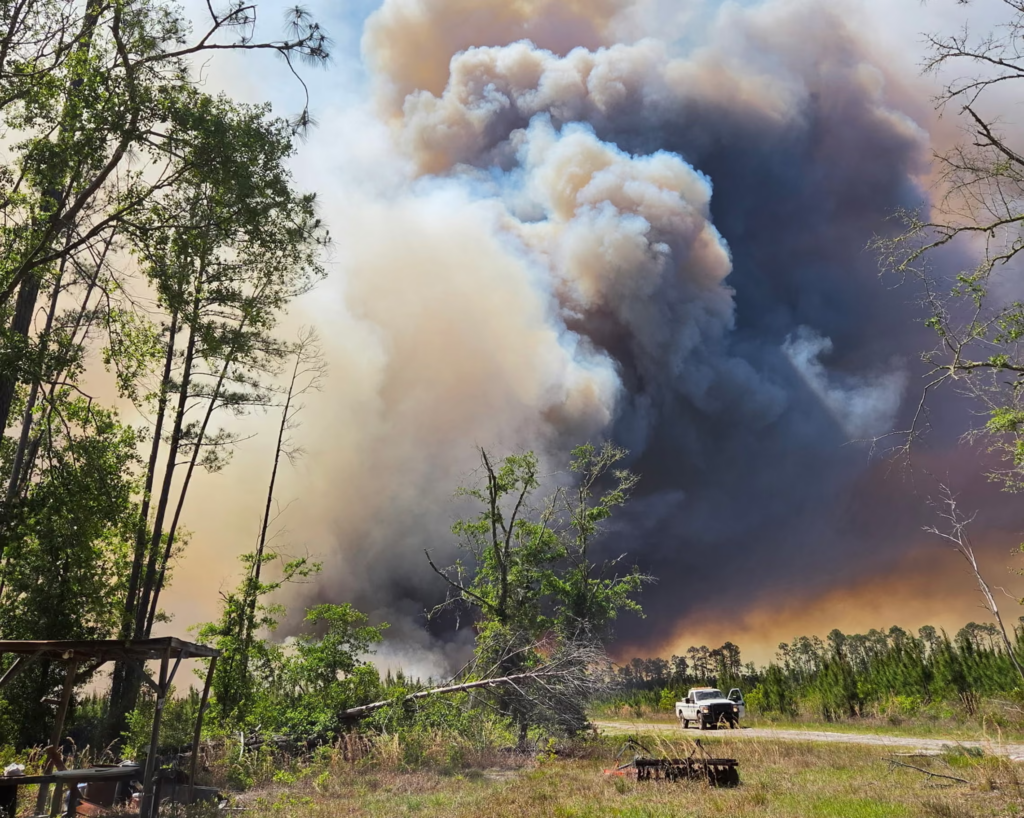
Smoke rising from the Pineland Road Fire in Clinch County, Georgia, on 20 April 2026. Photograph: Georgia Department of Natural Resources Handout/EPA
Mon 27 Apr 2026
Heavy rain slowed the progress of two sprawling southern Georgia wildfires over the weekend, allowing crews to make some progress in containing the blazes that have destroyed more than 100 homes.
Although the rain helped the firefighting efforts, it wasn’t “nearly enough to put the fires out” and crews responded to 10 new blazes throughout the drought-stricken state Sunday, the Georgia Forestry Commission said Monday.
The biggest blaze, the Pineland Road fire, has scorched more than 50 sq miles (130sq km) and at least 35 homes in a sparsely populated and heavily wooded part of the state about 35 miles (56km) north of Florida, which is also dealing with wildfires. The area has been full of highly combustible dead trees and other vegetation since Hurricane Helene carved a destructive path northward in September of 2024.
The second-biggest, the Highway 82 fire, has been burning since 20 April about 60 miles (97km) to the north-east. It has destroyed at least 87 homes and torched more than 35 sq miles (90 sq km), according to figures released Monday. It is only 6% contained.
“The fire basically doubled last night in size,” said Joey Cason, the Brantley county manager, in a Facebook post on Sunday. “It is a dynamic fire event that will be impacted by the wind.”
Authorities believe the Highway 82 blaze was sparked by a foil balloon hitting live power lines. That created an electrical arc that ignited combustible material on the ground. They think the Pineland Road fire was started by sparks from a welding operation.
An unusually large number of wildfires are burning this spring across the south-east. Firefighters have been battling more than 150 other wildfires in Georgia and Florida alone.
Scientists say the threat of fire has been amplified by a combination of extreme drought, gusty winds, the climate crisis and dead trees and other vegetation.
No fire deaths or injuries have been reported in Georgia. But in northern Florida, Nassau county sheriff’s office volunteer firefighter James “Kevin” Crews died on Thursday evening after he had an unspecified medical emergency while suppressing a brush fire.
Here are some “ETs” recorded from around the U.S. the last couple of days, their consequences, and some extreme temperature outlooks, as well as any extreme precipitation reports:
Here is More Climate News from Monday:
(As usual, this will be a fluid post in which more information gets added during the day as it crosses my radar, crediting all who have put it on-line. Items will be archived on this site for posterity. In most instances click on the pictures of each tweet to see each article. The most noteworthy items will be listed first.)