The main purpose of this ongoing blog will be to track planetary extreme, or record temperatures related to climate change. Any reports I see of ETs will be listed below the main topic of the day. I’ll refer to extreme or record temperatures as ETs (not extraterrestrials).😜
Main Topic: More Proof That Global Heating Is Upsetting Natural Rhythms
Dear Diary. Many times, climate change denial people will point falsely that thermometer readings worldwide have been reading higher due to their bring located near cities, which are expanding, creating stronger urban heat island effects. That’s not true of course because meteorological stations are also located across smaller towns and in rural areas.
Nature does provide another way to see how global warming trends are behaving via when flowers blossom and plants begin to grow leaves. In the U.S. we have seen remarkable early bloomers due to a record warm March into April:
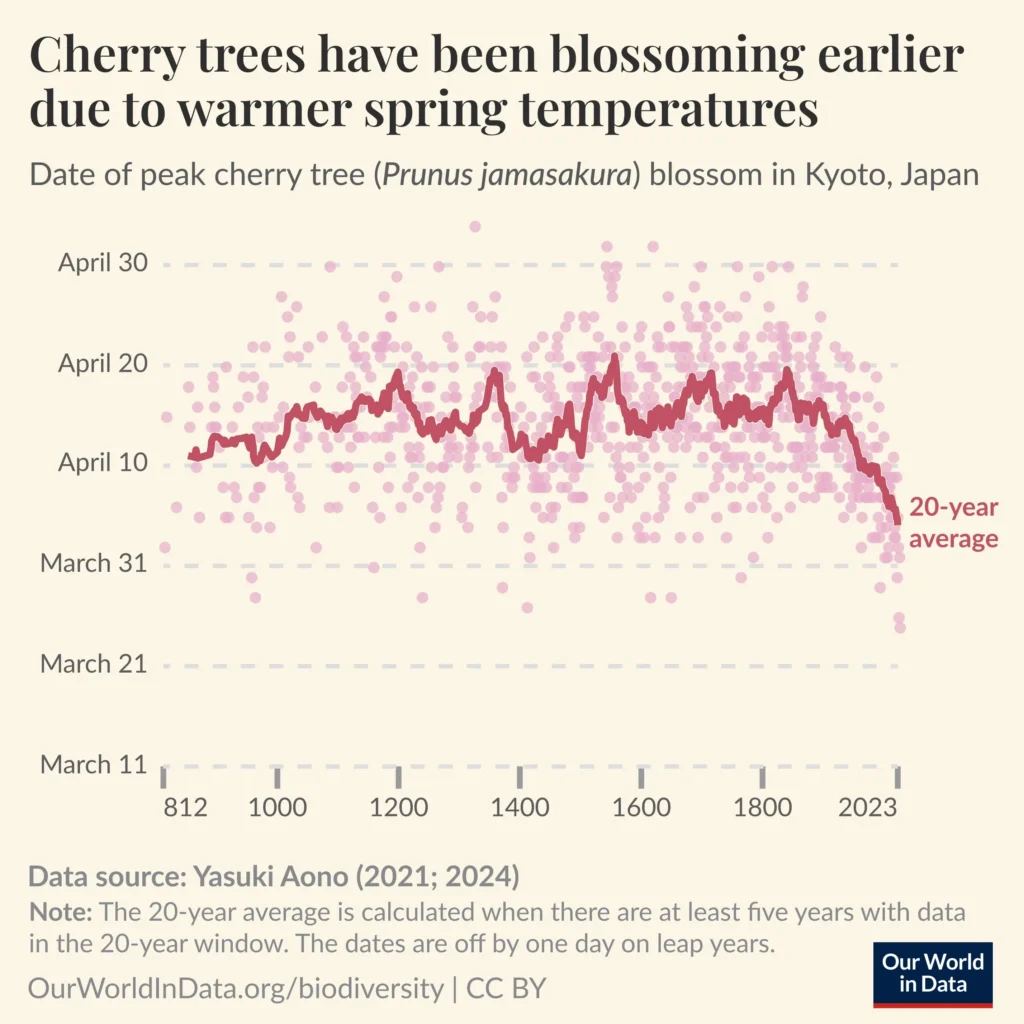
A very long standing dataset is the arrival of Japan’s cherry blossoms. This chart is one that climate deniers have a hard time explaining:
Here are more details from the Guardian:
The Guardian view on Japan’s cherry blossom: when spring slips out of time
A 1,200-year dataset shows the ‘peak bloom’ is arriving earlier. Global heating is unsettling nature’s rhythms – and their cultural meaning
Sun 19 Apr 2026
Apicture posted on social media last April by Prof Yasuyuki Aono of a spreadsheet, with its blank row for 2026, carries a quiet poignancy. Prof Aono died before he got to fill in this year’s entry for when the cherry blossom fully bloomed in Kyoto. The academic had spent decades reconstructing dates of flowering that go back to the ninth century. His work illuminated how a botanical event long associated with the Japanese idea of mono no aware – a sadness at the passing of things – is shifting because of the climate crisis.
The “peak bloom” now occurs around two weeks earlier than in previous centuries. In the 1820s full bloom arrived in mid-April. In 2023 the full-flowering date was 25 March. An earlier blooming indicates warmer springs – and Prof Aono’s data provides a warning signal that Japan’s “sakura front” comes sooner each year.
But this change is more than just a biological response to rising temperatures. In Japan, it threatens to disrupt what the seasons mean. Springtime arrives with hanami – weeks of picnics and petals – as the blossom sweeps north from Okinawa to Hokkaido in a blaze of pink and white.
The timing matters beyond the aesthetic. Japan’s tourism industry relies on the $9bn a year generated by cherry blossom season. Such is the craze in the country that a town near Mount Fuji cancelled this year’s festivities because it was being overrun by visitors in search of “Instagrammable” spots.
Prof Aono’s work suggested that March temperatures in Kyoto have risen by several degrees since the early 19th century – enough to shift peak bloom by weeks rather than days. His records suggest that this century is much hotter than previous ones. The pattern is not unique to Japan. Since 1921, the US has recorded peak bloom dates for the cherry trees Japan had given as a gift to Washington a century ago. In both cases, it has advanced by about a week.
Another researcher will now maintain and update the records. Prof Aono learned classical Japanese script to read historical documents and reconstructed centuries of bloom dates. A millennium of book-keeping sounds permanent. But it depends on decades of effort by individuals whose lives are finite.
The information ultimately rests on a 1939 effort to compile a chronology: the seamless 1,200‑year dataset began as a painstaking act of archival recovery. By 1956 a Japanese meteorologist, Hidetoshi Arakawa, had made an intellectual leap. Writing about Kyoto’s cherry blossoms, he argued that the dates of their flowering were more than cultural markers of spring: they were climate records. By the late 1960s researchers had expanded the dataset and used it to analyse long‑term trends.
To the Japanese, the flowering cherry has always been more than a plant and its significance has been woven into the fabric of their history. In the 10th-century masterpiece The Tale of Genji, arguably the world’s first novel, there’s a whole chapter on the cherry-blossom festival staged in the imperial palace. Nine centuries later the Meiji restoration of rapid industrialisation promoted it as a symbol of both modernity and loyalty to the emperor. Disputes over the blossom’s origin periodically burst open in east Asia. The stakes could not be higher. Earlier blooms due to global heating risk breaking the natural rhythms that give meaning to sakura’s fleeting beauty.
Here are some “ETs” recorded from around the U.S. the last couple of days, their consequences, and some extreme temperature outlooks, as well as any extreme precipitation reports:
Here is More Climate News from Friday:
(As usual, this will be a fluid post in which more information gets added during the day as it crosses my radar, crediting all who have put it on-line. Items will be archived on this site for posterity. In most instances click on the pictures of each tweet to see each article. The most noteworthy items will be listed first.)