The main purpose of this ongoing blog will be to track planetary extreme, or record temperatures related to climate change. Any reports I see of ETs will be listed below the main topic of the day. I’ll refer to extreme or record temperatures as ETs (not extraterrestrials).😜
Here is a new feature for this blog, which I will add daily. This is the latest inciteful Green News Report from my friends Desi Doyen and Brad Friedman at Progressive Voices. Hit ‘continue reading,’ listen, then hit return to see my daily topics:
Main Topic: Americans Are Increasingly Pessimistic About Avoiding the Worst Effects of Climate Change
Dear Diary. Speaking of climate culture wars written about in yesterday’s diary, one group of people, the Democrats, are becoming increasingly agitated that not enough is being done to avoid the worst effects if climate change. Meanwhile Republicans insist that there is no climate problem and due to our democratic system are impeding necessary action. Ironically, China’s autocratic system is allowing great changes to be made to try to prevent climate catastrophe.
Obviously, warnings from climate scientists like Dr. Michael Mann have educated most Americans on the perils of doing nothing about climate change. Yet we have another problem. Doomerism on climate with the idea that not enough can be done, so why bother, is simply wrong. Each tick of preventing another rise of .1°C above preindustrial conditions for global averages is a victory.
So, what are Americans thinking on climate as of mid 2026? Here are some answers from pewresearch.org:
Growing Pessimism Among Americans on Climate Change | Pew Research Center
|May 28, 2026
Americans Are Increasingly Pessimistic About Avoiding the Worst Effects of Climate Change
Democrats are much more likely than Republicans to perceive harms from climate change
By Brian Kennedy and Isabelle Pula
(Trekandshoot/Getty Images)
Key takeaways:
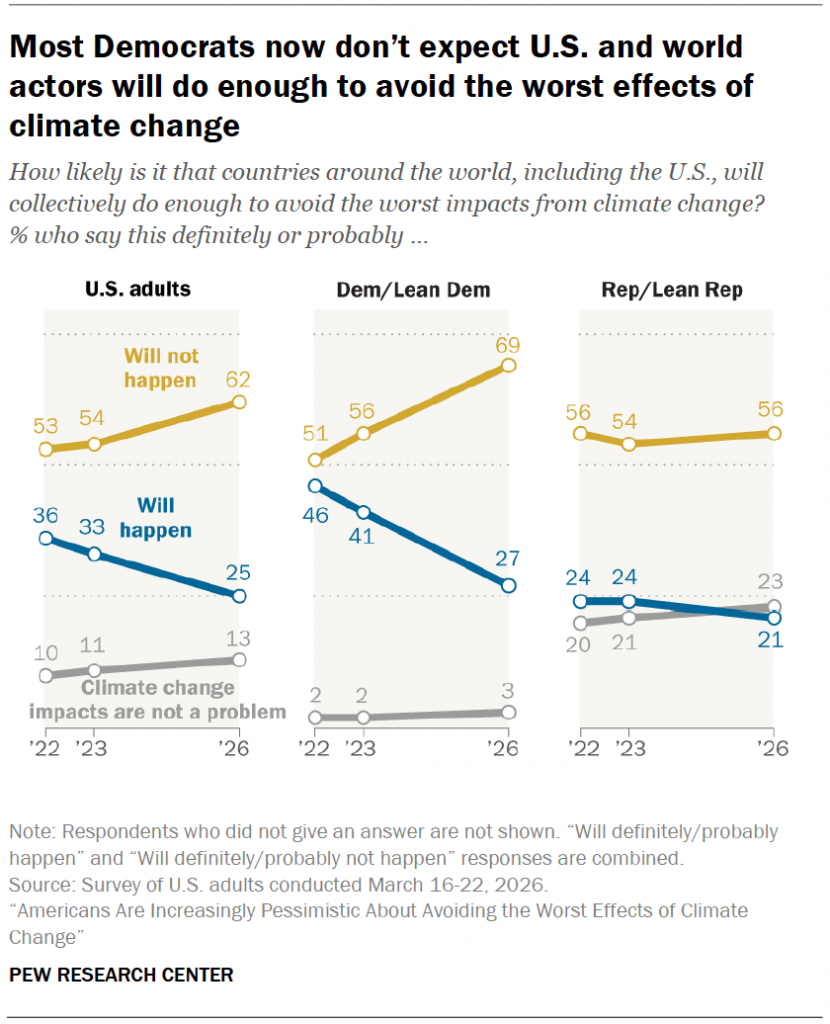
- About six-in-ten Americans say countries around the world, including the U.S., will not do enough to avoid the worst effects of climate change. Among Democrats, this share has increased from 51% in 2022 to 69% in 2026.
- About half of U.S. adults say tech companies can do a lot to address climate change, but few expect technology to actually solve problems caused by climate change in the future.
- A majority of Americans, especially Democrats, say the federal government is doing too little on climate change. This overall share is slightly higher than it was during the Biden administration.
A majority of Americans think climate change is a very big or moderately big problem for the country, including almost all Democrats and Democratic-leaning independents. But just one-quarter of adults now say international actors will do enough to avoid the worst effects of climate change – while a clear majority say the opposite. This growing pessimism is driven by Democrats.
Four years ago, during the Biden administration, Democrats were more closely split on whether the United States and other countries will do enough to avoid the worst impacts from climate change (46% said this will happen, 51% said it will not). Most Democrats now predict the U.S. and other countries will not do enough (69%).
This increasing pessimism comes at a time when the Trump administration has dramatically reshaped federal climate policy by taking actions such as withdrawing from international climate agreements, weakening limits on power plant emissions and weakening fuel efficiency standards.
These findings come from a Pew Research Center survey of 3,524 U.S. adults conducted March 16-22, 2026. This research builds on our long-standing work related to Americans’ views of climate change, the environment and extreme weather.
How big of a problem is climate change, and what should be done about it?
Republicans and Democrats remain deeply divided about how big a problem climate change is, how much harm it’s causing and how to address it.
Most Democrats and Democratic leaners (68%) say climate change is harming people in the U.S. a great deal or quite a bit. And about six-in-ten also say climate change is a very big problem facing the country today.
In contrast, only about two-in-ten Republicans and GOP leaners (22%) say climate change is harming people in the U.S. a great deal or quite a bit. And a majority see climate change as no more than a small problem.
Partisans also remain divided in how much they think the federal government is doing on climate change: 87% of Democrats say it’s doing too little, compared with 31% of Republicans. This gap has been wide – spanning at least 51 percentage points – since we started asking about the federal government’s role in 2018.
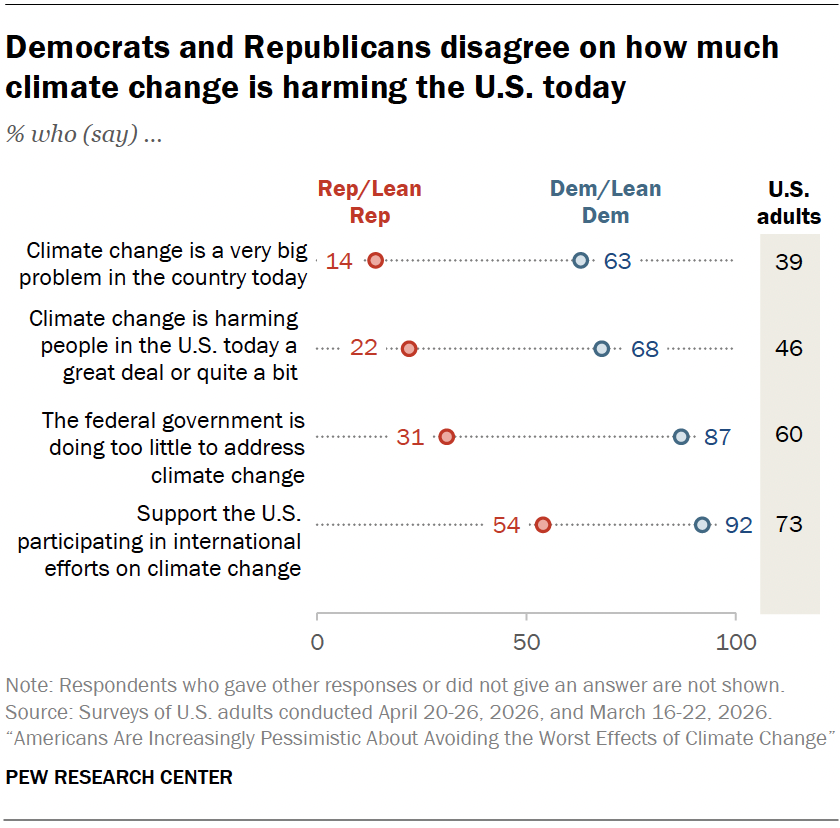
Although many Republicans are unconcerned about climate change, they show some openness to the U.S. working with other countries to address it. For example, 54% of Republicans today support the U.S. participating in international efforts on climate change, consistent with past Center surveys.
Younger and older Republicans differ on climate change
Younger Republicans see more harm in climate change and are more open to efforts to address it, compared with older Republicans.
- 31% of Republicans under 30 say climate change is harming the U.S. a great deal or quite a bit, and another 37% say it is harming the country some. In contrast, a majority of Republicans ages 50 and older (57%) say climate change is harming the country only a little or not at all.
- 48% of Republicans under 30 say the federal government is doing too little on climate change, compared with 21% of Republicans ages 50 and older.
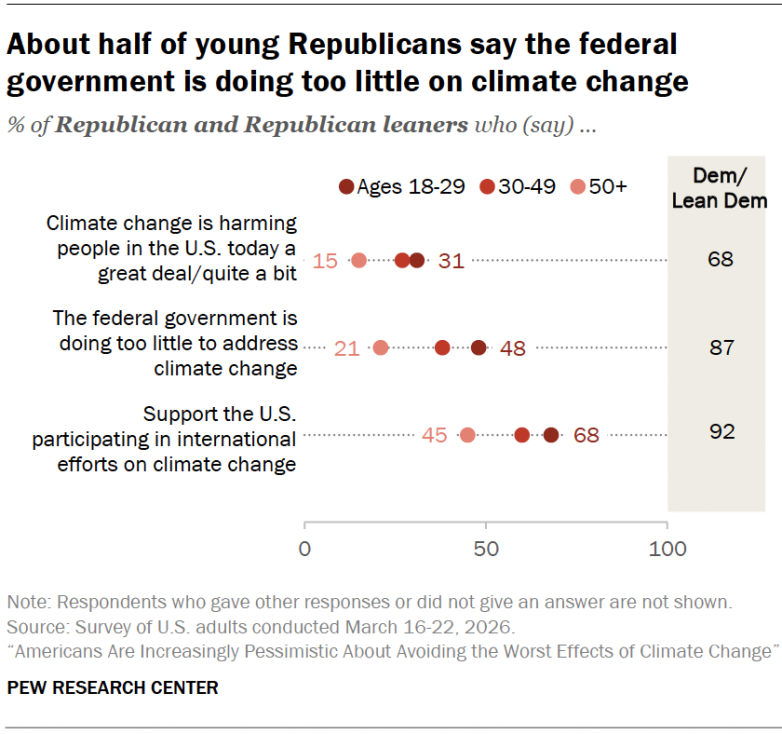
These age differences are consistent with past Center surveys. We’ve also found that younger Republicans are less supportive of fossil fuel energy sources than older Republicans.
Who can do the most to address climate change?
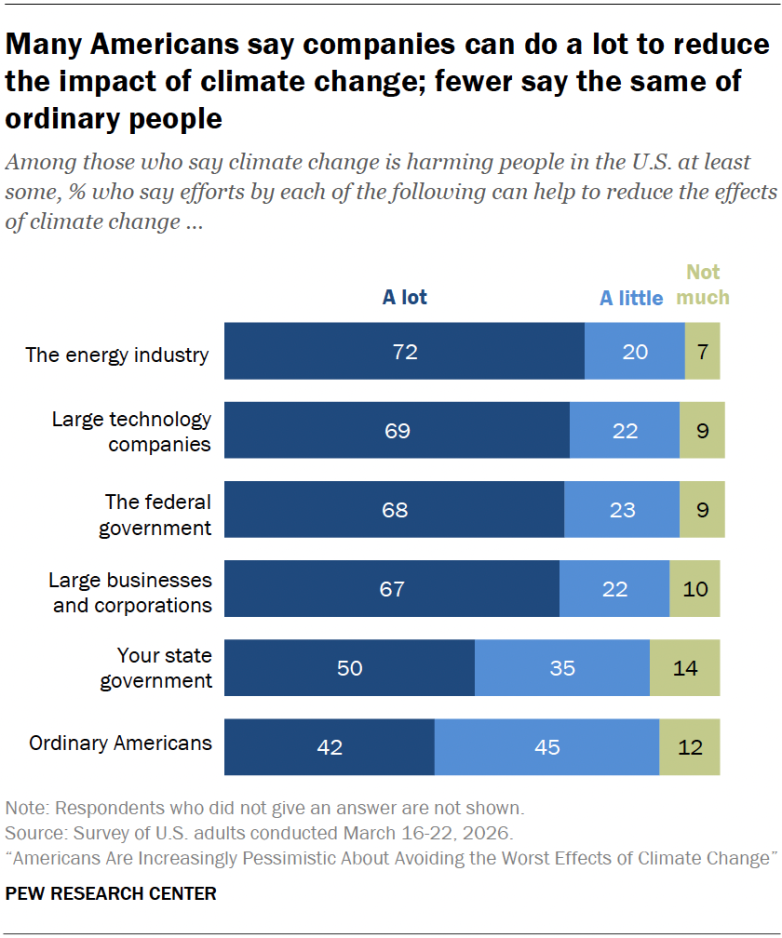
The survey asked the roughly three-quarters of U.S. adults who say climate change is causing at least some harm to the country how much certain actors can do to address its effects.
Most of these Americans say big businesses and corporations – including energy and technology companies – and the federal government can make a big difference. They are far less likely to say ordinary Americans can make a big difference.
Among those who say climate change is harming the U.S. at least some, Democrats are more likely than Republicans to say each of the groups we asked about can do a lot to reduce the effects of climate change.
The biggest difference between Democrats and Republicans is on the federal government (80% vs. 48%).
Even with these partisan gaps, more than half of Republicans who see harm from climate change say the energy industry and large technology companies can do a lot.
Can new technology address problems caused by climate change?
Experts increasingly talk about technological innovations that could address the effects of climate change. But thinking 30 years into the future, Americans are far more likely to say lifestyle changes will be needed to tackle these issues instead.
Among U.S. adults who say climate change is harming the country at least some, half think it is extremely or very likely that major changes to everyday life will be needed to address most of the problems caused by climate change.
Only two-in-ten say it is extremely or very likely that new technology will address most of the problems caused by climate change. A larger share (35%) say it is not too or not at all likely that technology will address these problems in the coming decades.
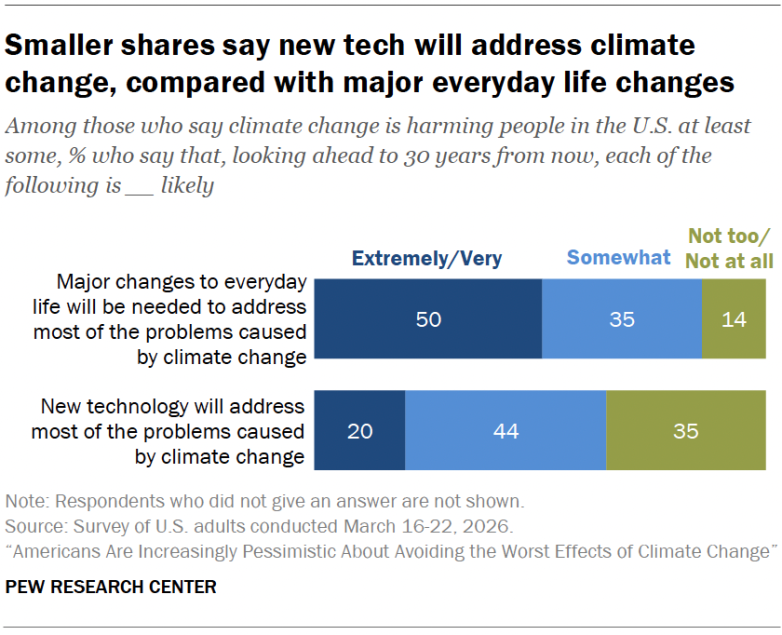
Democrats are more likely than Republicans to expect major lifestyle changes will be needed (58% vs. 38% among those who say climate change is harming people in the U.S. at least some). Partisans largely agree that it’s not extremely or very likely new technology will address most problems caused by climate change.
How much is the federal government doing on environmental protection?
The second Trump administration has moved to weaken environmental protections. Its actions since 2025 include rolling back air pollution regulations and proposing limits to waterway protections, as well as increasing access to federal lands for fossil fuel development and mining.
Majorities of Americans say the federal government is doing too little on certain aspects of environmental protection, such as preserving water and air quality and reducing the general effects of climate change.
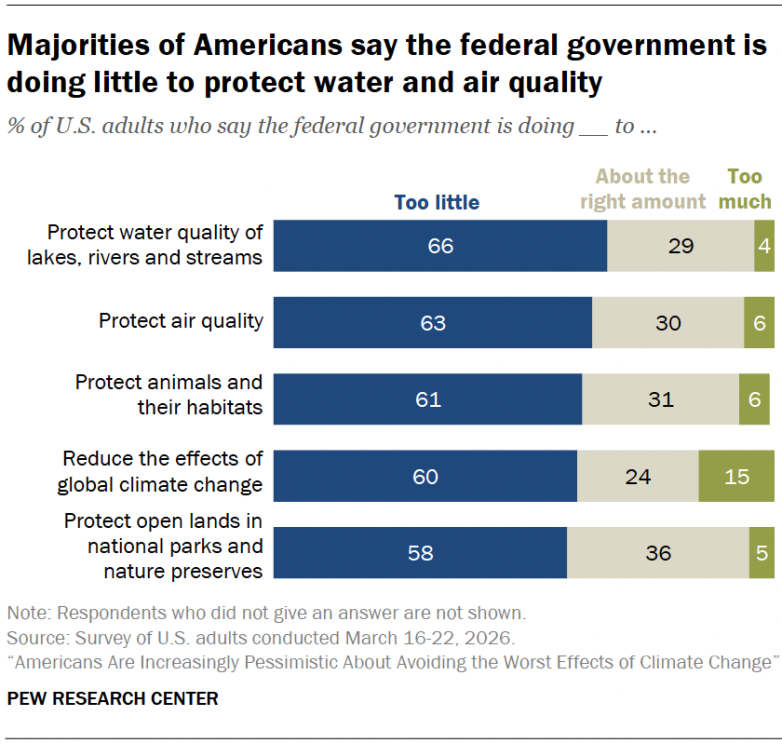
These shares are all modestly higher than they were during the Biden administration, increasing 3 to 10 percentage points each. The changes are driven mostly by the growing shares of Democrats who say the federal government is doing too little in these areas.
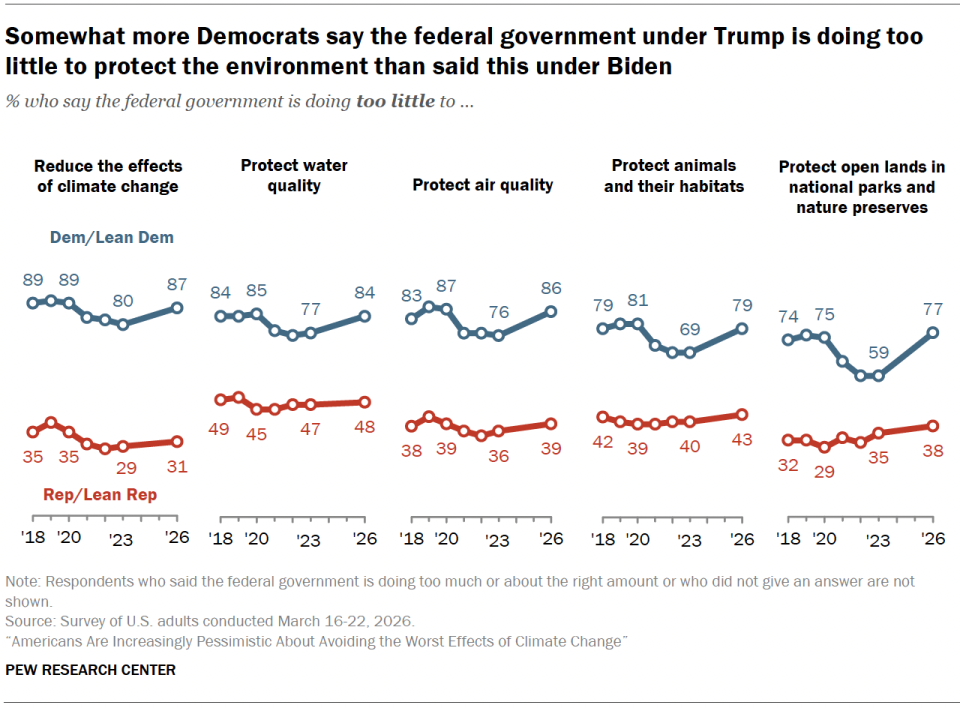
Democratic views of the federal government’s current role in environmental protection are roughly similar to what they were during the first Trump administration. (Majorities of Democrats said that the federal government was doing too little in these areas during the Biden administration as well).
Republican views are also broadly similar to the first Trump administration, though they are now a little more likely to say the federal government is doing too little to protect open lands in national parks and nature preserves.
Here are some “ETs” recorded from around the U.S. the last couple of days, their consequences, and some extreme temperature outlooks, as well as any extreme precipitation reports:
Here is More Climate News from Monday:
(As usual, this will be a fluid post in which more information gets added during the day as it crosses my radar, crediting all who have put it on-line. Items will be archived on this site for posterity. In most instances click on the pictures of each tweet to see each article. The most noteworthy items will be listed first.)