The main purpose of this ongoing blog will be to track planetary extreme, or record temperatures related to climate change. Any reports I see of ETs will be listed below the main topic of the day. I’ll refer to extreme or record temperatures as ETs (not extraterrestrials).😜
Here is a new feature for this blog, which I will add daily. This is the latest inciteful Green News Report from my friends Desi Doyen and Brad Friedman at Progressive Voices. Hit ‘continue reading,’ listen, then hit return to see my daily topics:
Main Topic: More Reports from European Heatwave Drogon
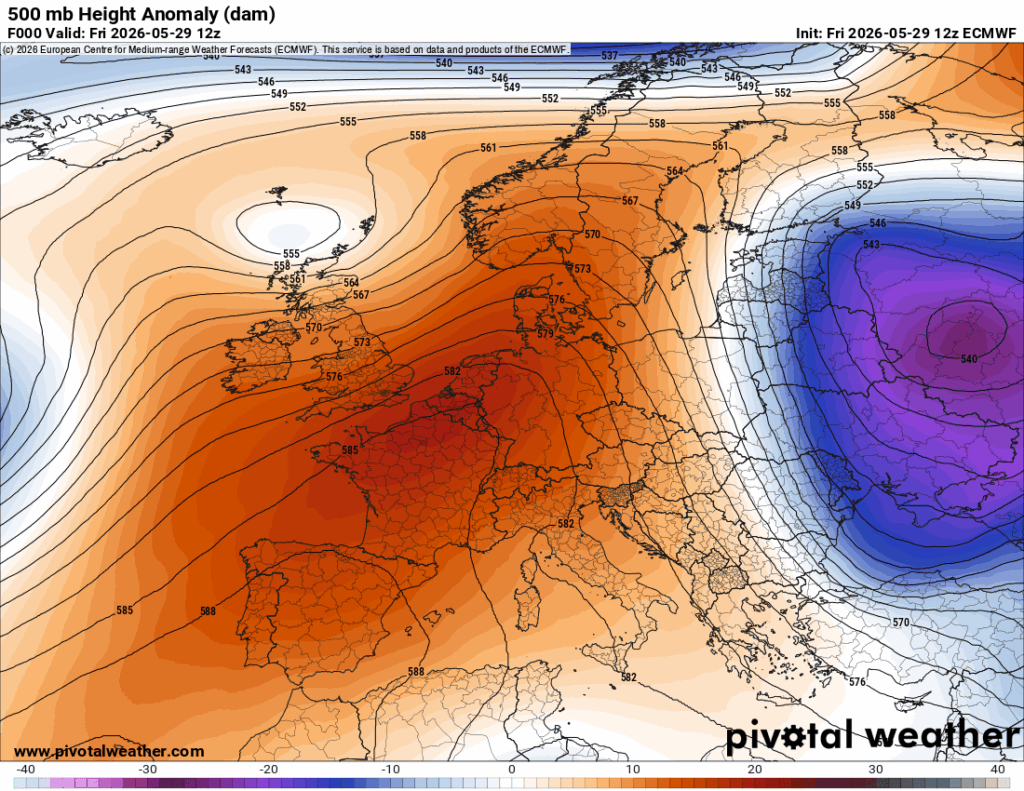
Dear Diary. The heatwave that has been roasting Europe has been intense enough to garner a name from yours truly. Across the pond, I have been using dragon names the last few years, so let’s continue with this method by naming this episode Drogon. Drogon was one of Daenerys Targaryen’s dragons in Game of Throne and is named after Khal Drogo. As the largest and fiercest of her dragons, Drogon plays a pivotal role in her journey to reclaim the Iron Throne.“Drogon’s flames, hot enough to melt stone, were the fire of vengeance and freedom, consuming all in their path.”—A Game of Thrones, George R.R. Martin
Drogon is a historic CAT4 in my book because when the number of deaths from this heat episode are tallied, that number will probably be between 100 and 1000 people. If the tally goes over 1000 fatalities, we will have another catastrophic CAT5 on our hands.
Thankfully, the heat dome in association with Drogon is coming down, so heat levels continent wide are moderating:
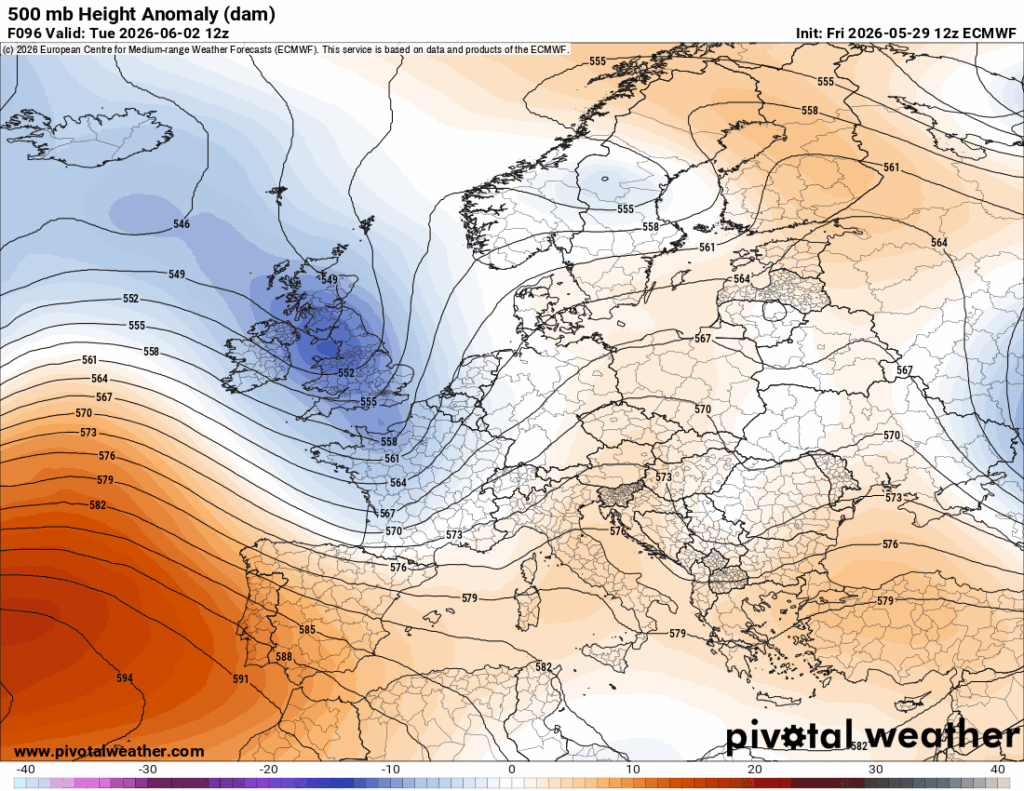
Drognan will be slain by an upper level trough by this coming Tuesday:
Here are more hot historic stats in association with Drogan as compiled by Bob Henson writing for Yale Climate Communications:
Western Europe is roasting in unprecedented spring heat – and it’s not alone
Climate scientist Christophe Cassou said the heat in France would have been virtually impossible in the preindustrial era.

by Bob Henson
May 27, 2026

A woman drinks water at the Elizabeth Tower, commonly known as Big Ben, in London, Tuesday, May 26, 2026. Temperatures in the London area topped 95 degrees Fahrenheit, the hottest May reading ever observed in the United Kingdom. (Image credit: AP Photo/Kin Cheung)
Astounding, summer-like heat is painting an ominous global picture as May 2026 draws to a close. One big headline-grabber this week has been the historic late-spring heat wave in and around Western Europe, which has pushed readings above 95 degrees Fahrenheit as far north as London. And dangerous early summer heat has also spread across many other parts of the Northern Hemisphere.
“This is an unprecedented event with a one in 1,000 chance of happening at this time of year in the climate of 1979 to 2025,” climate scientist Christophe Cassou told Le Monde, referring to the heat wave in France. “It would have been virtually impossible in the preindustrial era.”
Record-melting heat from Morocco to Ireland
A strong ridge of high pressure above Western Europe has kept skies largely clear, and the sinking air associated with the high warms as it descends. It’s a classic setup for early season heat, especially with sunshine already stronger than it is in early August.
What’s distressing is that millions of people have experienced not just a garden-variety May warm spell, but heat that’s gone beyond anything observed before June. This tableau has included record daytime heat as well as absurdly out-of-season “tropical nights,” when the temperature fails to drop below 68°F or 20 degrees Celsius. It’s eerily reminiscent of the epic late-March heat wave that brought summerlike heat across the central and western United States, pummeling hundreds of monthly records.
The heat wave arrived late last week in Spain, where residents are a bit more accustomed to hot weather in May. Record heat also extended across the Mediterranean, where the city of Taza, Morocco, had a daily minimum of 29.3°C (84.7°F), the highest ever recorded in that nation during May.
Some of the most premature and awful heat in Western Europe has struck France, where at least seven heat-associated deaths, including five drownings, had been reported as of Tuesday, May 26. Because many heat-related deaths are indirect (such as from heart attacks and strokes, which become a greater risk during heat waves), it can take weeks to months to assess how many “excess deaths” occurred during a particular stretch of heat.
France’s four-tier heat warning system – adopted in 2004, a year after the catastrophic heat wave that took an estimated 70,000-plus lives in Europe – was designed to be activated between June 1 and September 30. But on Wednesday, Meteo France had parts of west and northwest France at the second-highest warning level, orange. It’s the first time the system has ever been activated in May.
Across the British Isles, where average late-May highs stay below 70 degrees Fahrenheit, the heat has been especially bizarre. The highest temperature ever recorded in the United Kingdom during May – 32.8°C (91°F), set in 1922 and 1944 – was exceeded by a full 2 degrees Celsius (3.6°F) on Monday, May 25, when Kew Gardens in London rocketed to 34.8°C (94.6°F). And even that astonishing record fell just a day later, when Kew Gardens soared to 35.1°C (95.2°F) on Tuesday.
In an eye-opening case of synchronicity, a paper published last year in the British journal Weather estimated that the odds of breaking the UK’s 1922 and 1944 heat record for May had been boosted about three times by human-caused climate change, transforming a one-in-100-year event to a one-in-33-year event.
Led by the UK Met Office climate scientist Rebecca Holliday, the paper also noted that the record-warm May of 2024 didn’t seem that warm to many Britons, since there was no single heat wave on par with the current one. Instead, the month was largely wet, mild, and “dull.” According to Holliday and coauthors, this led to widespread surprise at the news of May’s overall record warmth: “much social media response around the subject was of disbelief …underlining that there can at times be surprising disconnects between objective climate statistics and human perception.”
As Holliday told Yale Climate Connections, “We started writing the study back in 2024 (80 years after the 1944 record), and at the time it felt unlikely that anything near 32°C would be felt.”
That’s the record that fell this week.
But this month is unlikely to be record-setting as a whole for the UK. As Holliday explained, “The first heat of the year is often the most notable in terms of perception and health impacts, but I think this one has been particularly noticeable because of the temperatures being cooler than average up until this point.”
Along with England, all-time national May records were broken on Monday for Wales (32.2°C at Clwyd) and for Ireland at multiple stations, including Killarney (29.1°C/84.4°F) and Shannon Airport (28.6°C/83.5°F). In turn, these were broken on Tuesday for Wales (32.9°C/91.2°F at Cardiff) and Ireland (30.6°C/87.1°F at Shannon).
The airport at Jersey – one of the Channel Islands, a UK territory between England and France – hit 32.6°C (90.7°F) on Monday. Some locations in the islands broke records not only for any May but for any June, said weather records expert Maximiliano Herrera, who has been documenting the last few days of records in exhaustive detail on Bluesky.
Remarkably widespread late-May heat elsewhere in the Northern Hemisphere
Getting less attention than Western Europe are many other areas north of the equator now suffering through unusually intense heat in these final days of meteorological spring (March through May).
Across parts of the northern tropics and subtropics that get midyear rainy seasons – including southern and eastern Asia and countries bordering the Caribbean – May is often the hottest and driest time of the year. But this year, the pre-monsoon heat has been especially vicious in many locations.
Across southeast China, more than 150 stations have set records for their warmest daily minimums ever observed in May. And northern India’s normally torrid spring has been even hotter than usual: New Delhi had its hottest May night in 14 years on Monday, May 26, only managing to dip to 32.4°C (90.3°F). The summer monsoon in and around India is predicted to deliver below-average rainfall in 2026, in part because of the developing El Niño.
In many places, the lack of nighttime relief has been particularly severe. On Tuesday, May 26, the minimum in Kingston, Jamaica, was a steamy 28.7°C (83.7°F) – the hottest daily low on record for any time of year anywhere in Jamaica, according to Herrera. The Trinidadian town of Piarco dipped only to 26.7°C (80°F) on Tuesday, the warmest daily low ever reported in May across Trinidad and Tobago. Among other cities in the region that have experienced their highest daily minima (overnight lows) on record for any May, as reported by Herrera, are Tela, Costa Rica, at 27.4°C (81.3°F), Mazatlan, Mexico, at 28.1°C (82.6°F), and Panama City, Panama, at 29°C (84.2°F).
Even the Florida Keys have gotten in on the unwelcome action. On four days this month – including Tuesday, May 26 – Key West failed to dip below 84°F (28.9°C), which is now the hottest daily minimum ever recorded there prior to June in weather data going back to 1872. The morning low on Wednesday, May 27, was again 84°F. Key West is also on track to finish its hottest May on record, just ahead of the current record-holder of May 2024.
Read: The 2026 Southwest U.S. heat wave was one of the six most astonishing weather events of the century
How long will this go on?
The British Isles experienced a slight cooldown on Wednesday, but temperatures topped 90°F once more in much of Western Europe, including Paris. Thursday will see a rebound in the UK, with a high around 90°F predicted for London, and 80s could continue into the weekend there, with readings near or above 90°F continuing across much of France, Spain, Italy, and nearby. Many more monthly heat records can also be expected elsewhere, including China, Japan, and Korea
By next week, the heat-producing upper high will erode, and cooler air will reach Europe.
What about El Niño?
Globally averaged temperatures could set a new record high this year, and they’ll very likely do so in 2027, assuming that an imminent El Niño event is as strong and builds as quickly as models have been predicting.
But the current spate of regional heat waves is unfolding ahead of the global circulation changes that El Niño will likely spawn later this year.
Jeff Masters contributed to this post.

Bob Henson
Bob Henson is a meteorologist and journalist based in Boulder, Colorado. He has written on weather and climate for the National Center for Atmospheric Research, Weather Underground, and many freelance… More by Bob Henson
Bob Henson’s “Western Europe is roasting in unprecedented spring heat – and it’s not alone” was first published on Yale Climate Connections, a program of the Yale School of the Environment, available at: http://yaleclimateconnections.org. This work is licensed under a Creative Commons Attribution-Noncommercial-No Derivative Works 2.5 license (CC BY-NC-ND 2.5).
Here are some “ETs” recorded from around the U.S. the last couple of days, their consequences, and some extreme temperature outlooks, as well as any extreme precipitation reports:
Here is More Climate News from Friday:
(As usual, this will be a fluid post in which more information gets added during the day as it crosses my radar, crediting all who have put it on-line. Items will be archived on this site for posterity. In most instances click on the pictures of each tweet to see each article. The most noteworthy items will be listed first.)