The main purpose of this ongoing blog will be to track planetary extreme, or record temperatures related to climate change. Any reports I see of ETs will be listed below the main topic of the day. I’ll refer to extreme or record temperatures as ETs (not extraterrestrials).😜
Here is a new feature for this blog, which I will add daily. This is the latest inciteful Green News Report from my friends Desi Doyen and Brad Friedman at Progressive Voices. Hit ‘continue reading,’ listen, then hit return to see my daily topics:
Main Topic: Antarctic Ice Sensitivity Is Much Greater Than Previously Thought
Dear Diary. Every time we focus on Antarctica the climate news continues to get worse. Now it appears that its ice sheets are far more sensitive to changes in atmospheric carbon levels than previously thought. Of course, meltwater from Antarctica will greatly increase devastating sea level rise, but thus process probably will come faster according to a new study.
Here are more details via SciTechDaily:
Antarctica Suddenly Became Far More Sensitive to Climate Change 1 Million Years Ago
Antarctica Suddenly Became Far More Sensitive to Climate Change 1 Million Years Ago
By Institute for Basic Science
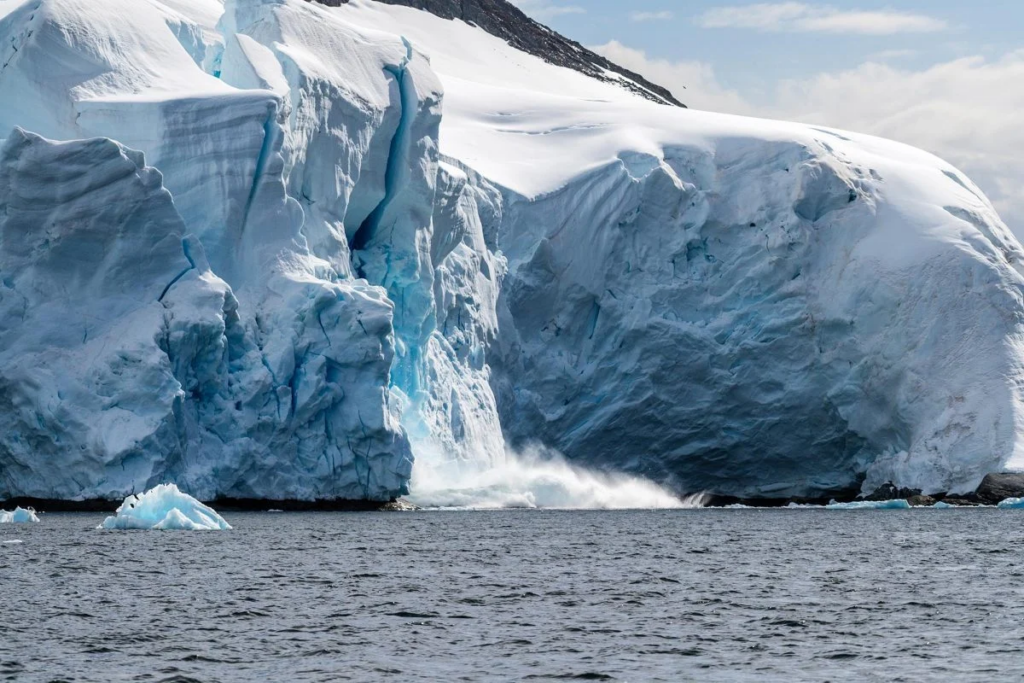
Antarctica’s vast ice sheet may have crossed a hidden climate threshold about one million years ago, fundamentally changing how it responds to shifts in Earth’s climate. Credit: Shutterstock
Scientists discovered that Antarctica’s ice sheet became dramatically more climate-sensitive after crossing a critical threshold one million years ago.
A new study published in Nature Geoscience suggests that Antarctica’s massive ice sheet underwent a major change about one million years ago, becoming far more responsive to shifts in Earth’s climate.
The research, led by scientists at the IBS Center for Climate Physics (ICCP) at Pusan National University in South Korea, offers fresh insight into how large ice sheets react to long-term climate changes and may help improve projections of future sea level rise.
Today, Antarctica contains the largest reservoir of ice on the planet and plays a crucial role in regulating global sea levels. Around one million years ago, however, Earth’s climate experienced a dramatic transformation. During this period, known as the Mid-Pleistocene Transition, ice ages became longer, colder, and more intense than before.
Although scientists have long recognized this shift, understanding exactly how the Antarctic ice sheet responded has been difficult because realistic records of ancient temperature and precipitation conditions have been limited.
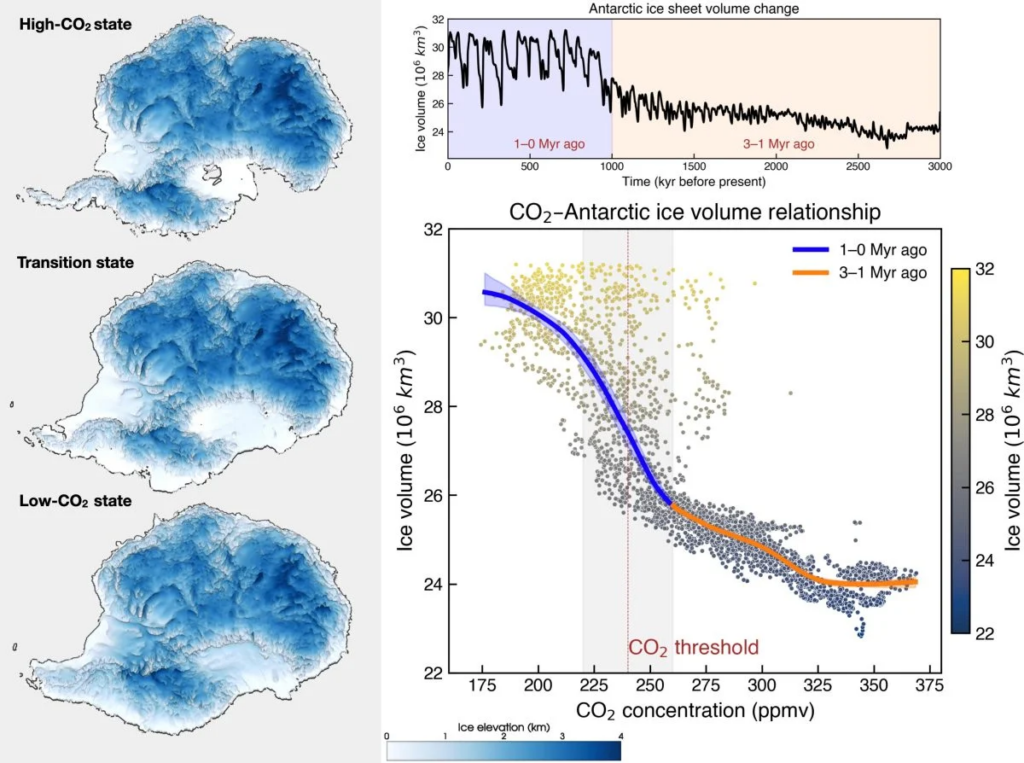
Top right panel shows the model simulation of Antarctic ice sheet volume change covering the last 3 million years. Bottom right panel represents the relationship between atmospheric CO₂ concentration and Antarctic ice volume changes. Blue and orange lines show nonlinear fits for 1-0 million years ago and 3-1 million years ago, respectively, with shaded bands indicating the 95% uncertainty range. Maps on the left show representative Antarctic ice elevation changes under high-, transitional-, and low-CO₂ states. Credit: Institute for Basic Science
Reconstructing Three Million Years of Climate History
To address that challenge, the research team relied on an advanced paleoclimate simulation recently developed at the ICCP. The model successfully recreates global climate conditions spanning the past 3 million years.
The scientists then used temperature and precipitation data from that simulation to drive the Penn State University ice-sheet–ice-shelf model. This sophisticated model tracks changes in ice sheet thickness, flow, and temperature across Antarctica and the Northern Hemisphere. It also simulates the behavior of floating ice shelves, including those in the Ross and Weddell Seas.
Running on one of South Korea’s fastest supercomputers dedicated to basic science research, the model produced a physically consistent picture of how the world’s major ice sheets evolved as climate conditions changed through time.
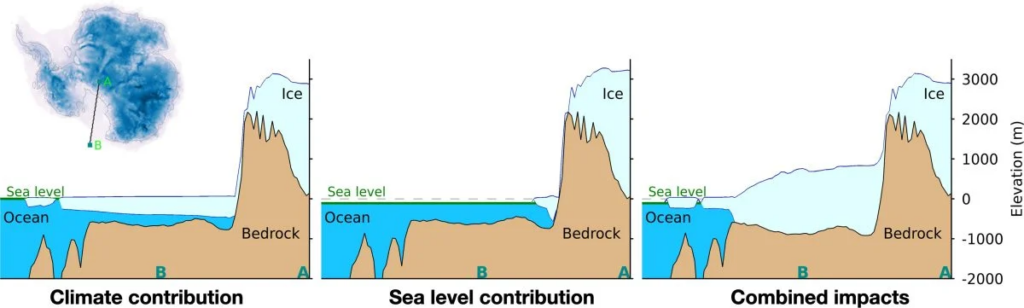
Ross Sea ice-shelf transect for low-CO₂ conditions, corresponding to high sensitivity to forcings: (left) climate contribution, (middle) sea-level contribution, and (right) combined impacts of climate and sea-level changes. Credit: Institute for Basic Science
A Critical CO2 Threshold Emerges
The simulations revealed that after the Mid-Pleistocene Transition, the Antarctic ice sheet began operating under a fundamentally different set of dynamics.
Researchers identified a key atmospheric carbon dioxide threshold of roughly 240 parts per million. When CO2 levels dropped below that value, Antarctic ice volume became much more sensitive to changes in both ocean and atmospheric temperatures. As a result, the size of the ice sheet fluctuated far more dramatically than before.
“After this transition, the Antarctic ice sheet reacts much more strongly to changes in climate forcing. This indicates that the system does not evolve gradually but instead becomes more responsive after crossing a particular threshold in the climate system,” said Dr. Kyung-Sook Yun, researcher at the IBS Center for Climate Physics and lead author of the study.
Why Antarctic Ice Grew More Rapidly
According to the simulations, several factors worked together to promote larger Antarctic ice sheets after the transition roughly one million years ago.
One factor was colder ocean temperatures during glacial periods, which reduced melting beneath portions of the Antarctic ice sheet that rest below sea level.
At the same time, global sea levels were approximately 50-100 m lower than they are today. The lower sea level reduced pressure on the bedrock beneath Antarctic ice shelves. Over time, this allowed the bedrock to slowly rise, a process that encouraged additional ice thickening along coastal regions.
Together, these mechanisms helped establish the larger and more persistent Antarctic ice sheets that characterized later ice age cycles.
Implications for Future Climate Change
The findings suggest that Antarctica may respond to climate change in a less predictable way than previously thought.
“Our findings suggest that the Antarctic ice sheet was more sensitive to external forcings than previously assumed. This also raises important questions about its future response to global warming,” said Prof. Axel Timmermann, Director of the IBS Center for Climate Physics and co-author of the study.
The researchers emphasize that ice sheets do not always respond gradually to environmental changes. Instead, they can cross thresholds that trigger abrupt shifts in behavior and dramatically alter their sensitivity to outside influences.
Understanding when and why those transitions occur is important for scientists trying to improve forecasts of future sea level rise in a warming world.
References:
“Increased sensitivity of the Antarctic Ice Sheet to decreasing CO2 across the Mid-Pleistocene Transition” by Kyung-Sook Yun, and Axel Timmermann, 28 May 2026, Nature Geoscience.
DOI: 10.1038/s41561-026-01979-2
“A transient coupled general circulation model (CGCM) simulation of the past 3 million years” by Kyung-Sook Yun, Axel Timmermann, Sun-Seon Lee, Matteo Willeit, Andrey Ganopolski and Jyoti Jadhav, 13 October 2023, Climate of the Past.
DOI: 10.5194/cp-19-1951-2023
Never miss a breakthrough: Join the SciTechDaily newsletter.
Follow us on Google and Google News.
Here are some “ETs” recorded from around the U.S. the last couple of days, their consequences, and some extreme temperature outlooks, as well as any extreme precipitation reports:
Here is More Climate News from Tuesday:
(As usual, this will be a fluid post in which more information gets added during the day as it crosses my radar, crediting all who have put it on-line. Items will be archived on this site for posterity. In most instances click on the pictures of each tweet to see each article. The most noteworthy items will be listed first.)