The main purpose of this ongoing blog will be to track planetary extreme, or record temperatures related to climate change. Any reports I see of ETs will be listed below the main topic of the day. I’ll refer to extreme or record temperatures as ETs (not extraterrestrials).😜
Dear Diary. Nasty Heatwave Koch, named for fossil fuel Koch Industries, had has been bringing excess heat to a large section of the nation starting in mid-July. Yesterday most heat advisories were dropped east of the Rockies, but Koch peaked in the West, setting many mostly daily records on Saturday:
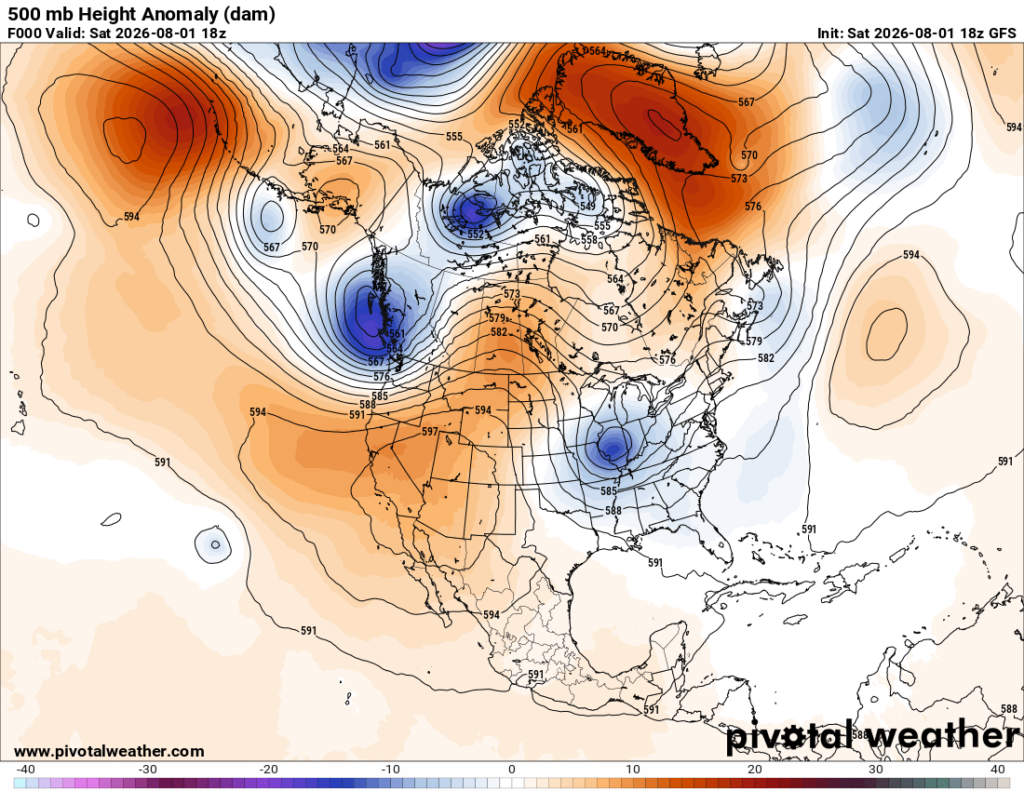
As far as the heat dome in association with Heatwave Koch goes, it had a peak on Saturday at about 598 decameters over Las Vegas:
The system will decrease to about 593 decanters on Monday but peak back at 597 decameters by Friday over the very same area:
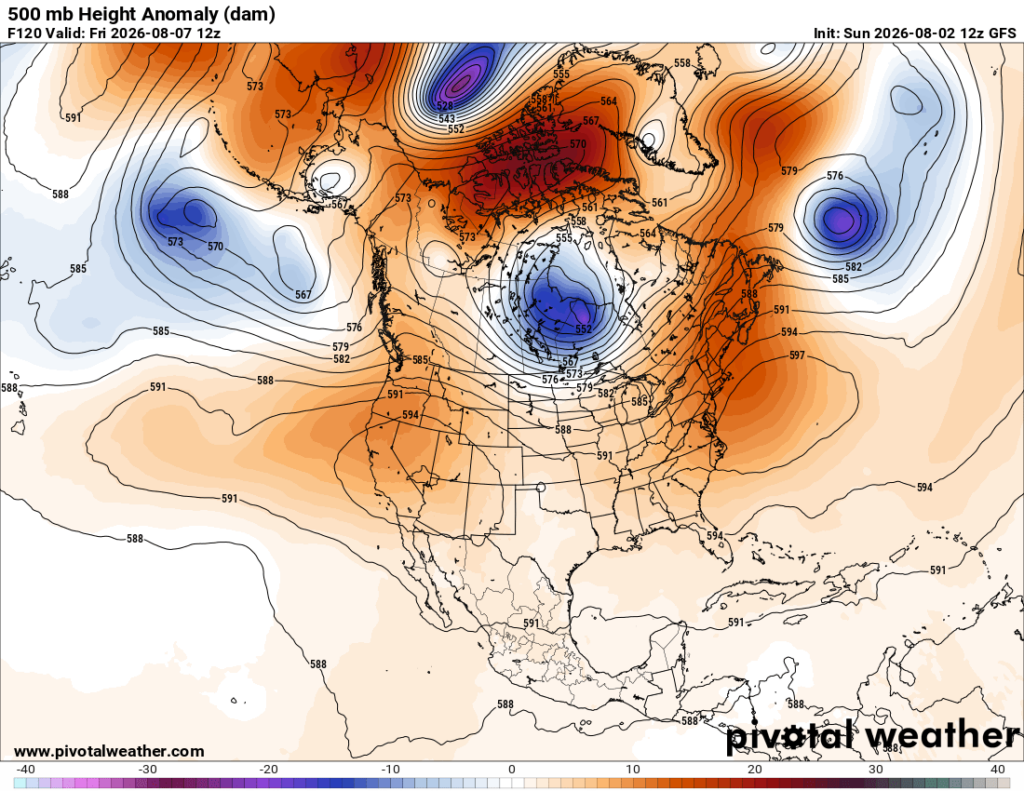
All this means is that dreadful extreme heat will continue for the Southwest the first week of August, including the big cities of Los Angeles, San Diego, Las Vegas, Phoenix, and extending eastward to Salt Lake City and Denver. Wildfires will also be a big threat for much of the West.
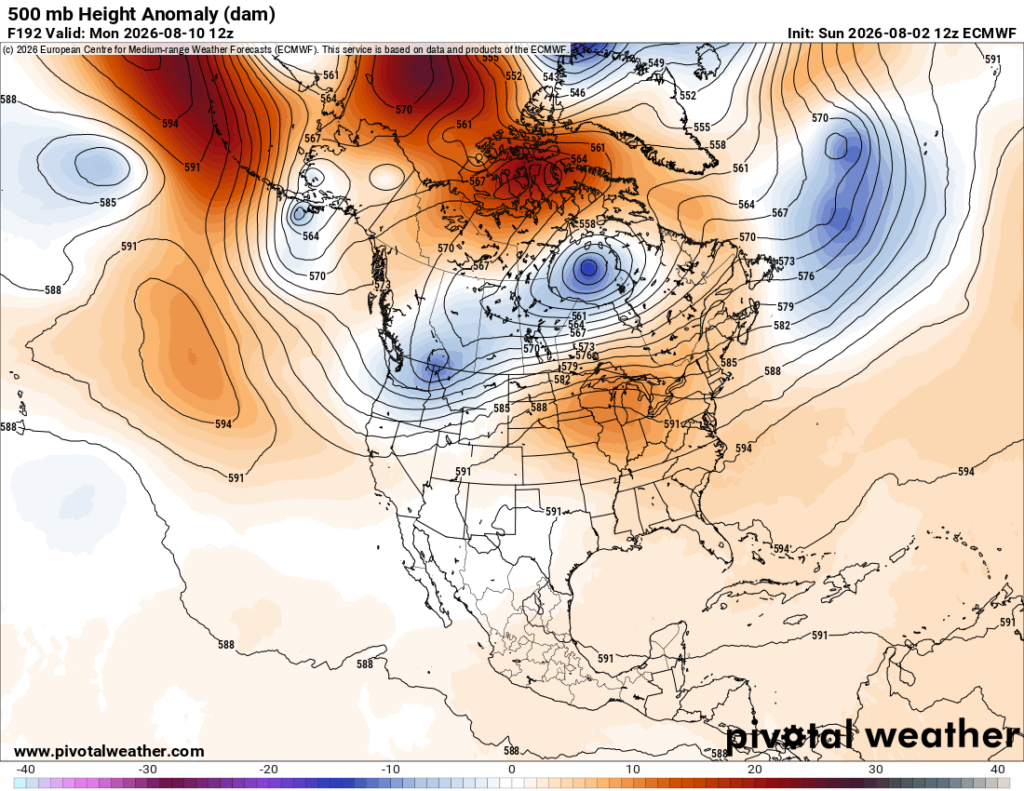
It will be interesting to see if Heatwave Koch ejects into the Plains and eastern U.S. going into mid-August:
Here are more details from the Los Angeles Times:
Western U.S. heat wave brings record temps, wildfire evacuations – Los Angeles Times
Western U.S. heat wave brings record temps to Phoenix, wildfire evacuations in Spokane

A woman fans herself in Little Tokyo on Friday amid a heatwave that broke temperature records and risked exacerbating wildfires across the Western U.S. (Arwen Clemans / Los Angeles Times)
Staff Writer Follow
Published Aug. 1, 2026 Updated Aug. 2, 2026
Yet another heat wave scorched the Western United States on Saturday, bringing extreme heat warnings to Southern California and record temperatures in the Southwest and Montana.
Wildfires erupted in the Pacific Northwest as the region faced an exceptionally rare “Particularly Dangerous Situation” warning due to extremely dry conditions and strong winds.
Phoenix reached 116 degrees Saturday afternoon, tying the region’s record for the hottest temperature ever recorded on the date Aug. 1, set in 1972, according to the National Weather Service. It was 6 degrees short of the area’s all-time record.
Las Vegas and El Centro, Calif., were within striking distance of their daily records, and both Great Falls and Helena, Mont., surpassed their daily records in preliminary measurements.
Officials in Southern California cautioned residents to look out for signs of heat-related illness, such as dizziness, confusion, headaches and nausea.
Extreme heat is one of the deadliest climate risks facing California. On the hottest days, heat-related illness can account for nearly 1 in every 100 emergency department visits in L.A. County. In 2025, the county recorded 10 heat-related deaths, according to a new dashboard.
Multiple days of high heat — with little relief overnight as temperatures remain high — can increase the risk.
“We’ve had these elevated temperatures for the last several days here, and that compounding effect can be significant,” said Rose Schoenfeld, a meteorologist with the National Weather Service. “We have some elevated humidity across the area that increases those overnight low temperatures a bit as well.”
The National Weather Service recommends limiting outdoor activity to the early hours of the day and staying in air-conditioned spaces during the afternoon and evening. It further advised residents never to leave pets or children unattended in vehicles, and to check in on loved ones.
The Pacific Northwest, which has had dozens of wildfires burning for days, saw a surge of wildfire activity Saturday afternoon into evening amid the National Weather Service’s strongest form of wildfire weather warning.
Roughly 5,000 homes have been evacuated and about 600 homes, businesses and other buildings have been destroyed by wildfires that remained uncontained Sunday in eastern Washington state, authorities said.
The fires burned more than 8.2 square miles (about 21 square kilometers) around Spokane, Washington’s second largest city, and were among dozens across the western U.S. — stretching the ability of federal, state and local agencies to fight them. No deaths have yet been reported from the fires in the Spokane area.
While the high temperature Sunday in Spokane was forecast to remain below 80-degrees, wind gusts from 35 mph to 45 mph were expected later in the day, said Benjamin Cossel, public information officer for the federal response team from California called in Saturday night to deal with the Spokane-area fires.
“We have weather working against us, and we have terrain working against us,” Cossel said.
In Northern California, The Press Democrat of Santa Rosa reported that, as of 8 a.m., Sunday the Feliz Fire in Mendocino County, had burned 841 acres and containment stood at 10%, according to Cal Fire. All evacuation orders were downgraded. The Mendocino Voice said that Highway 101 in southern Mendocino County reopened Saturday night after being closed for hours due to the fire.
Southern California’s heat warnings were set to expire Sunday night, with Schoenfeld noting the heat wave was expected to weaken Sunday into early next week.
The high temperatures are the result of a high-pressure system lingering over the area. As the air’s pressure increases, it heats up. The high pressure also stifles the sea breeze that can bring cooler ocean air onto land. Meanwhile, the region’s sticky humidity is thanks to an airflow pattern bringing moist, tropical air to Southern California.
The Associated Press contributed to this story.

Noah Haggerty is an environment and science reporter at the Los Angeles Times covering wildfire in the American West. A graduate of Northeastern University, he has a background in physics research, focusing on spacecraft propulsion and fusion energy. Haggerty joined The Times in 2024 as an AAAS Mass Media Fellow.
Here are some “ETs” recorded from around the U.S. the last couple of days, their consequences, and some extreme temperature outlooks, as well as any extreme precipitation reports:
Here is More Climate News from Sunday:
(As usual, this will be a fluid post in which more information gets added during the day as it crosses my radar, crediting all who have put it on-line. Items will be archived on this site for posterity. In most instances click on the pictures of each tweet to see each article. The most noteworthy items will be listed first.)