The main purpose of this ongoing blog will be to track planetary extreme, or record temperatures related to climate change. Any reports I see of ETs will be listed below the main topic of the day. I’ll refer to extreme or record temperatures as ETs (not extraterrestrials).😜
Here is a new feature for this blog, which I will add daily. This is the latest inciteful Green News Report from my friends Desi Doyen and Brad Friedman at Progressive Voices. Hit ‘continue reading,’ listen, then hit return to see my daily topics:

Green News Report with Brad Friedman & Desi Doyen
Episode: 10/29/2026 — More info…
Dear Diary. I haven’t touched on what volcanic activity can do to our climate very much. Despite all of our carbon pollution, if there were one or two big tropical volcanoes to erupt like Krakatoa in 1883, our climate would temporarily cool. Most recently, this happened in 1991 when Mount Pinatubo erupted releasing SO₂ that cooled global temperatures by ~0.5 °C (0.9 °F) between 1991–1993 (Source Wikipedia).
This is not to write that volcanic activity will save our climate bacon. Some eruptions can belch more carbon into the atmosphere, warming out planet. Even if sun blocking chemicals and soot do get released, most conditions are temporary, lasting no more than about five years. Once a big eruption ceases and if we have not changed our carbon polluting ways, global temperatures shoot back up.
New research on what eruptions can do to our climate has been reported by PHYS.org. Here is their report:
Volcanic eruptions in the tropics are a major factor in Earth’s thermostat
November 2, 2026 feature
Volcanic eruptions in the tropics are a major factor in Earth’s thermostat
by Hannah Bird, Phys.org
edited by Sadie Harley, reviewed by Robert Egan
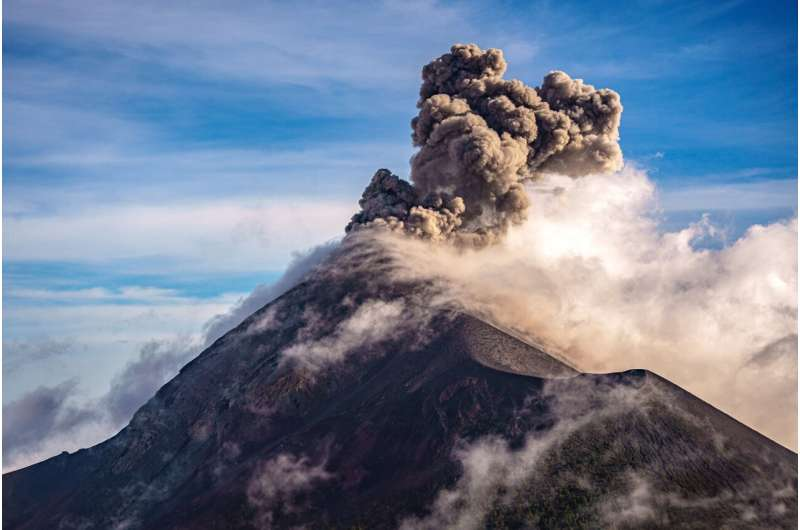
Volcanic eruptions lead to aerosol formation in the atmosphere that can block sunlight and cool the planet. Credit: Diego Girón/Pexels.
Volcanic eruptions are known for their spectacular visual displays of vivid lava, as well as the devastating impacts they can have on the environment and the communities who live nearby. But they can also have far-reaching impacts across the globe.
Explosive eruptions release vast quantities of sulfur dioxide gas into the upper atmosphere (stratosphere), where it reacts with water vapor and oxygen to form tiny aerosol droplets of sulfuric acid. These droplets scatter and reflect incoming solar radiation from the sun back out to space, reducing the warming energy reaching Earth’s surface and therefore helping to keep the planet cooler for multiple months or even years.
A famous example of this is when Mount Tambora in Indonesia erupted in 1815, leading to the “year without a summer” in 1816. Mary Shelley spent much of that time indoors due to the poor weather and wrote the literary classic “Frankenstein” in Switzerland and England—a curious cultural connection to a seemingly unrelated event far away.
New research, published in Geophysical Research Letters, has now explored whether a volcano’s location makes a difference in the amount of cooling experienced in the Northern Hemisphere.
A cooling conundrum
Dr. Zachary McGraw, of Columbia University, and colleagues report that previous studies have found volcanic eruptions in the middle latitudes between 30° and 70° (known as the extratropics) produced greater cooling than tropical eruptions of similar magnitude.
To test this, the researchers used a NASA climate model to simulate the difference between tropical and extratropical eruptions that released different amounts of sulfur gas across eruptions in summer and winter.
However, the team found no clear indication of increased Northern Hemisphere cooling based on an erupting volcano’s location—at most, an extratropical eruption increased cooling by twice as much, not the 7.5 times found in previous studies.
They identified that there could be some enhanced cooling from extratropical eruptions as a result of the microscopic aerosols being concentrated within just the Northern Hemisphere, whereas aerosols from tropical eruptions are moved into both hemispheres by wind patterns to distribute the reflective cooling effects of aerosols more evenly. This is the only mechanism that they say could create increased cooling in the extratropics, and there is no known process that could amplify cooling to 7.5 times.
To consider this in real terms, McGraw and the team tested this theory against ancient climate records to see how past tropical and extratropical eruptions had influenced weather. One of these so-called paleoclimate proxies is tree rings. The annual growth rings of trees can become wider during wet or warm seasons and narrower during dry or cold years when they’re experiencing more environmental stress.
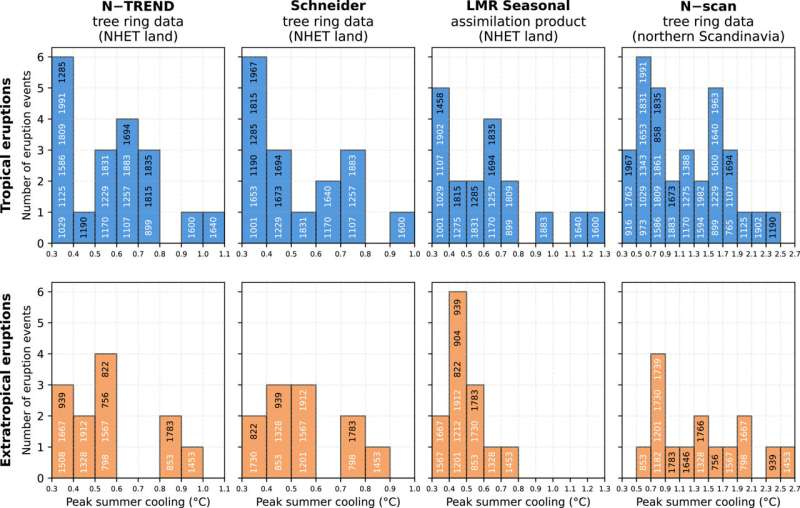
Historical events of cooler-than-normal summers following eruptions in the tropics (top row) and Northern Hemisphere middle latitudes (bottom row). Credit: McGraw et al., 2026.
They therefore considered tree ring data associated with historical records of extratropical eruptions from 1783 CE in Iceland, 536 CE somewhere in the mid-latitudes and 43 BCE in Alaska, as well as simulating 100,000 similar eruptions and subsequent cooling periods due to a lack of modern extratropical eruptions.
This was compared to numerous post-750 CE tropical eruptions to identify patterns in weather following an eruption and validate whether modeling can accurately represent climate patterns seen in historical records.
In doing so, the researchers found that Northern Hemisphere cooling coincides more often with tropical eruptions and that extratropical eruptions are comparatively rarer, so have a smaller influence on temperatures in the Northern Hemisphere.
They also identified shorter aerosol lifespans for extratropical eruptions (often up to nine months) compared to tropical eruptions (up to three years). They attributed this to sulfur gases being released into the atmosphere at lower heights, aerosols being washed away by rain and snow due to the wetter and cooler climates, and the poleward transport of aerosols from mid-latitudes.
The bigger picture
Disputing the cooling power of extratropical eruptions helps scientists explore the temporary effects of eruptions alongside longer-term trends in climate that are driven by other factors, such as human-made greenhouse gas emissions.
This study has important implications for understanding the risks posed to society. With tropical eruptions remaining the dominant driver of cooling in the Northern Hemisphere, scientists can use this knowledge to model how aerosols can be distributed across the planet, assess potential issues for agricultural production and global food security and the risk of conflicts over resources leading to geopolitical instability, and make meaningful plans to tackle climate risks.
Written for you by our author Hannah Bird, edited by Sadie Harley, and fact-checked and reviewed by Robert Egan—this article is the result of careful human work. We rely on readers like you to keep independent science journalism alive. If this reporting matters to you, please consider a donation (especially monthly). You’ll get an ad-free account as a thank-you.
Publication details
McGraw et al., No evidence for strongly enhanced Northern Hemisphere cooling from extratropical versus tropical eruptions, Geophysical Research Letters (2026). DOI: 10.1029/2026GL122071
Journal information: Geophysical Research Letters
Key concepts
Who’s behind this story?

Hannah Bird
PhD Earth Sciences in oceanography and paleontology. 10+ years translating complex science for mainstream media audiences. Full profile →

Sadie Harley
BSc Life Sciences & Ecology. Microbiology lab background with pharmaceutical news experience in oil, gas, and renewable industries. Full profile →

Robert Egan
Bachelor’s in mathematical biology, Master’s in creative writing. Well-traveled with unique perspectives on science and language. Full profile →
Here are more “ET’s” recorded from around the planet the last couple of days, their consequences, and some extreme temperature outlooks, as well as any extreme precipitation reports:
Here is More Climate News from Monday:
(As usual, this will be a fluid post in which more information gets added during the day as it crosses my radar, crediting all who have put it on-line. Items will be archived on this site for posterity. In most instances click on the pictures of each tweet to see each article. The most noteworthy items will be listed first.)