Made August 2023/Updated SEP 2024/SEP 2025/OCT 2026
The purpose of this post is to catalogue counts of monthly records (record high maximums, record high minimums, record low minimums, record low maximums) for China coming into the National Centers for Environmental Information’s site and all related charts and graphs produced in my Excel files for those data sets. For example, the highest temperature set during the month of March at Atlanta Hartsville-Jackson Airport was 89F set on 3/23/1995. I continue to update these data as part of my long-term work examining the warm-record/cold-record relationships first studied in the 2009 Meehl et al. paper published in Geophysical Research Letters, research that I helped initiate during 2000–2009. Each individual count could be a report of a tied surface record or one broken by several degrees Fahrenheit. Here is the link to the NCEI site:
https://www.ncdc.noaa.gov/cdo-web/datatools/records
More from NCEI:
“The daily records summarized here are compiled from a subset of stations in the Global Historical Climatological Network. A station is defined as the complete daily weather records at a particular location, having a unique identifier in the GHCN-Daily dataset.
For a station to be considered for any parameter, it must have a minimum of 30 years of data with more than 182 days complete each year. This is effectively a “30-year record of service” requirement, but allows for inclusion of some stations which routinely shut down during certain seasons. Small station moves, such as a move from one property to an adjacent property, may occur within a station history. However, larger moves, such as a station moving from downtown to the city airport, generally result in the commissioning of a new station identifier. This tool treats each of these histories as a different station. In this way, it does not “thread” the separate histories into one record for a city.
This tool provides simplistic counts of records to provide insight into recent climate behavior, but is not a definitive way to identify trends in the number of records set over time. This is particularly true outside the United States, where the number of records may be strongly influenced by station density from country to country and from year to year. These data are raw and have not been assessed for the effects of changing station instrumentation and time of observation.”
All counts include ties of records.
An updated 2016 study from Dr. Jerry Meehl indicates that the ratio from year to year will average around 15 to 1 by 2100 for the United States:
Per one of the authors of both the 2009 and 2016 studies, Claudia Tebaldi said “This climate is on a trajectory that goes somewhere we’ve never been. And records are a very easy measure of that.”
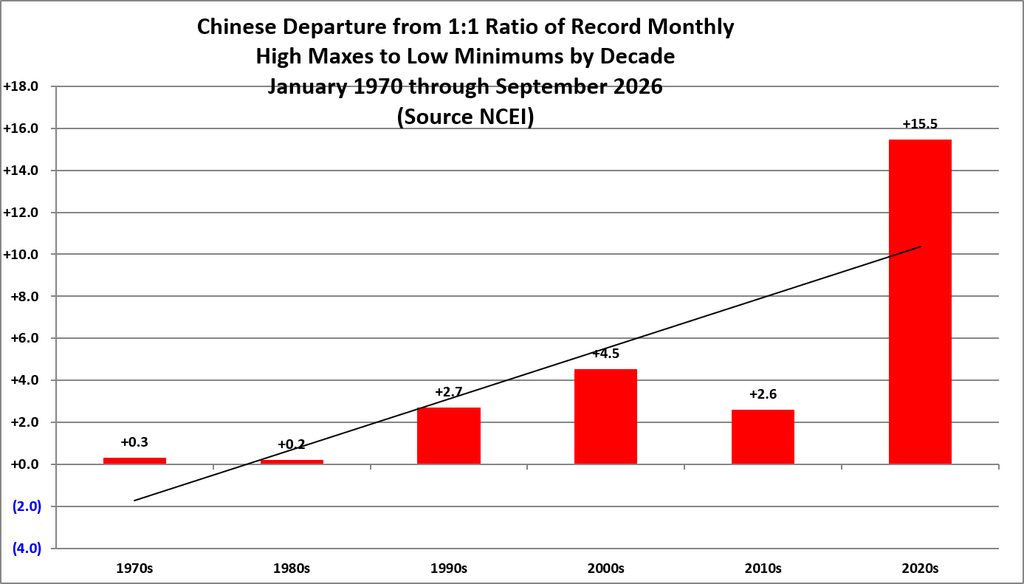
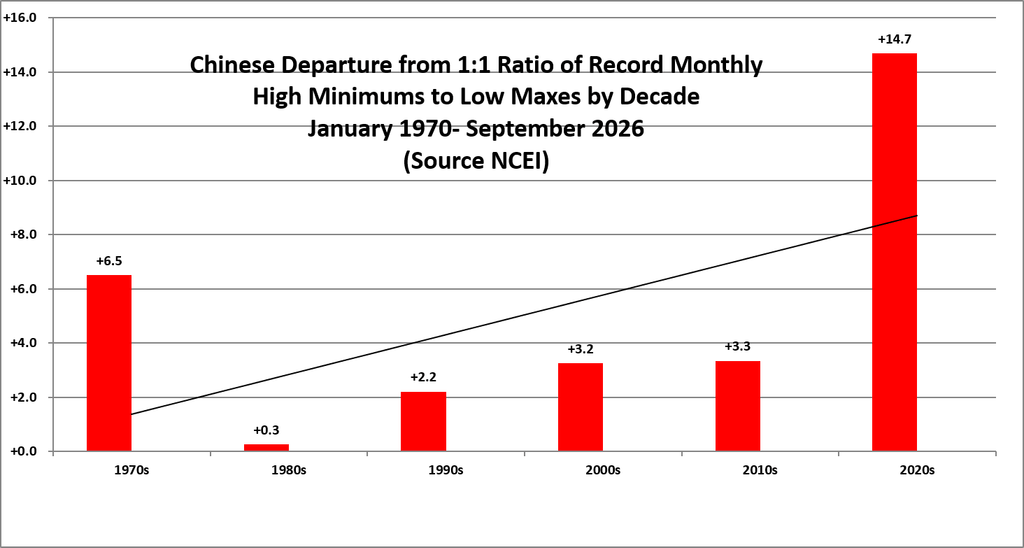
All of the data listed below is part of this one chart. So far, the ratio of monthly record high maxes to low minimums for the 2020s is higher than any other decade since the 1970s:
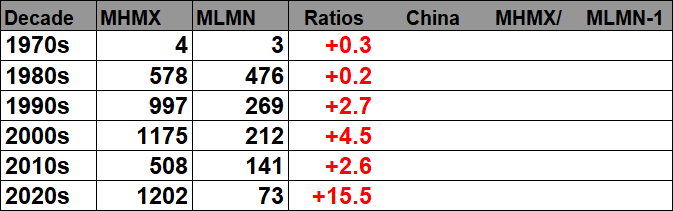
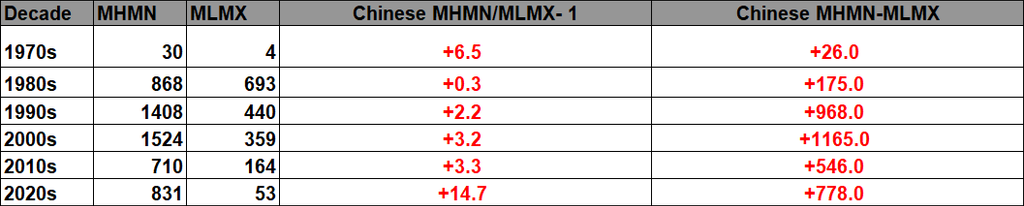
Here are the current monthly record counts per decade, which have gone into the prior chart:
Scientific Assessment of China’s Monthly Temperature-Record Analysis
Our Chinese analysis reveals a strong and scientifically meaningful relationship between monthly temperature anomalies and the frequency of record-breaking warmth and cold.
Using temperature anomalies relative to the 1961–1990 climatological baseline, grouped into 0.10°C increments, we find that the farther monthly temperatures depart from their historical average, the more strongly temperature records tend to favor the direction of that departure. The relationship exhibits a pronounced nonlinear pattern, consistent with findings from Germany, Australia, Canada, and the other countries investigated.
The results are particularly striking for the two categories of Chinese monthly temperature records:
| Monthly record comparison | Anomalies ≥ +2°C | Anomalies ≤ −1°C |
|---|---|---|
| MHMX / MLMN | ~20.6 warm records per cold record | ~2.4 cold records per warm record |
| MHMN / MLMX | ~36.0 warm records per cold record | ~1.9 cold records per warm record |
These results indicate that exceptionally warm Chinese months strongly favor new monthly warm-temperature records. The warm-record dominance is especially pronounced for monthly high minimums compared with monthly low maximums. This suggests that monthly daytime and nighttime temperature extremes may respond differently to changes in the background climate.
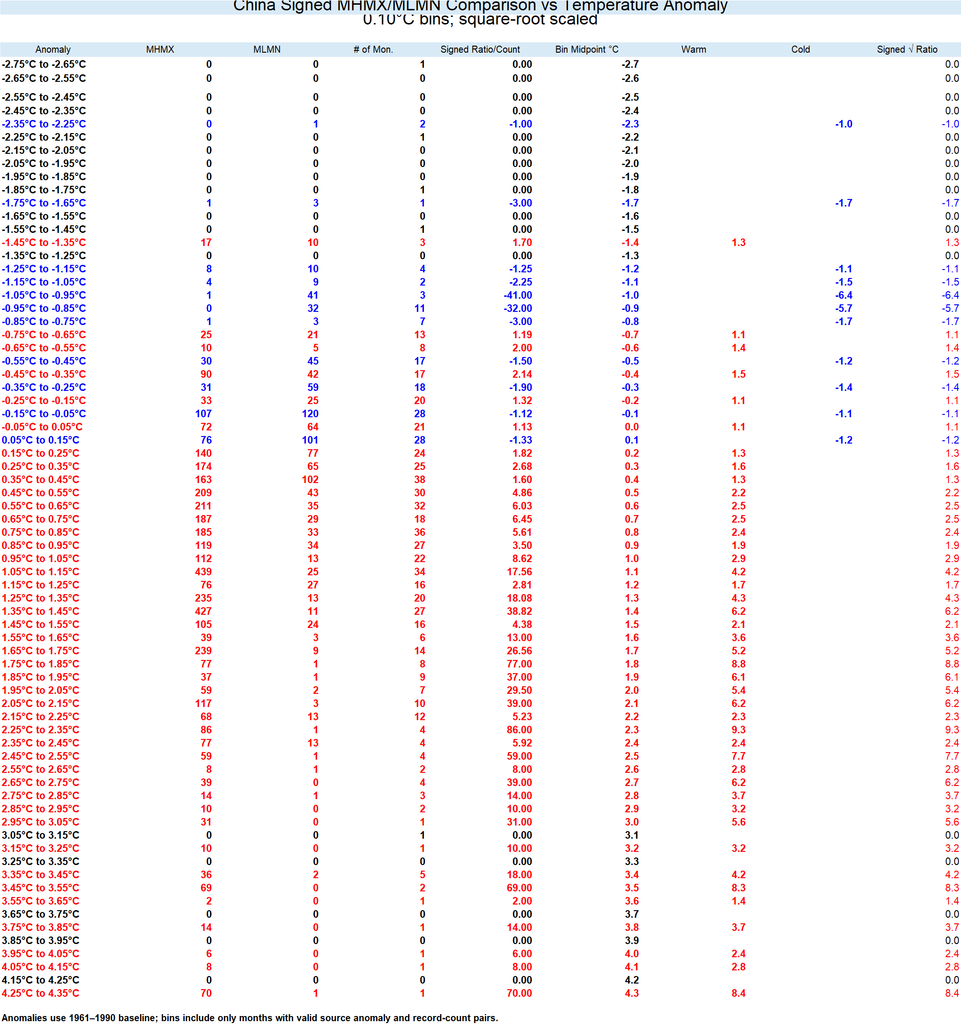
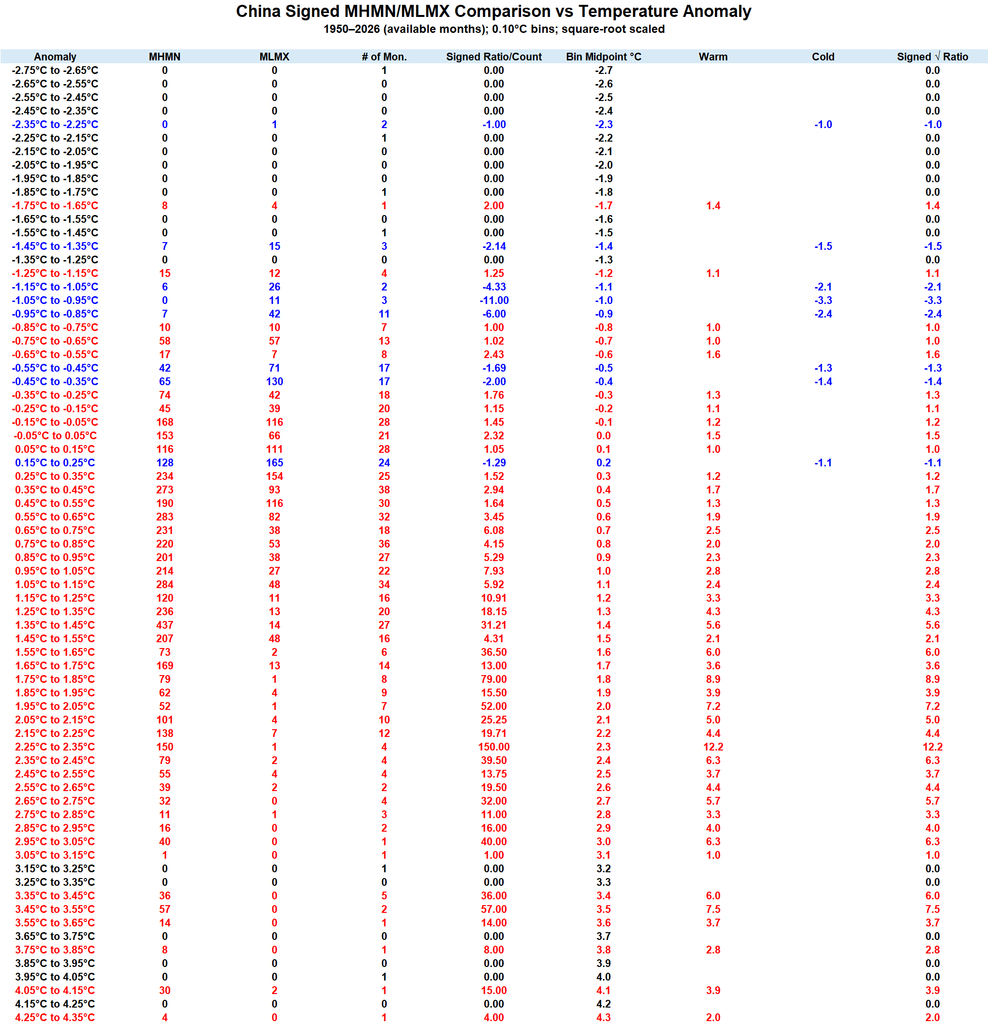
At anomalies of +2.0°C or greater, the MHMX/MLMN comparison produces 783 warm records versus 38 cold records, while the MHMN/MLMX comparison produces 863 warm records versus just 24 cold records. These differences are substantial, although the sample sizes are smaller than those for more frequently occurring temperature anomalies.
An important finding is that the imbalance becomes much smaller near climatological normal. During months with anomalies within approximately ±0.5°C, the MHMX/MLMN comparison produces 1,125 warm records and 743 cold records, while the MHMN/MLMX comparison produces 1,488 warm records and 1,103 cold records. Although warm records still predominate, the differences are much smaller than those observed during exceptionally warm months.
The coldest anomaly categories require particular caution. At −2.0°C and colder, the available Chinese monthly data contain only one cold record and no warm records in each comparison. Consequently, meaningful numerical ratios cannot be established for these extreme cold bins. Using the broader threshold of −1.0°C and colder provides a more informative comparison, although the sample sizes remain relatively small.
Across the complete Chinese monthly dataset, warm records outnumber cold records in both comparisons:
- MHMX/MLMN: 4,463 warm records versus 1,174 cold records, approximately 3.80 to 1.
- MHMN/MLMX: 5,295 warm records versus 1,704 cold records, approximately 3.11 to 1.
These aggregate results reinforce the substantial predominance of monthly warm-temperature records in China’s available observational record.
Scientific interpretation
These findings are consistent with the expected statistical consequences of a warming climate. As the temperature distribution shifts toward higher values, opportunities to exceed previous warm-temperature extremes increase, while the likelihood of establishing new cold-temperature extremes generally diminishes.
An especially interesting feature is that China’s monthly high-minimum records show a stronger warm-to-cold imbalance than its monthly high-maximum records during the warmest anomaly categories. This could reflect differences in daytime and nighttime temperature variability, atmospheric circulation, cloud cover, humidity, or other regional climate processes. However, identifying the physical mechanisms would require additional investigation.
China’s results are particularly valuable because they exhibit the same broad relationship found in countries with substantially different climates and geographical characteristics. Despite differences in observational histories and station networks, the association between warmer monthly anomalies and increasing warm-record dominance appears remarkably consistent.
Several limitations must be considered. China’s usable NCEI record-count history is considerably shorter than that of Germany and some other countries investigated, with most available observations beginning in the 1970s. Reporting delays can also leave recent observations incomplete for approximately 18 months, making the 2025 and 2026 record counts provisional.
Additionally, differences in station density, observational coverage, historical record lengths, and the number of record-setting opportunities can influence the counts. The very large warm-to-cold ratios in extreme anomaly categories should be evaluated alongside their sample sizes and uncertainty. The square-root transformation improves graphical readability but does not establish statistical significance.
This analysis is observational rather than a formal attribution study. Nevertheless, the strong correspondence between independently processed monthly temperature-anomaly data and NCEI record counts provides descriptive evidence that background climate conditions are closely associated with the frequency of record-setting warmth and cold.
Overall assessment: China’s monthly temperature-record analysis provides compelling descriptive evidence that the background thermal state is strongly associated with the balance between warm and cold temperature records. Its most significant finding is the pronounced increase in warm-record dominance during exceptionally warm months, particularly for monthly high-minimum temperatures. The consistency of this relationship with findings from other countries strengthens the broader international picture of shifting temperature extremes in a warming climate.
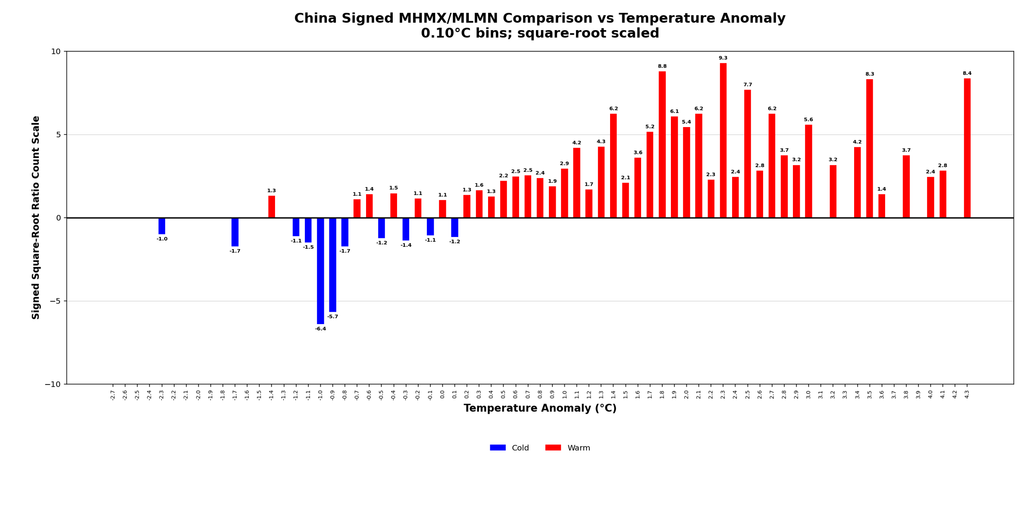
Monthly temperature anomalies are grouped into 0.10°C intervals relative to the 1961–1990 average. Within each interval, warm and cold record counts are compared using a signed ratio. For example, nine warm records for every cold record produce a signed square-root value of +3.0, while nine cold records for every warm record produce −3.0. Positive bars indicate warm-record dominance, and negative bars indicate cold-record dominance. The transformation makes large differences easier to display without changing the underlying record counts.
The 2020s:
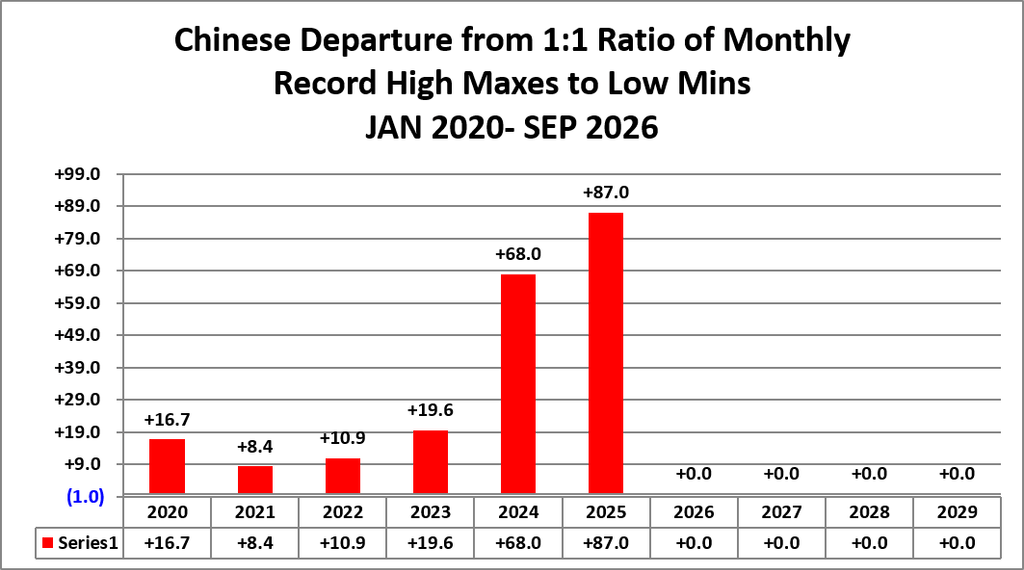
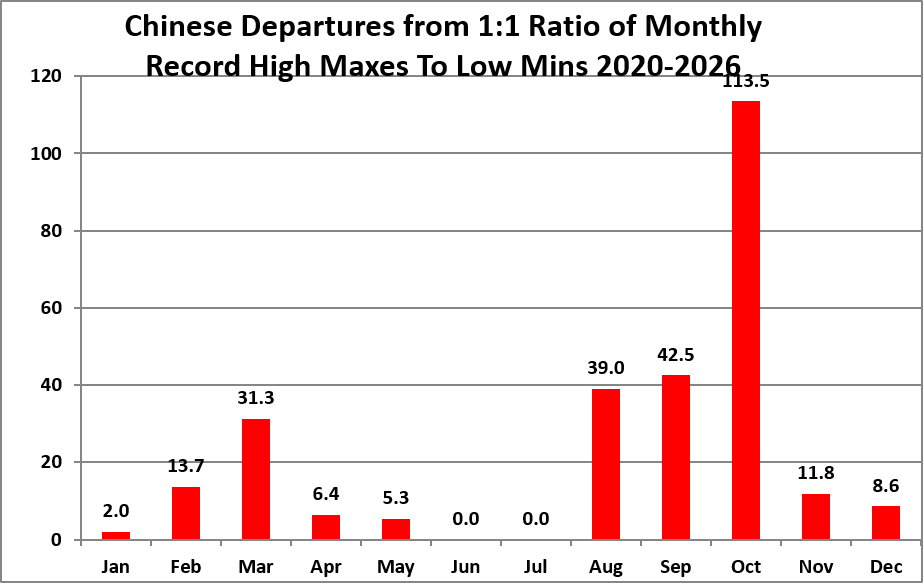
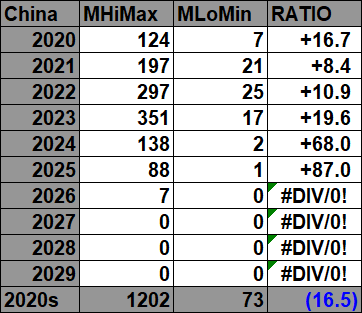
For the following data sets of record of monthly high minimums and low maximums I have opted not to boldly highlight ratios greater than 10 to 1. Blue colors represent cold months and red warm. Months and years that are all-time record cold or hot are colored purple. Temperature anomalies greater than +0.5°C are shown in red, while anomalies below −0.5°C are shown in blue. Values within ±0.5°C are shown in black. All-time warmest and coldest months and years are highlighted in purple. Record-count ratios are displayed separately using the established warm-versus-cold comparison. I have opted not to catalogue data prior to 1970 since record counts decrease substantially prior to the decade of the 1970s. Time stamps for when I last updated counts are located in the upper left-hand corner of each chart. Drop me a note if you see an error or if you have suggestions for improvements.
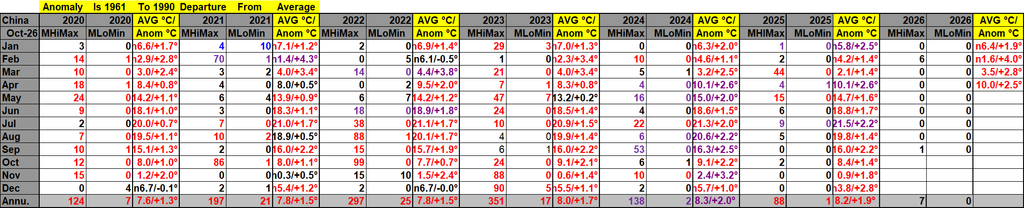
The 2010s:



The 2000s:



The 1990s:



The 1980s:



The 1970s:



The sparse data from the 1970s has limited statistical value.


All of the data listed below is part of this one chart:
Here are the current monthly record counts per decade, which have gone into the prior chart:
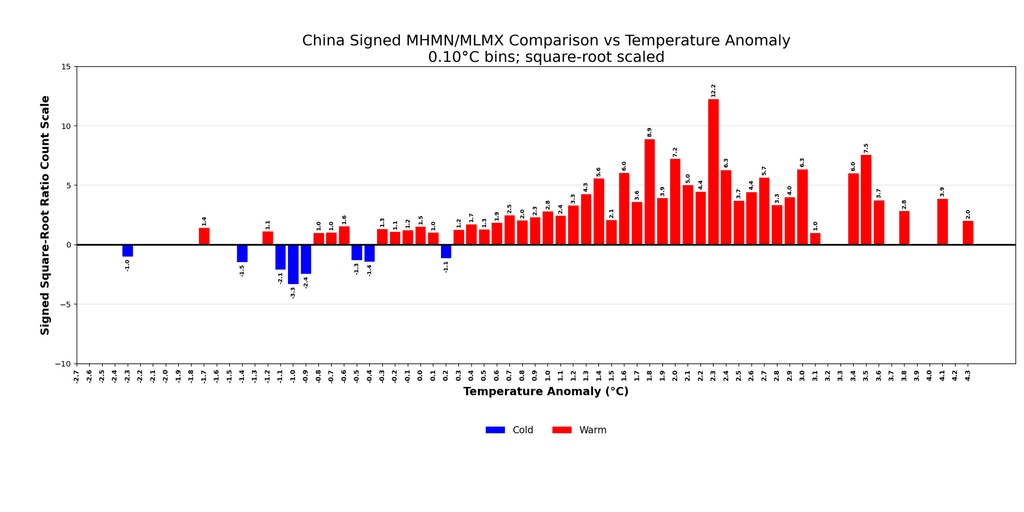
Monthly temperature anomalies are grouped into 0.10°C intervals relative to the 1961–1990 average. Within each interval, warm and cold record counts are compared using a signed ratio. For example, nine warm records for every cold record produce a signed square-root value of +3.0, while nine cold records for every warm record produce −3.0. Positive bars indicate warm-record dominance, and negative bars indicate cold-record dominance. The transformation makes large differences easier to display without changing the underlying record counts.
The 2020s:
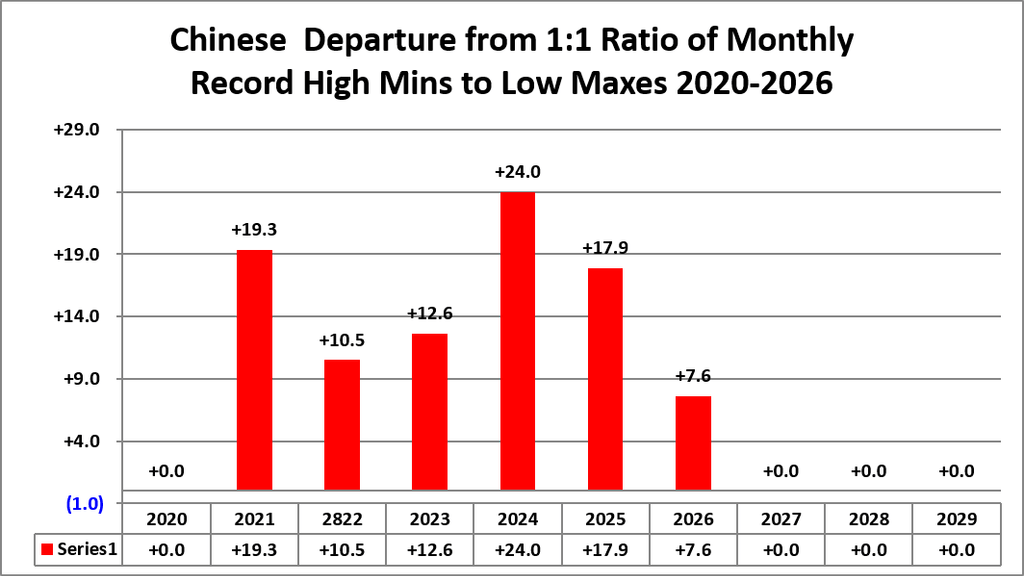
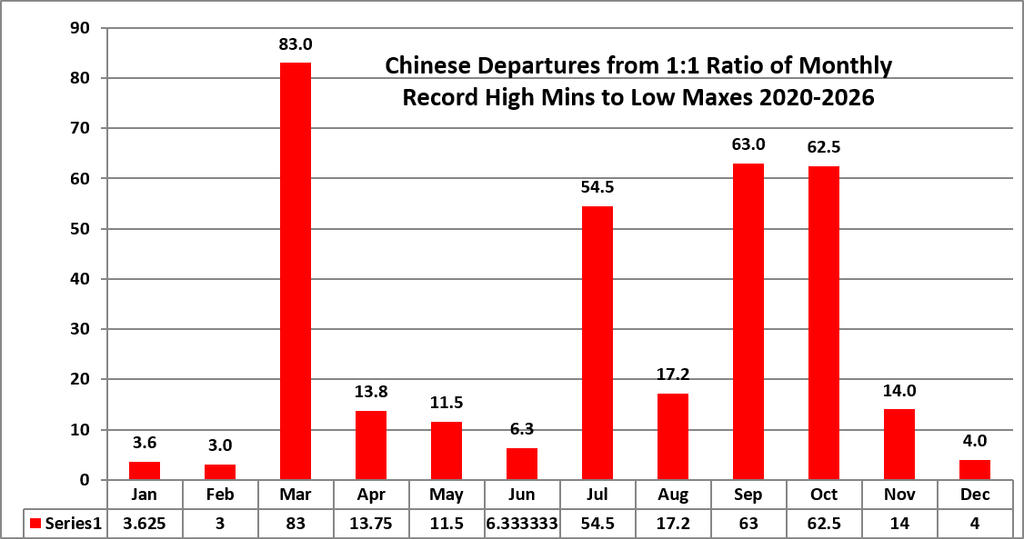
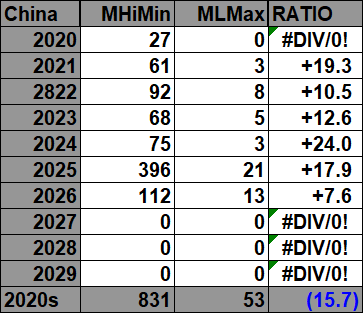
For the following data sets of record of monthly high minimums and low maximums I have opted not to boldly highlight ratios greater than 10 to 1. Blue colors represent cold months and red warm. Months and years that are all-time record cold or hot are colored purple. Temperature anomalies greater than +0.5°C are shown in red, while anomalies below −0.5°C are shown in blue. Values within ±0.5°C are shown in black. All-time warmest and coldest months and years are highlighted in purple. Record-count ratios are displayed separately using the established warm-versus-cold comparison. I have opted not to catalogue data prior to 1970 since record counts decrease substantially prior to the decade of the 1970s. Time stamps for when I last updated counts are located in the upper left-hand corner of each chart. Drop me a note if you see an error or if you have suggestions for improvements.

The 2010s:



The 2000s:



The 1990s:



The 1980s:



The 1970s:



The sparse data from the 1970s has limited statistical value.


These are all of the counts of NCEI monthly record Chinese temperature reports (including tied records) back to January 1970.
The Climate Guy