The main purpose of this blog will be to track planetary extreme, or record temperatures related to climate change. Any reports I see of ETs will be listed below the main topic of the day. I’ll refer to extreme or record temperatures as ETs (not extraterrestrials).😜
Main Topic: NCEI Global and National Record Count and Ratio Summaries at the End Of 2025
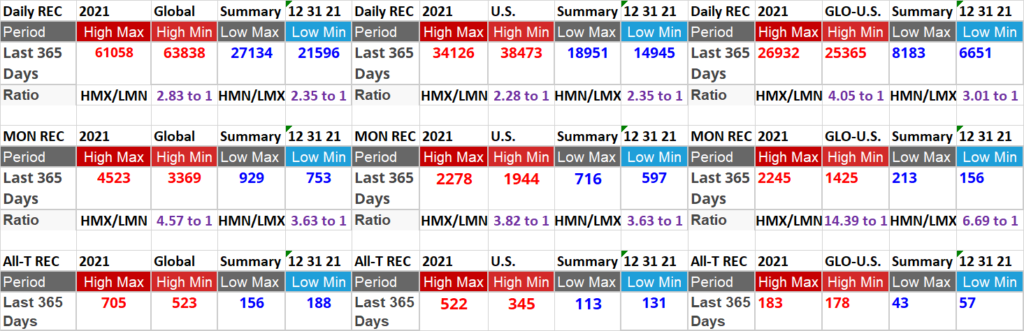
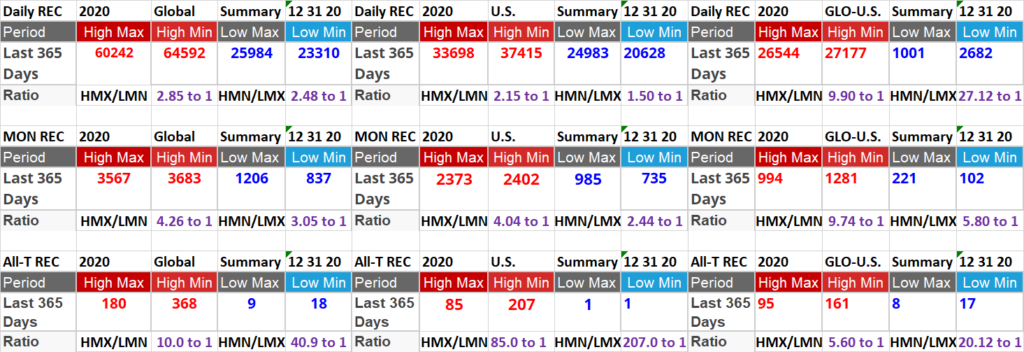
Dear Diary. Happy New Year 2026! At the beginning of every year that I have the health and privilege to live, I’ll be gleaning National Center for Environmental Information global record counts for scientific purposes. It remains unfortunate that their system does not archive this data much like it does for that of individual countries. Once a new year arrives, poof, the prior year’s global tallies are gone unless an army of statisticians were to add record reports from over one hundred countries:
The main purpose for doing this year end exercise is to glean global totals to compare to global averages and anomalies with national U.S. totals. Since NCEI United States totals of record counts (including tied records) are part of global totals, I have thought to subtract these to get all totals outside of the U.S. from 2020-2025.
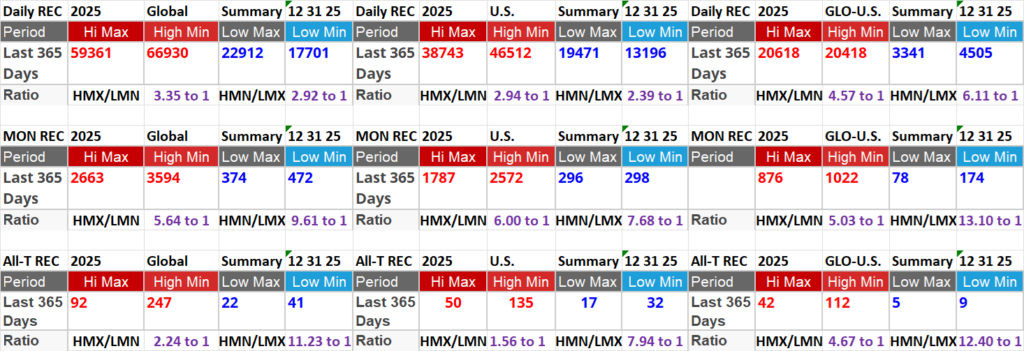
Here are totals from 2025 keeping in mind that global temperature averages to about 1.4°C above preindustrial conditions:
One caveat to data from 2025. Due to a late year government shutdown, there has been a lack of global data coming into the NCEI temperature record tracker system. Therefore, 2025’s data is incomplete compared to years from 2020-2024. We do see that the ratio of DHMX to DLMN records for the U.S. was near 2.4 to 1, which is expected from the Meehl study as we go through the 2020s. That U.S. ratio was about 1.8 to 1 for the decade of the 2000s.
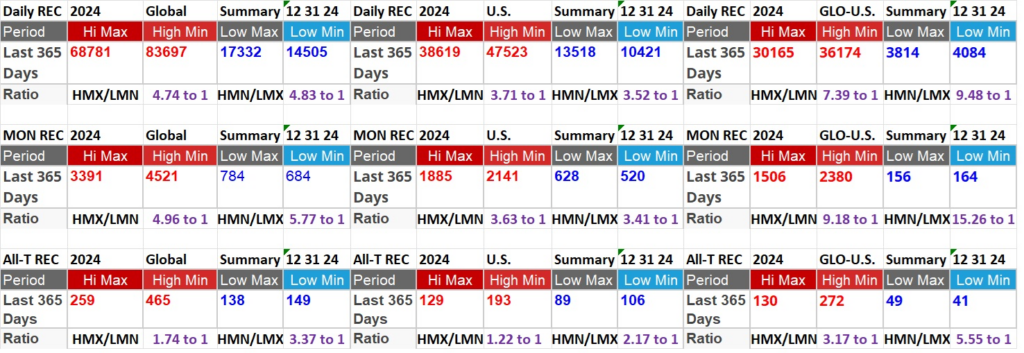
Here are totals from 2024 keeping in mind that El Niño transitioned to La Nina conditions by the end of the year combined with climate change spiked global temperature averages to about 1.6°C above preindustrial conditions:
Notice that global daily ratios have risen over the past five years from 2020-2024 looking at the charts listed below. I contend that extreme temperatures are very sensitive to global averages…in this case just a couple of tenths of a degree Celsius warmer this year has made a big difference in association with the intensities of heatwaves.
These statistics are no surprise since we saw a record hot 2024 that globally DHMX to DLMN ratios were near 4.75 to 1. Outside of the U.S. that NOAA figure was near 7.40 to 1.
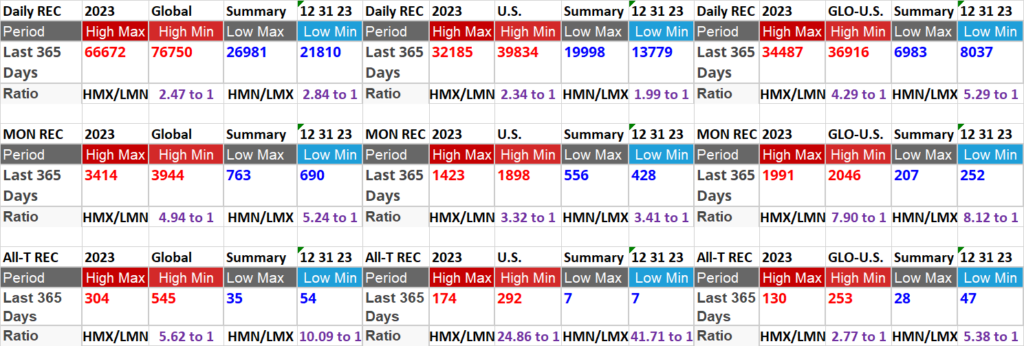
Here are totals from 2023 keeping in mind that El Nino combined with climate change spiked global temperature averages to about 1.5°C above preindustrial conditions:
Notice that daily and monthly ratios for the globe outside of the U.S. were higher than for the United States. Interestingly, all-time ratios were higher for the U.S., indicating that summer heat was very intense here from the Southwest into the south-central states during 2023 to produce such a statistic.
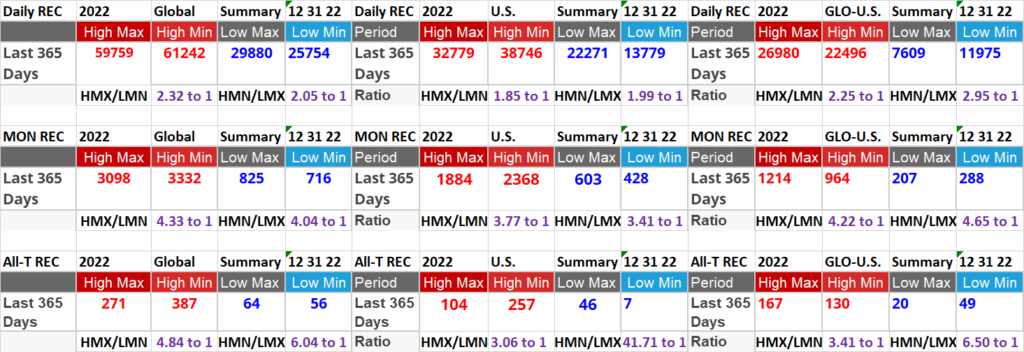
Here are totals from 2022, a slightly cooler year globally at about 1.3°C above preindustrial conditions:
Nearly all ratios for 2022 were lower than those of 2023.
Here are those of 2021. Global temperature averages were about the same as those for 2022 at +1.3°C above preindustrial conditions. The U.S. had a hotter year in 2021 than in 2022:
And lastly, here are totals from 2020. Once more like in 2021 and 2022, global temperature averages were about 1.2°C to 1.3°C above preindustrial conditions:
Yes, all of these statistics are very much skewed towards what we would expect in a warming world. What will 2026 hold? Keep reading the Extreme Temperature Diary to find out.
Here are some “ETs” recorded from around the planet the last couple of days, their consequences, and some extreme temperature outlooks, as well as any extreme precipitation reports:
#DDC issues Record Event Report (RER) at Jan 1, 2:01 AM CST …RECORD HIGH TEMPERATURE SET AT GARDEN CITY REGIONAL ARPT KS… https://t.co/CFFUVG3Nxw
#GLD issues Record Event Report (RER) at Jan 1, 12:35 AM MST …RECORD HIGHS OBSERVED AT GOODLAND, HILL CITY AND MCCOOK ON NEW YEARS EVE… https://t.co/zbYWGXBpWg
Juneau airport snowfall 46.8 inches (118.9cm) December 27-30, 2025 is the highest four-day total on record, breaking the previous record of 45.9 inches (116.6cm) set Apr 1-4, 1963. Data since 1944. #akwx #Climate #Snow @spiraledu.bsky.social @alaska.bsky.social
2025 at Utqiaġvik, Alaska's northernmost community, was the eighth mildest year in more than a century of climate observations. Eight of the ten mildest years have occurred since 2016. #akwx #Arctic #Climate #ClimateChange @climatologist49.bsky.social
(As usual, this will be a fluid post in which more information gets added during the day as it crosses my radar, crediting all who have put it on-line. Items will be archived on this site for posterity. In most instances click on the pictures of each tweet to see each article. The most noteworthy items will be listed first.)
"[T]his year was one of the three hottest ever recorded.""157 extreme weather events throughout 2025.""[H]eat waves 10 times more likely this past year than they were a decade ago."#USA #China #Iceland #Chile #Climate #FossilFuels #Forests #Water
This year has been brutal for the #climate movement.Rollbacks, repression, & outright denial, especially in the US, have made progress feel fragile & uneven.Which is exactly why it matters to pause & look back at what did move forward in 2025.Here are 12 real wins 🏆, one for each month 🧵⬇️
January:A Scottish court ruled the Rosebank oilfield approval unlawful, a major legal blow to one of the UK’s biggest undeveloped oil projects. ⛔🛢️Years of community resistance & legal pressure paid off. Courts are increasingly forcing governments to follow their own #climate laws.
February:A major report confirmed clean energy costs will keep falling in 2025, further undercutting fossil fuels. 💲📉This isn’t abstract: cheaper renewables mean fewer excuses for new coal, oil, & gas, and stronger leverage for #climate campaigners everywhere.
March:The Dutch government ruled out gas drilling in the Wadden Sea, one of Europe’s most sensitive ecosystems.A clear example of environmental protection winning out over extraction, after years of public pressure to defend this UNESCO World Heritage site 🌍
April: Renewables generated a record 32% of global electricity in 2024, according to @ember-energy.org. The transition is no longer hypothetical. Clean power is already reshaping energy systems, faster than many governments expected or planned for.
May:Delft joined The Hague & Utrecht in banning fossil fuel advertising in public spaces ✊These city-level actions matter: they challenge the social licence of fossil fuel companies & treat #climate harm like other public health threats
June: Insurers continued pulling back from coal mine coverage as #climate policies tightened.Without insurance, new coal projects become unviable. This is quiet but powerful pressure, driven by risk, regulation, and sustained campaigning.
July:The world’s top UN court affirmed that international treaties compel wealthy nations to curb global warming. This is a landmark for #ClimateJustice, strengthening legal arguments already being used by activists and communities worldwide. ⚖️
August:A high court in South Africa halted an offshore drilling project after a legal challenge by coastal communities, stopping Shell and TotalEnergies in their tracks.Another reminder: frontline resistance, backed by the law, can still stop extraction projects outright.
September:Global investment in renewable energy rose 10% on 2024 levels, despite political backlash & rollbacks.Capital is moving. Even hostile governments are struggling to slow the economic momentum behind clean energy.
October:A French court ruled that TotalEnergies misled consumers over its #climate claims.Greenwashing is no longer risk-free. Courts are beginning to treat deceptive climate marketing as a serious legal issue.
November:Britain became the world’s largest economy to commit to ending new oil and gas exploration.A decision shaped by years of public campaigning, and a signal that “no new fossil fuels” is entering the policy mainstream 🥳
December:Thanks to the efforts of @peopleandplanet.bsky.social eight more UK universities cut recruitment ties with the fossil fuel industry.A cultural shift, driven from below: students & staff challenging the normalisation of fossil fuel careers inside public institutions ✊🎉
Taken together, these wins tell a clear story Renewables keep getting cheaper💚Fossil fuel projects keep losing in court ⚖️& grassroots pressure keeps translating into real limits on extraction✊The setbacks are real, but so is the momentum, built month by month by people who refuse to give up!
“Erecting billions of dollars of real estate in harm’s way ultimately costs all of us. The barrier island boom has often inflated hurricane damage, helping fuel Florida’s soaring property insurance rates and saddling taxpayers statewide with the growing tab for shoring up coastlines.”
Early look at December 2025 temperatures around the #Arctic courtesy @khaustein.bsky.social. Way above average the entire Arctic Ocean basin plus Greenland and nearby areas in Canada. Below normal central/western Siberia and the coldest Dec in decades in parts of northwest North America. #Climate
"The hot drought conditions that drive elevated tree mortality are projected to frequently emerge during a typical dry season 20 to 40 years from now"#ClimateEmergency
#News: #Coral #reefs have shaped Earth’s #climate for 250 million years, driving recovery from carbon shocks, evolution of marine #animals. Their decline today brings huge loss, unless we intervene now 🧐🌊 #ClimateChange #Boycott4Wildlife @palmoildetect.bsky.social theconversation.com/coral-reefs-…
New study by Hu et al. reveals #IndonesianThroughflow’s nonlinear response to #CO2, with a rapid decline after crossing a #TippingPoint. The first point may be approaching, signaling a potential climate #Tipping element with implications for global #climate.www.nature.com/articles/s41…
One of my #Climate resolutions this year is to get better at soy cookery & to share what I learn.Also: growing 200 row ft of soy for edamame and other uses. There’s not a market for it here, but I realized frozen edamame is costing us a lot at the store. 🌱What are y’all’s climate resolutions?
Why is New Year’s so #cold in #Florida? It’s simple. There’s a big mountain of warm air (relative to normal) over Greenland and Eastern Canada. That is blocking cold air from moving east through Canada and instead it’s being rerouted (like a detour) into the Deep South.
Planning approvals for battery, wind, and solar projects in Great Britain (GB) have almost doubled over the past year, with more than 45GW of capacity approved in 20251. This is 96% higher than last year’s 23GW, and enough to power 12.9 million homes. www.cornwall-insight.com/press-and-me…
Mongabay's investigative journalism logged 870+ impacts in 2025—exposing Amazon crimes, driving indictments in Brazil, and empowering Indigenous communities to protect their lands.
At Toronto Pearson Airport, a dedicated team from Falcon Environmental uses a unique approach to keep the skies clear, featuring their star employee, Ivan the bald eagle. The Weather Network's Mark Robinson spoke to the experts about how they use falconry to protect both passengers and wildlife.
HAPPY NEW YEARand one where we choose to dig deeper, sideways and expand on what we know to shape a world where people and nature thrive.#OurFuture #newyear #photography #nature #climate #forest #forestfriends
HAPPY NEW YEARand one where we choose to claim the world as ours and reject everything that harms us and nature.#OurFuture #newyear #photography #nature #climate #scape #clouds
If you like these posts and my work on record temperature ratios, please contribute via my PayPal widget on this site. Thanks in advance for any support.