The main purpose of this ongoing blog will be to track planetary extreme, or record temperatures related to climate change. Any reports I see of ETs will be listed below the main topic of the day. I’ll refer to extreme or record temperatures as ETs (not extraterrestrials).😜
Here is a new feature for this blog, which I will add daily. This is the latest inciteful Green News Report from my friends Desi Doyen and Brad Friedman at Progressive Voices. Hit ‘continue reading,’ listen, then hit return to see my daily topics:
Main Topic: U.S. Monthly Attribution Summary from Climate Central – April 2026
Dear Diary. Lately Climate Central has begun to produce monthly anthropogenic climate change attribution reports for the U.S. We saw whopping manmade markers from their last report for an extremely warm March 2026. Last month was anomalously warm, but not as warm as March. Still, April 2026 may indeed rank in the top 20 warmest months since 1895 when NCEI first began recording U.S. climate stats. Speaking of that, we should have their climate report for April 2026 out in a day or two.
Here is that report from Climate Central:
Monthly Attribution Overview – April 2026 | Climate Central
Monthly Attribution Overview – April 2026
An analysis of how climate change boosted United States temperatures in April 2026
Using Climate Central’s Climate Shift Index (CSI) tool to measure the impact of climate change on daily temperatures across the United States, as well as NOAA’s Applied Climate Information System (ACIS) to find daily temperature information, we have compiled a high-level overview of how climate change has affected temperature trends in April in cities across the United States. (Dataset downloadable as Excel workbook here.)
1. High-level findings
- Overall, the U.S. saw above-average temperatures in April, with an average anomaly — or difference from normal — of 3.4°F across 192 cities.
- While the western U.S. remained only slightly above average, the national trend was primarily driven by substantial anomalies across the east.
- Sixty-two cities experienced one of their top five warmest April temperatures on record. On average, stations have data dating back to 1893.
- Elevated temperature anomalies — or differences from normal — occurred in all nine U.S. Climate Regions: Southwest, West, Northwest, Northern Rockies and Plains, South, Southeast, Upper Midwest, Ohio Valley, and Northeast.
- April 2026 was exceptionally warm, mirroring long-term April warming trends, which show that nearly all cities analyzed have warmed since 1970, consistent with findings from Climate Central’s 2025 Winter Package.
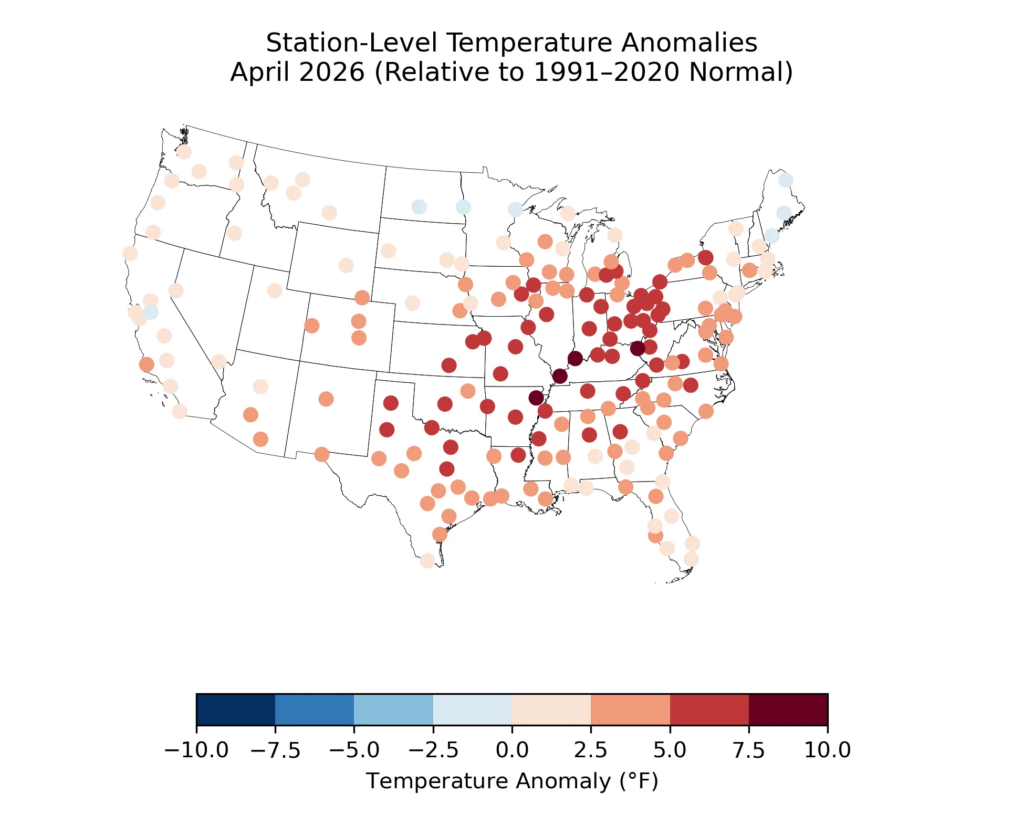
Figure 1. Temperature anomalies (differences from normal) for April 2026 relative to 1991-2020 normals. Analysis based on threaded ACIS station-level data.
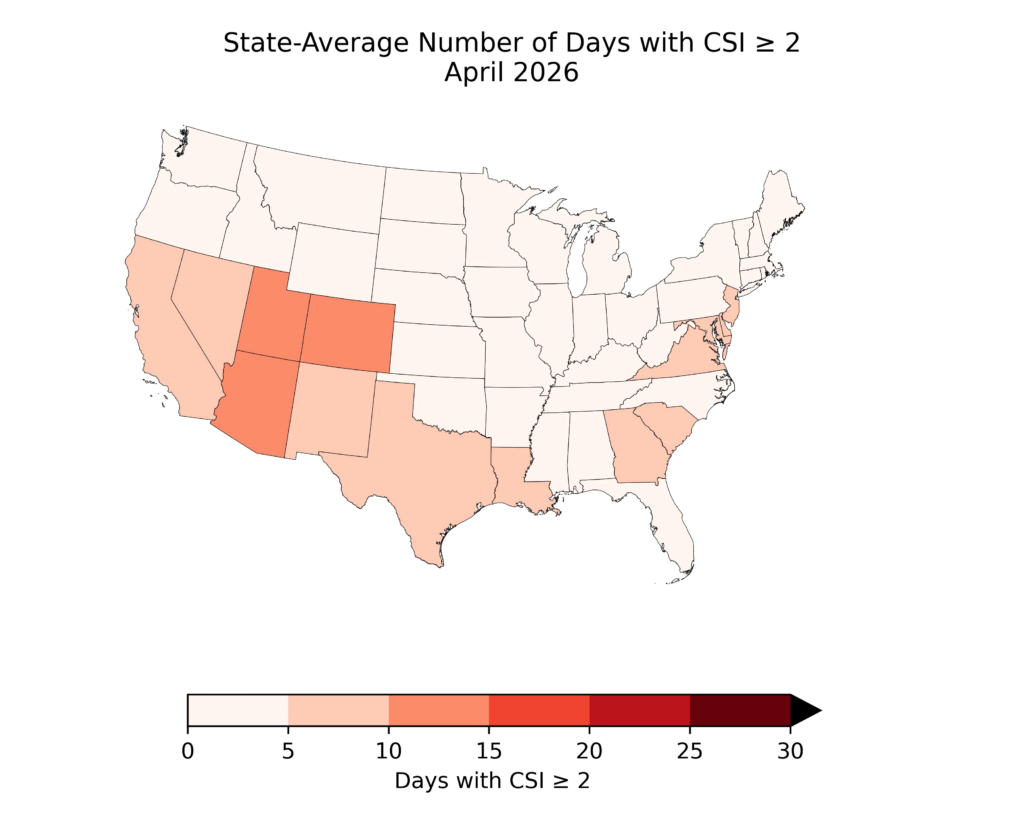
Figure 2. Statewide average days with a CSI level 2 or higher for April 2026. Analysis based on ERA5 data.
2. Local temperature anomaly analysis
- The average temperature anomaly — or difference from normal — across the 192 cities analyzed was 3.4°F.
- April temperatures were overwhelmingly warm, with 179 cities recording warmer-than-average conditions, compared to 11 cities that experienced cooler-than-average conditions.
- Temperatures were elevated across many areas in the Northwest, Southwest, West, Northern Rockies and Plains, South, Southeast, and Upper Midwest, Ohio Valley, and Northeast. The Ohio Valley stood out as the warmest region, with average temperatures more than 5.8°F above normal.
- Twenty-two cities experienced their hottest April on record.
- The most unusually warm city in April was Jonesboro, Arkansas, which was 8.2°F warmer than usual.
- Of the 192 locations analyzed, most (183) showed long-term warming trends for April, indicating that these cities have warmed on average since 1970.
- Reno, Nevada, experienced the greatest increase, with average April temperatures 7.9°F warmer than in 1970.
Table 1. ACIS stations with the highest April 2026 temperature anomaly.
| City | State | Temperature anomaly or difference from normal (°F) | Average temperature (°F) | Warming since 1970 (°F) |
|---|---|---|---|---|
| Jonesboro | AR | 8.2° | 68.8° | 0.2° |
| Evansville | IN | 8.0° | 65.1° | 2.7° |
| Huntington | WV | 7.8° | 64.8° | 3.5° |
| Paducah | KY | 7.5° | 66.3° | 2.4° |
| Columbus | OH | 7.4° | 60.3° | 4.7° |
| Indianapolis | IN | 7.3° | 60.8° | 2.9° |
| Pittsburgh | PA | 7.3° | 58.7° | 4.6° |
| Cincinnati | OH | 7.2° | 61.6° | 3.2° |
| Louisville | KY | 7.2° | 66.1° | 4.9° |
| Parkersburg | WV | 7.1° | 61.6° | 3.1° |
Table 2. ACIS stations with the fastest warming April since 1970.
| City | State | Warming since 1970 (°F) | Temperature anomaly or difference from normal (°F) | Average temperature (°F) |
|---|---|---|---|---|
| Reno | NV | 7.9° | 0.0° | 51.4° |
| Las Vegas | NV | 7.2° | 1.3° | 68.8° |
| El Paso | TX | 7.0° | 2.5° | 69.1° |
| Tucson | AZ | 6.8° | 3.8° | 71.8° |
| Phoenix | AZ | 6.5° | 4.5° | 77.6° |
| Tampa | FL | 5.5° | 1.9° | 75.7° |
| Albany | GA | 5.1° | 2.1° | 68.9° |
| Erie | PA | 5.0° | 5.6° | 52.8° |
| Louisville | KY | 4.9° | 7.2° | 66.1° |
| Chattanooga | TN | 4.9° | 4.9° | 66.6° |
Local Climate Shift Index analysis
- San Juan, Puerto Rico, had 19 days at or above CSI 2 in April, indicating that temperatures on those days were made at least two times more likely because of climate change.
- Four cities across the country experienced at least a week’s worth of days at or above CSI 2.
- On average, cities in the Southwest experienced the highest number of days (10) with a CSI of 2 or above.
Table 3. ACIS stations with the highest number of days at or above CSI 2 during April 2026.
| City | State | Days at CSI 2 or higher | Days at CSI 5 | Average temperature (°F) | Temperature anomaly or difference from normal (°F) |
|---|---|---|---|---|---|
| San Juan | PR | 19 | 12 | 80.6° | 0.5° |
| Honolulu | HI | 19 | 14 | 76.2° | -0.3° |
| Colorado Springs | CO | 14 | 0 | 50.7° | 3.3° |
| San Diego | CA | 14 | 0 | 64.0° | 1.1° |
| Tucson | AZ | 13 | 4 | 71.8° | 3.8° |
| Salt Lake City | UT | 11 | 1 | 52.5° | 0.8° |
| Grand Junction | CO | 10 | 1 | 54.7° | 2.9° |
| Odessa | TX | 10 | 0 | 70.3° | 4.3° |
| San Francisco | CA | 10 | 0 | 59.1° | 1.8° |
| Phoenix | AZ | 10 | 1 | 77.6° | 4.5° |
| Victoria | TX | 10 | 5 | 73.9° | 3.7° |
METHODOLOGY
Calculating the Climate Shift Index
All Climate Shift Index (CSI) levels reported in this brief are based on daily average temperatures and ERA5 data. See the frequently asked questions for details on computing the Climate Shift Index, including a summary of the multi-model approach described in Gilford et al. (2022).
City analysis
We analyzed 192 Applied Climate Information System (ACIS) stations associated with U.S. cities. For each city, we found the CSI time series from the nearest 0.25° grid cell. We calculated the number of days at CSI levels 2, 3, 4, and 5. We used ACIS data to find the average monthly temperatures, temperature anomalies (compared to 1991-2020 normals), and precipitation information, and to derive average monthly warming trends for each city.
Regions
Regions are defined by NOAA’s National Centers for Environmental Information climate regions.
Here are some “ETs” recorded from around the U.S. the last couple of days, their consequences, and some extreme temperature outlooks, as well as any extreme precipitation reports:
Here is More Climate News from Thursday:
(As usual, this will be a fluid post in which more information gets added during the day as it crosses my radar, crediting all who have put it on-line. Items will be archived on this site for posterity. In most instances click on the pictures of each tweet to see each article. The most noteworthy items will be listed first.)