The main purpose of this ongoing blog will be to track planetary extreme, or record temperatures related to climate change. Any reports I see of ETs will be listed below the main topic of the day. I’ll refer to extreme or record temperatures as ETs (not extraterrestrials).😜
Here is a new feature for this blog, which I will add daily. This is the latest inciteful Green News Report from my friends Desi Doyen and Brad Friedman at Progressive Voices. Hit ‘More info,’ listen, then hit return to see my daily topics:

Green News Report with Brad Friedman & Desi Doyen
Episode: 11/19/2026 — More info…
Dear Diary. Our civilization began to develop about 10,000 years ago when the last ice age entered a thaw or interglacial period. This warming aided the rise of agricultural in the middle eastern Mesopotamia area, which was the very first step towards the rise of cities then writing. During the 1300s the black death or plague in conjunction with climate cooling leading to dreadful harvests caused the European population to be cut in half with much suffering. The Little Ice Age followed but ended with a warming trend starting in the middle of the 19th century. Why? Because the Industrial Revolution began to pump tons of heat trapping carbon dioxide gas into the atmosphere.
So admittedly there has been one good consequence of our carbon pollution. If the planet had slidden into a new ice age, our civilization would be stressed in about as many ways as with current global warming. Of course, now there is too much warming, which must be stopped with the reigning in of the use of fossil fuels.
Long ago I wrote about how we as humans are in control of what I call the Global Thermostat. For more on that read:
Extreme Temperature Diary-March 25, 2018/ Topic: The Global Thermostat Revisited – Guy On Climate
For new science on why the planet has naturally entered a cooling cycle, here is a new Science article:
Earth’s next ice age may have already begun. Global warming stopped it | ScienceDaily
Earth’s next ice age may have already begun. Global warming stopped it
Date: November 24, 2026
Source: Columbia Climate School
Summary: Scientists have uncovered surprising evidence that Earth’s next ice age may have already begun, only to be stopped by global warming. By studying ancient plants preserved beneath the Barnes Ice Cap in the Canadian Arctic, researchers discovered that the remnants of a massive ice sheet began expanding again about 2,000 years ago, signaling the possible start of a new glacial period. But by the 1960s, rising temperatures had reversed that growth, causing the ice to shrink instead.
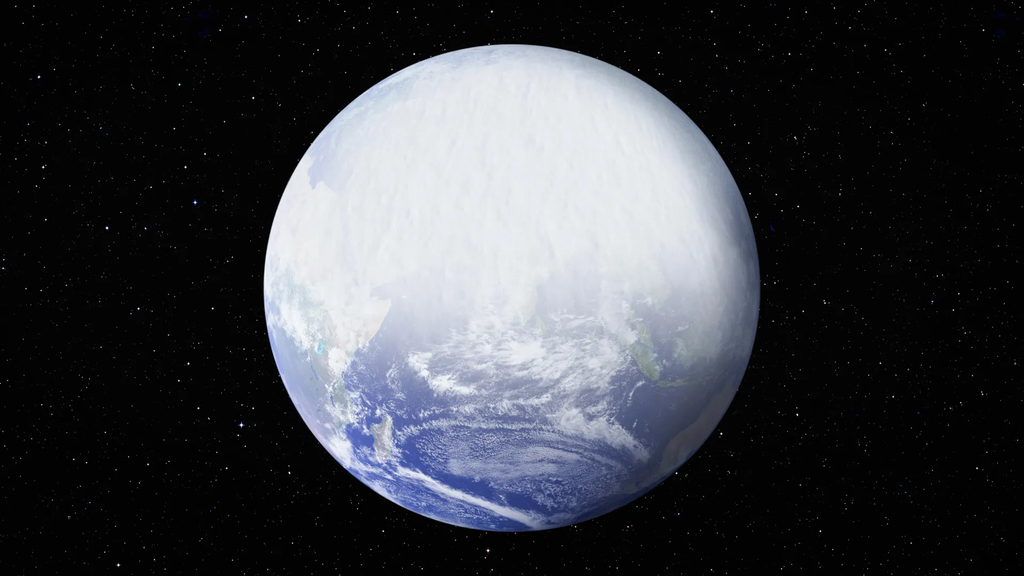
Earth’s next ice age may have already begun 2,000 years ago, but global warming stopped it before it could take hold. Credit: Shutterstock
About 2,000 years ago, the remnants of a massive ice sheet in the Canadian Arctic began expanding once again. According to new research, this slow buildup of ice may have marked the beginning of Earth’s next glacial period, commonly called an ice age. But something unexpected happened. By the 1960s, rising summer temperatures had reversed the trend, causing the ice to retreat instead of grow.
The findings suggest that global warming may have interrupted a new ice age that was already getting underway, fundamentally altering a natural climate cycle that has shaped Earth for millions of years.
“It was just getting started, everything was normal, the next glaciation was about to happen — and yet it stopped,” says Nicolás Young, a geochemist at Columbia Climate School’s Lamont-Doherty Earth Observatory. “It’s a very powerful example of how we have jolted the system.”
Ancient Arctic Ice Reveals a Surprising Climate History
In a study published in Science, Young and fellow Lamont geochemist Joerg Schaefer, along with their colleagues, investigated the history of the Laurentide Ice Sheet. This enormous mass of ice covered much of Canada and the northern United States between approximately 95,000 and 20,000 years ago.
At its greatest extent, the Laurentide stretched from north of the Arctic Circle all the way south to Illinois. In some locations, its ice was more than two miles thick. Although most of this enormous ice sheet disappeared as the climate warmed, one surviving piece remains.
Known as the Barnes Ice Cap, this ancient remnant sits on central Baffin Island in Nunavut, Canada, and covers an area roughly the size of Delaware.
“People always say that it disappeared, but that’s not true,” says Young.
Scientists already knew that the Laurentide Ice Sheet had repeatedly grown and retreated during the roughly 2.6 million years since extensive continental glaciation began in North America. What remained uncertain was whether the ice sheet had ever become smaller than it is today before expanding again.
Answering that question could reveal whether a new cycle of glaciation had begun much more recently than scientists previously believed.
(A note on terminology: Technically, we are still living in an ice age-the Late Cenozoic Ice Age-which started about 34 million years ago. Within it, colder glacial periods alternate with warmer interglacial ones, including the one we live in now. What people casually call an “ice age” is usually a glacial period. The last glacial period ended about 11,700 years ago.)
Ancient Plants Preserved Beneath Ice Hold the Clues
Piecing together the history of an ice sheet is particularly challenging when researchers are looking for evidence of its smallest extent and earliest stages of regrowth. As glaciers advance, they frequently scrape across the land, destroying the geological traces that could reveal where and when the ice first began spreading.
The Barnes Ice Cap, however, offers an unusual opportunity to investigate this history.
Unlike most glaciers, it is frozen directly to the bedrock beneath it and does not slide across the landscape. As a result, plants that once grew in areas later covered by expanding ice can remain preserved in place for thousands of years.
Since the Barnes Ice Cap began retreating in 1960, previously buried vegetation has gradually emerged from beneath the melting ice. Researchers can collect these ancient plant remains and determine when they were alive using radiocarbon dating.
This technique measures carbon-14, a harmlessly radioactive form of carbon that living organisms absorb from the atmosphere. Once an organism dies, its carbon-14 begins breaking down at a predictable rate. By measuring how much remains, scientists can estimate when the plant stopped growing and became buried beneath the ice.
These dates provide a record of when the advancing glacier covered different parts of the landscape.
“If you do this enough times, you can actually develop a timeline of that ice margin systematically advancing over plants. You’re actually tracking the expansion of that ice margin,” says Young.
Earth’s Next Ice Age May Have Begun 2,000 Years Ago
The research team examined ancient vegetation uncovered by the retreating Barnes Ice Cap, along with plant remains exposed beneath smaller ice caps that have recently melted in the surrounding region.
Together, these samples allowed the scientists to reconstruct thousands of years of glacial change.
Their results indicate that the Laurentide Ice Sheet reached its smallest extent approximately 3,000 years ago. Then, around 2,000 years ago, temperatures became cold enough for the remaining ice to begin expanding again.
Young and his colleagues argue that this renewed growth should be recognized as the start of Earth’s next glacial period.
That interpretation differs from previous research based on climate models, which has generally suggested that the next glaciation would not begin for thousands or even tens of thousands of years.
The disagreement partly comes down to how scientists define the beginning of a glacial period. Rather than waiting until enormous ice sheets have spread across continents, Young’s team proposes that the first sustained expansion of an existing ice sheet should mark the starting point.
Under that definition, the next glaciation had already begun long before modern scientists recognized it.
The discovery also casts new light on a controversial scientific debate from the 1970s, when some climate researchers suggested that another ice age might be approaching.
“It actually was happening,” Young says. “They couldn’t quite prove it, but now we sort of have the evidence.”
However, this early expansion would not have produced an immediate or dramatic transformation of the planet. According to Young, it would have taken thousands of years for the cooling to become noticeable and roughly 30,000 years for the Laurentide Ice Sheet to regain its enormous continental dimensions.
The process was only in its earliest stages when the warming climate brought it to a halt.
Global Warming Reversed the Growth of the Ice Sheet
By the 1960s, conditions had changed enough that the Barnes Ice Cap was losing more ice during the summer than it could replace through winter snowfall.
Instead of continuing to expand, the ancient ice began shrinking.
According to the researchers’ interpretation, this reversal effectively ended the developing glacial period before it could progress into a full-scale ice age.
The consequences may extend far beyond the present day. Models projecting the future of the Barnes Ice Cap indicate that it could disappear entirely within the next few centuries.
“That will be the true very last remains of the Laurentide, disappearing for good,” Young says.
The Loss of an Ancient Ice Cap Could Change Future Ice Ages
The disappearance of the Barnes Ice Cap could also have implications for how future glacial periods develop.
In the past, the Laurentide Ice Sheet provided a starting point for renewed glaciation whenever Earth’s climate cooled sufficiently. Because a large existing mass of ice helps create conditions favorable for further ice accumulation, it can trigger reinforcing processes that allow glaciers to expand.
Scientists describe this kind of process as a positive feedback. In this case, existing ice helps promote the growth of additional ice, allowing an ice sheet to become increasingly extensive as temperatures remain cold.
Without the Laurentide’s last surviving remnant, a future glacial period might unfold differently.
Researchers cannot yet determine when another glaciation could begin under atmospheric conditions influenced by elevated greenhouse gas concentrations. If enormous continental ice sheets eventually start forming again, they may have to develop without the ancient ice that previously helped initiate their growth.
The findings suggest that global warming has done more than melt glaciers and shrink existing ice sheets. It may have interrupted a glacial cycle that was already beginning, while also removing a feature that helped sustain ice age cycles across North America for millions of years.
“What has been an extremely natural and predictable phenomenon is now gone,” says Young.
Story Source:
Materials provided by Columbia Climate School. Note: Content may be edited for style and length.
Journal Reference:
- Nicolás E. Young, Gifford H. Miller, Martha Raynolds, Helga Bueltmann, Scott J. Lehman, Jonathan H. Raberg, Kylie Seward, Simon L. Pendleton, John T. Andrews, Patrick J. Webber, Joerg M. Schaefer. Late Holocene reexpansion of the Laurentide Ice Sheet. Science, 2026; 394 (6822): 455 DOI: 10.1126/science.aed3379
Here are some “ETs” recorded from around North America the last couple of days, their consequences, and some extreme temperature outlooks, as well as any extreme precipitation reports:
Here is More Climate News from Tuesday:
(As usual, this will be a fluid post in which more information gets added during the day as it crosses my radar, crediting all who have put it on-line. Items will be archived on this site for posterity. In most instances click on the pictures of each tweet to see each article. The most noteworthy items will be listed first.)