The main purpose of this ongoing blog will be to track planetary extreme, or record temperatures related to climate change. Any reports I see of ETs will be listed below the main topic of the day. I’ll refer to extreme or record temperatures as ETs (not extraterrestrials).😜
Main Topic: Record-Torching March Heat ‘Virtually Impossible’ Without Climate Change
Dear Diary. The hate dome in association with our first major heatwave of 2026, Artex, peaked out near 598 decameters on Thursday. It produced an all-time record max for March of 110°F at Martinez Lake, Arizona on Thursday.
Temperatures will come down slightly from this weekend into early next week over the Southwest but not below daily record levels in most instances. Record heat is now spreading into the Plains and Southeast.
This record warmth would not be possible without human induced climate change via the burning if fossil fuels for power. Here are more details from Dr. Jeff Masters and Bon Henson:
Record-torching March heat ‘virtually impossible’ without climate change » Yale Climate Connections
Record-torching March heat ‘virtually impossible’ without climate change
Friday’s spring equinox may seem like a quaint notion to those already enduring furnace-like 90-110°F summer heat.


by Jeff Masters and Bob Henson
March 20, 2026
A sign warns hikers of trail closures due to extreme heat at Camelback Mountain on Thursday, March 19, 2026, in Phoenix, Arizona. Phoenix hit 105°F, breaking its previous all-time March heat record of 100°F set on March 26, 1988. (AP Photo/Rebecca Noble)
Multiple all-time March heat records crumpled on Wednesday and Thursday, March 18-19, as one of the most extreme weather events in world history blitzed the Southwest U.S. and far northwest Mexico with unprecedented March heat. Many locations have been hit with their earliest 100-degree-Fahrenheit weather on record, smashing all-time March and even April records, and temperatures are expected to soar even higher in some areas Friday and Saturday as the heat crescendoes.
The extreme ridge of high pressure responsible for the heat wave peaked on Thursday, reaching an intensity of about 3.5 to four standard deviations above normal (for those technically savvy, the 500-millibar height maxed out at about 597 decameters). Even though this ridge is now slowly weakening, more pulses of record March heat could erupt from the Desert Southwest to Texas Tuesday through Thursday.
Both Mexico and the United States have already experienced their hottest March readings on record this week. On Wednesday, Mexicali set a March record for Mexico with 40.9 degrees Celsius (105.6°F), and on Thursday, that new record was smashed with 42.5 degrees Celsius (108.5°F) at Hermosillo. Meanwhile, the U.S. March record of 108°F set at Rio Grande City, Texas, on March 30, 1954, was tied at North Shore, California, on Wednesday, and then broken on Thursday with 110°F at Martinez Lake, Arizona.
‘Virtually impossible’ without the hand of humans
A rapid attribution study released Friday by the research group World Weather Attribution concluded that the current heat wave would be virtually impossible in a world without human-induced climate change. Global temperatures have risen by around 1.3 degrees Celsius since preindustrial times, but the affected region is warming more dramatically than many other parts of the world, and a lengthening “long tail” at the hot end of the climate spectrum now allows the most extreme regional heat episodes to warm by substantially more than 1.3 degrees Celsius.
Among the findings in the rapid attribution study:
- Hotter and more likely: The mercury in this heat wave has risen about 1.4°F (0.8°C) higher than it would have just a decade ago, and about 4.7 degrees Fahrenheit (2.6°C) higher than it would have in a preindustrial world.
- Rarity of the event: Despite its increasing likelihood, a heat wave on this scale is still a rare event in today’s climate and is expected to occur about once every 500 years at any one spot.
- Timing: Across the hardest-hit area, March is the month now showing the most substantial long-term warming signal for heat extremes. Typical March temperatures have risen by as much as 6 degrees Celsius in parts of this region.
- Rapidity of the change: In just a decade, an event on par with this one has become about four times more likely due to climate change.
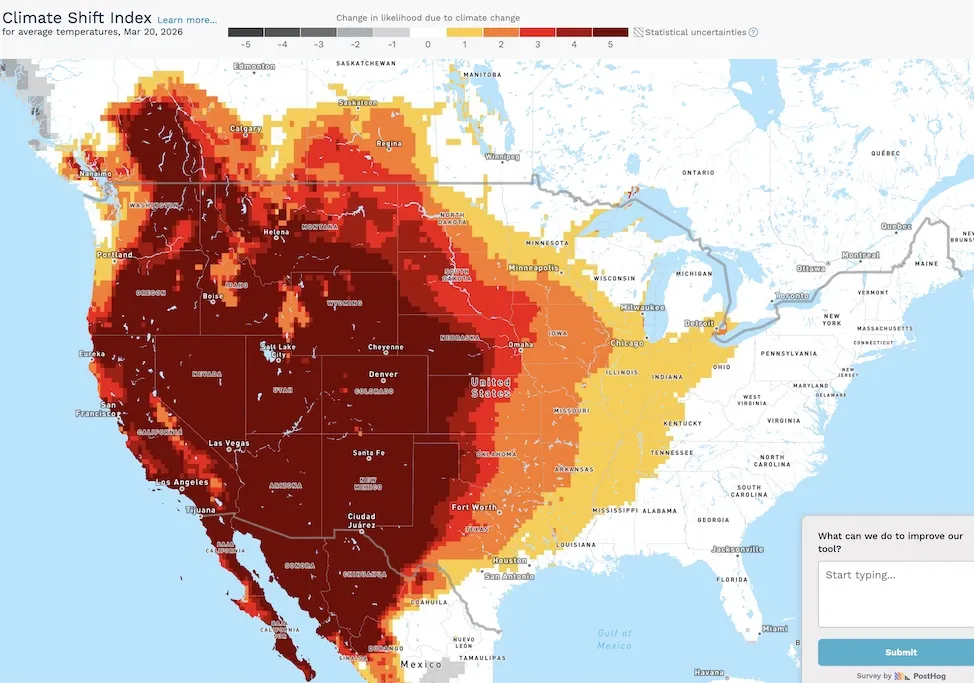
Figure 1. Climate Shift Index issued on Thursday, March 19, based on predicted temperatures for Friday, March 20. Most of the Western United States is enveloped by Level 5 heat, indicating that the odds of this extreme have been boosted at least fivefold by human-caused climate change. (Image credit: Climate Central)
Similar findings – that the intensity and scope of the current heat wave would have been virtually impossible without human-caused climate change – are embedded in results from the Climate Shift Index. This tool, created at the nonprofit Climate Central, estimates the odds by which climate change has shifted the odds of a particular extreme.
The Climate Shift Index for predicted U.S. temperatures for Friday, March 20 (see Fig. 2 above), shows broad areas with Level 5 results. These indicate where the odds of a depicted extreme have been increased fivefold by climate change. Such large values put the event into the realm where its likelihood in a preindustrial climate would be vanishingly small. (See the Bluesky thread below from Climate Central for the science behind that conclusion).
On top of the direct effects of this rapid-onset, multiday heat wave, including the risk of heat-related illness, the indirect effects on agriculture, water supply, and wildfires are likely to run into the billions of dollars. The implications for the U.S. Southwest are especially sobering, as snowpack had already been running at or near record lows. The massive upper high that’s connected to the ongoing heat wave is both suppressing any immediate hope of late-season snow and hastening the melt of whatever snow is left.
Two U.S. monthly heat records in a row
March 2026 is the second consecutive month in which the U.S. has set an all-time monthly heat record. On February 19, temperatures soared to 41.1 Celsius (106°F) at Falcon Dam in South Texas — the highest temperature ever recorded during meteorological winter (December-February) in the United States. The previous hottest U.S. winter temperature, according to NWS-Brownsville, was 40 degrees Celsius (104°F) in Rio Grande City, Texas, on Feb. 25, 1902.
As for astronomical winter, it ended with the vernal equinox at 10:46 a.m. EDT Friday, March 20 – so Thursday’s reading of 110°F at Martinez Lake, Arizona, if confirmed, will stand as the hottest U.S. temperature ever recorded in astronomical winter.
On Monday, the National Phenology Network reported that spring leaf-out is running far ahead of average in many parts of the U.S., including three to five weeks early in parts of Colorado, Kansas, and the Northern Great Plains and two to three weeks early in large parts of the Midwest, while leaf-out is running one to two weeks behind in parts of the coastal Southeast. The widespread early blooms could leave trees and shrubs vulnerable to a more seasonable April freeze.
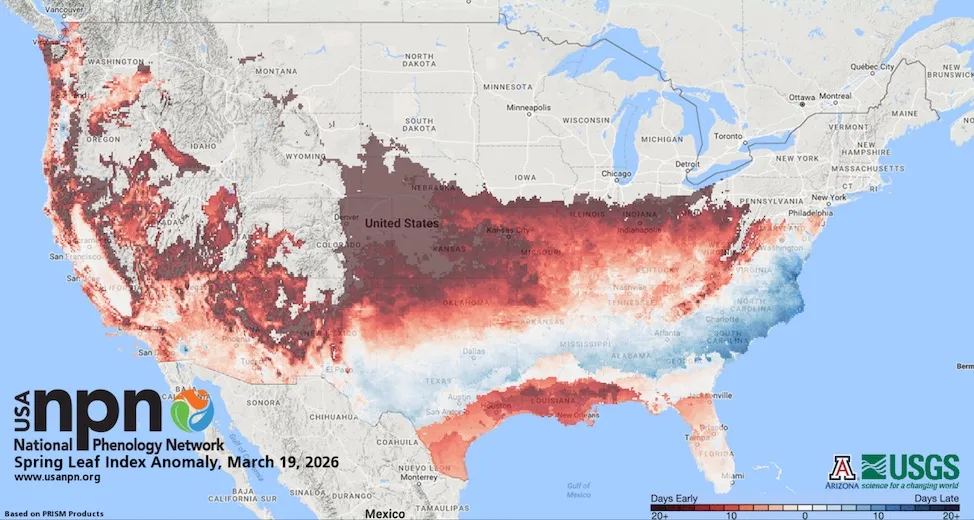
Figure 2. Spring leaf-out is running 20 or more days ahead of normal in parts of the Central Plains and Rockies. (Image credit: U.S. National Phenology Network.)
Truly bonkers: beating a previous all-time monthly record on 12 consecutive days
At the Grand Canyon’s gateway city of Flagstaff, Arizona, where weather records extend back to 1898, the all-time March temperature record before this bananas week was 73°F on March 17, 2007. On Tuesday, Flagstaff tied that record; Wednesday, it beat it by three degrees; and Thursday, it hit 84°F, demolishing the old March record by an astounding 11 degrees, and beating the all-time heat record for April by four degrees.
As detailed on Thursday by meteorologist Alan Gerard in his Balanced Weather Substack feed, the forecast maximum temperature for each of the next nine days — even a “cool” looking 73°F on Saturday, March 28 — would have been a monthly record before this year. That would make 12 consecutive days with high temperatures at or above Flagstaff’s previous monthly record high. Similar stories are unfolding for countless other stations with long-term periods of record in the West.
Five states have already broken or tied all-time monthly heat records this week, based on records and reports compiled below by weather records expert Maximiliano Herrera and Christopher Burt:
All-time monthly state high temperature records set this week:
—Wednesday, March 18
California: 108°F at North Shore (old record 107°F, Mecca Fire Station, March 21, 2004)
Arizona: 105°F at Laguna and Fort Yuma (old record 104°F, Yuma Quartermaster Station, March 21, 2004)
Wyoming: 86°F at Belle Fourche (tie, first set at Pine Bluffs, March 20, 1907)
—Thursday, March 19
Arizona: 110°F at Martinez Lake, Arizona (old record 105°, set the previous day at Laguna and Fort Yuma)
California: 109°F at Dos Palmas, Buttercup, and Cahuilla (old record 108°F, set the previous day at North Shore)
Nevada: 103°F at Laughlin (old record 100°F at Laughlin, March 17, 2007, and Bunkerville, March 18, 2007)
Utah: 93°F at St George, Zion Canyon, White Riff, and San Juan (tie, first set at La Verkin, March 21, 2004, and Lytle Ranch, March 22, 2004)
Wyoming: 87°F at Torrington and Guernsey (old record: 86°F, set the previous day at Belle Fourche, and at Pine Bluffs on March 20, 1907)
Many individual towns and cities have also broken their all-time March records, including as far north on Thursday as Denver, Colorado (85°F, topping 84°F from March 26, 1971) and Rapid City, South Dakota (86°F, beating 84°F from March 15, 2015). And as noted by Herrera, dozens of locations have already exceeded their all-time April records, including Kingman and Flagstaff, Arizona, and Albuquerque, New Mexico.
Christopher Burt contributed to this post.

Jeff Masters
Jeff Masters, Ph.D., worked as a hurricane scientist with the NOAA Hurricane Hunters from 1986-1990. After a near-fatal flight into category 5 Hurricane Hugo, he left the Hurricane Hunters to pursue a… More by Jeff Masters

Bob Henson
Bob Henson is a meteorologist and journalist based in Boulder, Colorado. He has written on weather and climate for the National Center for Atmospheric Research, Weather Underground, and many freelance… More by Bob Henson
Dr. Jeff and and Bob Henson’s “Record-torching March heat ‘virtually impossible’ without climate change” was first published on Yale Climate Connections, a program of the Yale School of the Environment, available at: http://yaleclimateconnections.org. This work is licensed under a Creative Commons Attribution-Noncommercial-No Derivative Works 2.5 license (CC BY-NC-ND 2.5).
More:
Here are some “ETs” recorded from around the U.S. the last couple of days, their consequences, and some extreme temperature outlooks, as well as any extreme precipitation reports:
Here is More Climate News from Saturday:
(As usual, this will be a fluid post in which more information gets added during the day as it crosses my radar, crediting all who have put it on-line. Items will be archived on this site for posterity. In most instances click on the pictures of each tweet to see each article. The most noteworthy items will be listed first.)