The main purpose of this ongoing blog will be to track planetary extreme, or record temperatures related to climate change. Any reports I see of ETs will be listed below the main topic of the day. I’ll refer to extreme or record temperatures as ETs (not extraterrestrials).😜
Main Topic: Why ‘Decoupling’ Energy Emissions from Economic Growth Underpins the Green Transition
Dear Diary. One thing that scares people away from our global green transition is the fear that their materialistic lifestyles will be stunted or reversed. Everyone wants their proverbial cake and eat it too. Au contraire. Economies can now expand with more goods being produced and consumed without any more carbon going into the air. The proliferation of solar energy alone can produce enough power alone for expansion, including the building of AI data centers. That’s fantastic news!
For more on this here is a new report from the Conversation:
Why ‘decoupling’ energy emissions from economic growth underpins the green transition
Published: March 20, 2026 10:16am EDT

Drax power station in North Yorkshire, England. btimagery/Shutterstock
Author
Farooq Sher Senior Lecturer, Department of Engineering, School of Science and Technology, Nottingham Trent University
When people talk about tackling climate change, the images are often solar panels, wind turbines and electric cars. But the bigger question is whether economies can grow without releasing more carbon. This hinges on “decoupling” – the idea that economic growth can be separated from greenhouse gas emissions.
At first glance, that sounds almost magical. How can a country expand without using more energy or producing more emissions? Yet decoupling is already happening. According to analysis from a thinktank called the Energy & Climate Intelligence Unit, economies responsible for roughly 92% of global GDP now show some form of decoupling. This means that emissions either rise more slowly than output or fall while GDP grows. So the historical link between growth and emissions can be weakened.
This is not abstract theory. In the UK, greenhouse gas emissions were around 54% lower in 2024 than in 1990 while the economy expanded. Falling emissions alongside rising GDP show that growth no longer always equals more pollution and that net zero targets could be achieved without forcing economic stagnation.
However, there is a distinction to make. This distinction is between relative decoupling and absolute decoupling. Relative decoupling is when growth slows relative to economic growth. Absolute decoupling, which is required to achieve net zero, is a reduction in emissions while economic growth increases. This is the only decoupling that can help achieve climate targets.
Earth systems scientist Mark Maslin explain the concept of net zero.
One way decoupling can occur is through a transformation in the energy sector. This is necessary to move towards renewable electricity sources. This is because there has been an increase in the use of clean energy sources relative to fossil fuels in some countries. However, this is not enough, as there is a need to make better use of clean energy through an improved grid system to avoid energy waste.
Energy efficiency is another major component. Across transport, buildings and industry, measures such as better insulation, efficient equipment and smarter process control can cut energy use for the same output. According to the International Energy Agency, energy intensity (the energy needed per unit of economic output) needs sustained declines of about 4% per year this decade to meet net zero goals. This shows that significant efficiency gains remain achievable.
Another important factor is technological innovation. For example, clean hydrogen, carbon capture, smart grids, and the electrification of transport can help an economy grow while emissions fall. However, it is only possible if it is integrated into the entire system, rather than being seen as a separate technology. It is similar to traffic flow. For example, building more roads is not a solution if traffic is a problem. Similarly, deploying renewables is not a solution if the entire energy system is not seen as a single system.
Zooming out and focusing in
Decoupling is not automatic. For example, sectors such as aviation, cement, steel, chemicals, electricity and heat are among the most carbon-intensive parts of industrial manufacturing. These are widely considered “hard-to-abate” sectors, as their emissions remain closely tied to high-temperature processes and fossil fuel use.
Even in easier-to-abate sectors, such as electricity generation and road transport, there can be a rebound effect. This means that efficiency gains or lower energy costs lead to increased overall demand. To overcome these challenges, it is critical to focus on the performance of the entire system.
The good news is that decoupling is becoming increasingly visible. There is evidence of this across many economies, including the UK, US, Germany and France, where emissions have declined while GDP has continued to grow. In the UK, emissions have fallen while GDP has grown. This indicates that growth and climate protection need not be in conflict, and that good engineering and system design can support both.

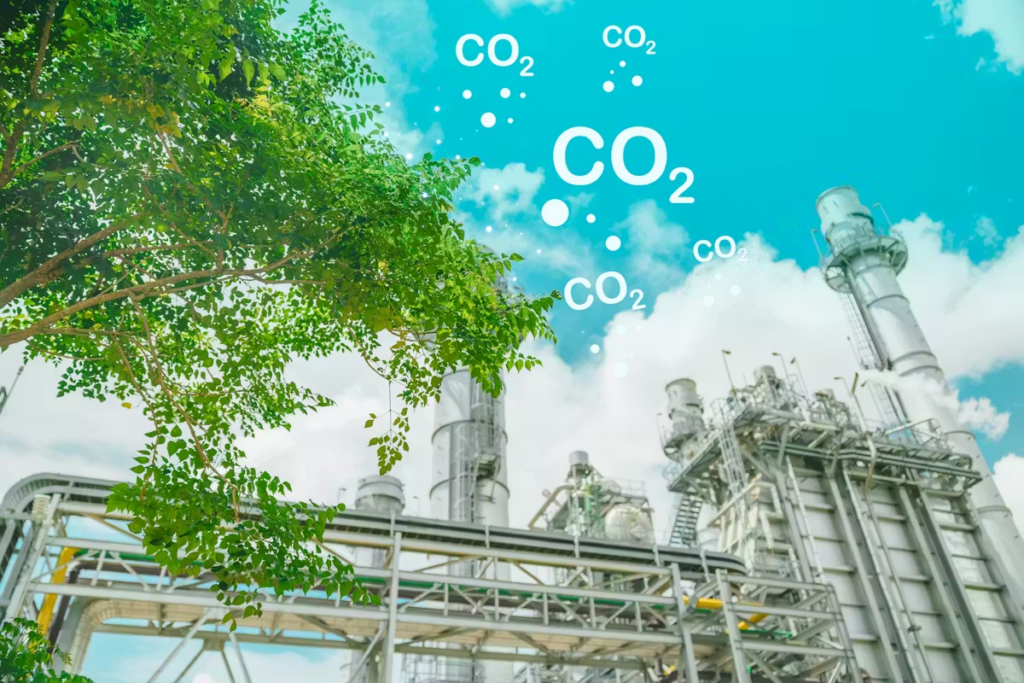
Decoupling economic growth from reliance on fossil fuels is a major undertaking but must become the norm. Quality Stock Arts/Shutterstock
To deliver net zero by 2050, absolute decoupling must become the norm. This means going beyond renewable targets and considering system design, infrastructure, flexibility, efficiency and integration across energy, transport and industry.
Combined with policy and investment approaches that reward lower carbon intensity, these strategies could substantially cut cumulative emissions. For example, if global energy intensity improves by around 4% per year through 2035 (meaning economies use less energy to produce the same level of output, such as through better building insulation, more efficient industrial equipment and electrification of transport) billions of tonnes of CO₂ could be avoided while GDP continues to grow.
Similarly, if countries achieve reductions comparable to the UK’s 54% cut in emissions since 1990 – which was driven largely by phasing out coal in power generation, expanding renewables, improving energy efficiency and shifting towards lower-carbon fuels – net zero pathways could become far more feasible. This makes decoupling a practical roadmap for the green transition.
Here are some “ETs” recorded from around the U.S. the last couple of days, their consequences, and some extreme temperature outlooks, as well as any extreme precipitation reports:
Here is More Climate News from Sunday:
(As usual, this will be a fluid post in which more information gets added during the day as it crosses my radar, crediting all who have put it on-line. Items will be archived on this site for posterity. In most instances click on the pictures of each tweet to see each article. The most noteworthy items will be listed first.)