The main purpose of this ongoing blog will be to track planetary extreme, or record temperatures related to climate change. Any reports I see of ETs will be listed below the main topic of the day. I’ll refer to extreme or record temperatures as ETs (not extraterrestrials).😜
Main Topic: Where Summer-Like Heat Has Shattered Records from Heatwave Artex — And Where It Will Spread Next
Dear Diary. March madness commenced over the weekend, but on this blog we are talking about astounding monthly record temperatures bring set over many southern and Plains states and not basketball. The earliest heatwave that I have named during a year, which was CAT3 Heatwave Artex, was historic because it set all-time March records for 14 states. Not only that, Artex set the all-time max of 112°F at multiple stations from California into Arizona for the month of March for the United. I am retiring the name of Artex just like the hurricane center retires hurricane names when certain hurricanes become historic in nature.
Artex would not have been possible unless without our burning of fossil fuels since the 19th century.
On Sunday heat from Artex moderated below weather service criteria for advisories or warnings, so these were dropped. Thus, Artex has ended, but its ghost, or heat dome persists, so more daily and maybe even monthly records will be set through this week across mainly the southern tier of states.
The Washington Post has written a good summary on Artex and forecast record heat going into next weekend, which I am reposting here. (To see a couple of charts thar I did not repost, hit the following link.):
March warmth has been off the charts. Where it will continue this week. – The Washington Post
Where summer-like heat has shattered records — and where it will spread next
Around 540 additional high-temperature records could be broken across 28 states from coast-to-coast this week.
March 23, 2026 at 7:04 a.m. EDT
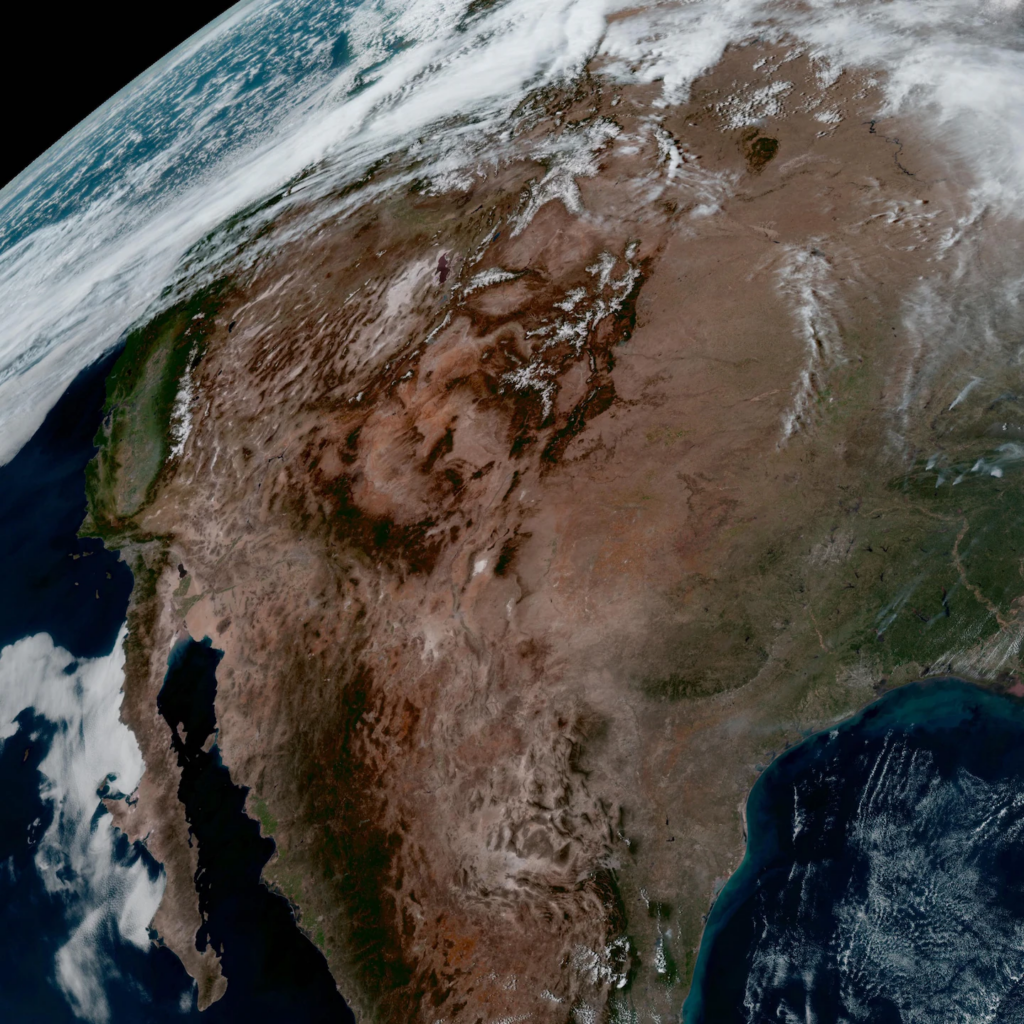
Not a cloud to be found over the Southwest on Friday, when a new national temperature record of 112 degrees for the month of March was set in the United States. (NOAA/NESDIS)

By Ben Noll
A record-breaking heat dome will continue to bring abnormally warm temperatures across the West this week as some of its summer-like heat spreads east.
At least 14 states have preliminarily broken their March high temperature record. On Thursday, a new national temperature record for March of 110 degrees was set in Arizona. That stood for one day — until it reached 112 degrees in Arizona and California on Friday. Now, around 540 additional high-temperature records are forecast to be neared, tied or broken across 28 states from coast-to-coast.
“This is one of the more anomalous heat events that we’ve ever observed in the Southwestern United States,” said climate scientist Daniel Swain in a live-stream broadcast.
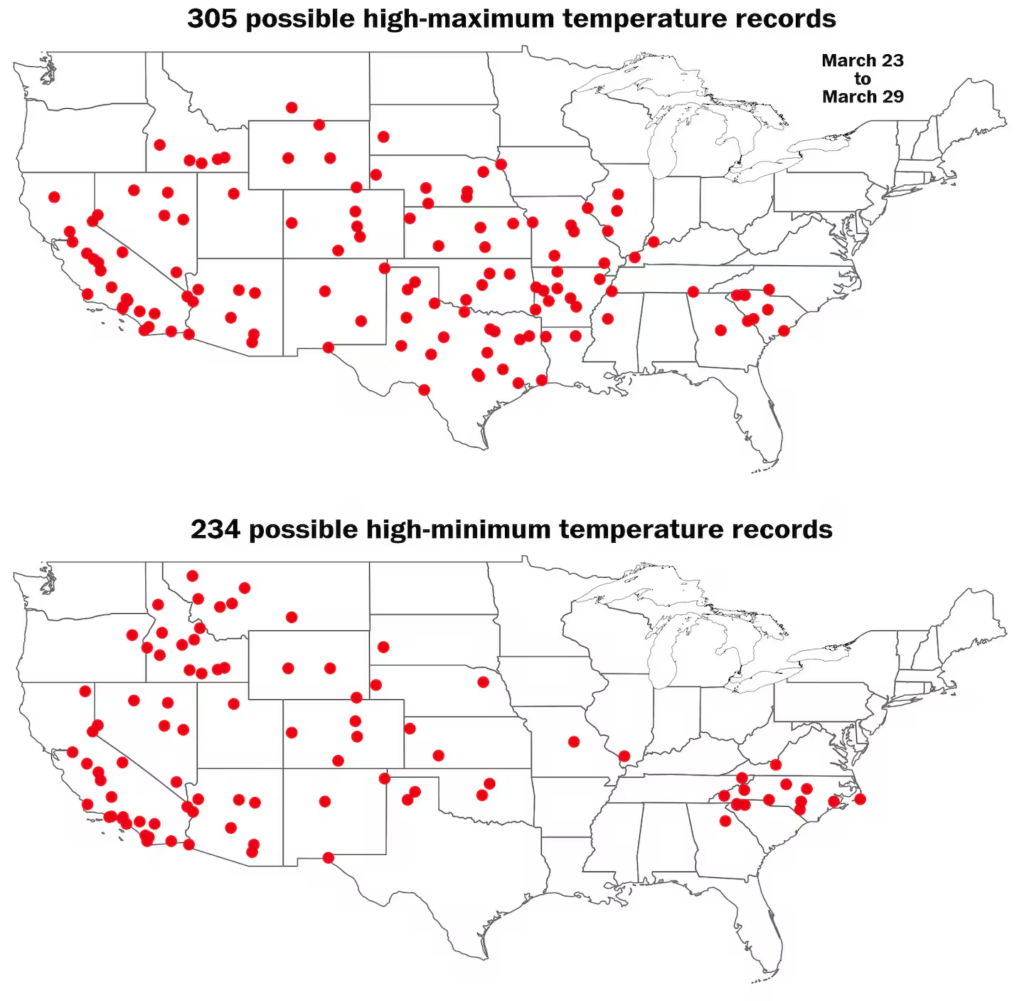
Around 540 high-temperature records may be neared, tied or broken at 157 locations over the next week, shown here. (Ben Noll/The Washington Post; data source: NOAA)
Here are new statewide March temperature records that have been set so far, according to data analyzed by weather historian Maximiliano Herrera.
- Arizona: 112 degrees near Yuma and Martinez Lake.
- California: 112 degrees near Ogilby and Winterhaven.
- Nevada: 106 degrees near Laughlin.
- Kansas: 101 degrees near Phillipsburg and Plainville.
- New Mexico: 100 degrees near Carlsbad.
- Nebraska: 99 degrees near Cambridge.
- Iowa: 97 degrees near Honey Creek.
- Missouri: 97 degrees near Harrisonville and St. Charles.
- South Dakota: 97 degrees near Vermillion.
- Utah: 97 degrees near St. George.
- Colorado: 96 degrees near Burlington and Campo.
- Wyoming: 90 degrees near Guernsey, Torrington and Wheatland.
- Minnesota: 88 degrees near Luverne.
- Idaho: 86 degrees near Star.
Western heat expands east
The week will start with more extreme heat in the West before it expands into the Plains and parts of the Midwest and Southeast from Tuesday to Friday.
On Wednesday, the high could reach 90 degrees in Denver. That would be more than a month earlier than the earliest 90-degree day on record there. Also Wednesday, it’s forecast to reach 92 degrees in Albuquerque — after reaching 91 there this past Saturday, a record for March and April. In Phoenix, high temperatures topped 100 degrees for five straight days — reaching as high as 105 — the earliest such streak on record. More 100-degree heat is forecast there this week.
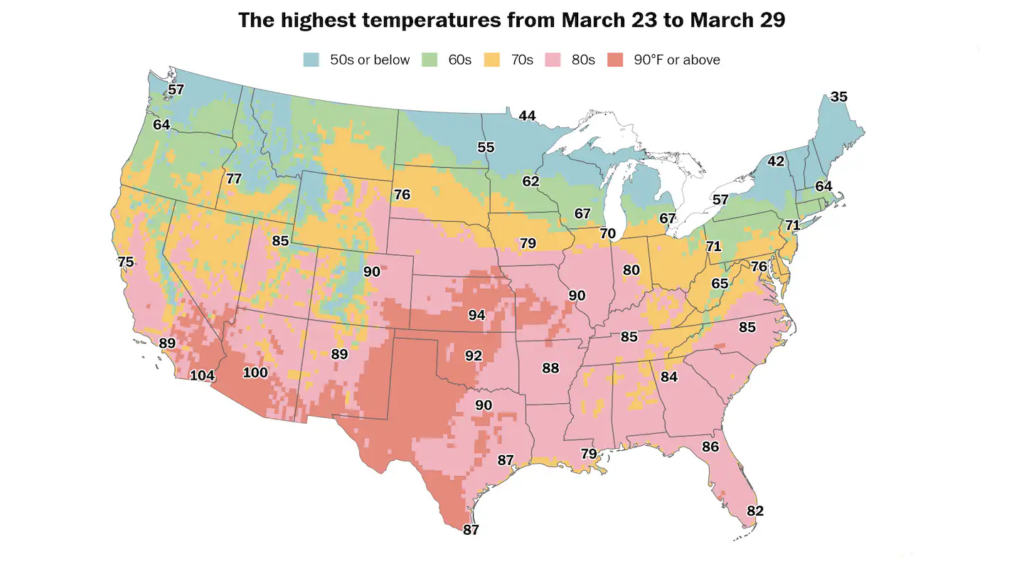
Around 27 million people across the United States may experience 90-degree heat this week. (Ben Noll/The Washington Post; data source: ECMWF)
On Wednesday, record warmth could affect areas from the Dakotas to Texas, spreading eastward to Kentucky and Tennessee on Thursday and reaching Georgia and the Carolinas on Friday — with highs in the 80s and 90s.
Around the end of the month, more seasonable weather could return to the West — including the chance for some precipitation — as unusual warmth pushes eastward, with a warm start to April possible near the East Coast.
An extreme month in the U.S.
It’s been the warmest March on record so far across the United States — and it could become one of the most unusually warm months overall, with a nationwide departure from average of 6 to 8 degrees.
The most unusually warm states have been California, Arizona and Nevada, all experiencing temperatures of at least 9 degrees above-average so far this month.
The heat dome formed due to weakened jet stream winds, creating a traffic jam in the atmosphere near North America and causing weather patterns to stagnate — which is part of the reason Hawaii has seen relentless rain and destructive flooding. The dome’s strength was probably, in part, a result of unusual polar vortex behavior, and the extreme temperatures it produced were likely boosted by climate change.
Although it has been particularly cold in Alaska, no contiguous states have experienced below-average temperatures so far this month.
By Ben Noll Ben Noll is a meteorologist passionate about explaining the why behind the weather, extreme events and climate trends. He has expertise in data analysis, supercomputer-driven graphics and forecasting weather worldwide. follow on X@BenNollWeather
Much More:
Here are some “ETs” recorded from around the U.S. the last couple of days, their consequences, and some extreme temperature outlooks, as well as any extreme precipitation reports:
Here is More Climate News from Monday:
(As usual, this will be a fluid post in which more information gets added during the day as it crosses my radar, crediting all who have put it on-line. Items will be archived on this site for posterity. In most instances click on the pictures of each tweet to see each article. The most noteworthy items will be listed first.)