The main purpose of this ongoing blog will be to track planetary extreme, or record temperatures related to climate change. Any reports I see of ETs will be listed below the main topic of the day. I’ll refer to extreme or record temperatures as ETs (not extraterrestrials).😜
Main Topic: Why There’s More to Renewables Than Tackling the Climate Crisis
Dear Diary. Most of us know that renewable energy from solar, wind, geothermal and other sources are meant to generate electricity without emitting more carbon into the atmosphere that us changing our climate for the worse. There are other benefits such as improving air quality and getting independence from relying on other countries to procure fossil fuels.
Some of these countries that rely heavily on oil production like Saudi Arabia and Venezuela have very corrupt governments that true democracies won’t want to deal with. The ongoing war with Iran hinging on the oily bottleneck in the Strait of Hormuz is a direct result of addiction to fossil fuels. Countries are now scrambling to break that addiction via quickly erecting renewable infrastructure with leadership coming not from the U.S. but from China.
A recent Guardian article has delt with this subject and is used for our main subject of the day:
The net benefits of net zero: why there’s more to renewables than tackling the climate crisis
Regardless of the environment, the shift away from fossil fuels brings an array of additional upsides, from technological innovation and job creation, to energy security and national resilience
By Rhymer Rigby
Illustration and animation: Kürşat Ünsal
Paid for by

Mon 23 Mar 2026 12.20 EDT
The environmental benefits of cleaner energy are well known. These range from mitigating climate change to eliminating pollution near generating sources. In the UK, decarbonising the electricity grid is already a big environmental success story. Greenhouse gas emissions attributable to electricity supply fell by more than 50% between 1990 and 2022, faster than any other source. Meanwhile, once widespread problems such as acid rain are a fading memory in many countries, especially in the west.
But there are myriad other benefits to having a clean energy network. Clean power generation and distribution are very much industries of the future and tend to deliver high value jobs. Better still, in countries like the UK and the US, these jobs are likely to be located outside the prosperous cities and are often in the areas that have been hit the hardest by industrial decline.
“The green economy, which is the second fastest growing sector globally, has the capacity to create well-paid jobs, revitalising communities across the country,” says James Alexander, CEO of the UK Sustainable Investment and Finance Association.
Job creation
It is estimated that up to 300,000 more skilled workers are required to build out the network. As well as creating jobs building equipment and making components, these industries also deliver new jobs servicing infrastructure. The biggest ever rewiring of Britain’s electricity grid since electrification is now underway and creating tens of thousands of jobs in energy and its supply chains. ScottishPower’s SP Energy Networks will create 1,400 new jobs and support 11,000 more just in its transmission upgrades alone. It is also true of offshore wind, which requires significant maintenance by highly skilled workers. The number of people working in the offshore wind industry has risen from just over 32,000 in 2023 to almost 40,000 in 2025 – an increase of 24%. Altogether 55,000 people now work in the wind industry. These jobs typically pay well and are predominantly located in places where they often didn’t exist before – for instance in the UK’s coastal towns, particularly in the north-east of Scotland, east of England and the Humber. Decarbonised energy also creates jobs in related areas ranging from green finance to domestic retrofit.
Analysis by the Confederation of British Industry (CBI) last year showed that the UK net zero economy (encompassing renewable energy and related activities such as green finance) grew by 10% in 2024, far more strongly than the economy as a whole, generating £83bn in gross value added. The CBI further found that net zero businesses employed almost a million people and paid average salaries of £43,000, which is £5,600 higher than the national average. Speaking in January this year, the chancellor, Rachel Reeves, said: “There is no trade-off between economic growth and net zero. Quite the opposite. Net zero is the industrial opportunity of the 21st century.”
Cheaper bills
Green energy also holds out the possibility of significantly cheaper power. While renewables tend to be expensive to build, with high upfront costs, they provide cheaper power once built and aren’t exposed to the volatile global gas markets.
Of course, this isn’t just good for household consumers. Cheaper renewable power benefits existing industries, particularly those that are power intensive. One notable example of this outside the UK is Iceland, which is a major aluminium exporter despite having no bauxite (aluminium ore) mines. Rather, its abundant geothermal energy capacity makes it economical to ship in aluminium ore, smelt it and export low-carbon aluminium.
Although decarbonising the grid is often viewed as being about inputs (such as solar and wind power), the actual grid itself is equally crucial and requires significant investment and upgrading. “An economy powered by renewable energy will require an equally powerful electricity grid,” says Layla Sawyer, secretary general of CurrENT, which represents grid technology providers in Europe. “Investing in new, innovative technologies that can transport enormous quantities of electricity to the places where it is needed will allow Europe to remain an attractive location for industries that rely on cheap energy.”
National security
Another significant benefit of a decarbonised grid is national security. “For decades, the UK’s dependence on imported fossil fuels has left us hugely vulnerable to price shocks, threatening families and businesses,” says Alexander. “We can break this cycle by expanding our use of domestic renewable power.”
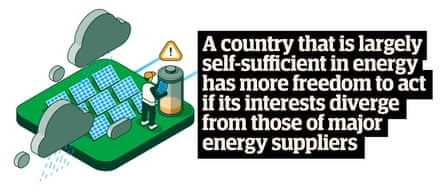
Energy security also has a strong geopolitical dimension. A country that is largely self-sufficient in terms of energy has more freedom to act if its interests suddenly diverge from those of major energy suppliers. This issue was thrown into sharp relief in 2022 when Russia invaded Ukraine. Gas prices spiked, and suddenly many European countries found themselves energy dependent on an aggressive neighbour. If that wasn’t enough of a wake-up call, this year’s war in the Middle East has given us the latest geopolitical lesson in the connection between national resilience and energy self-sufficiency.
Finally, there are the economic and geopolitical benefits of being at the forefront of technology in an ever more competitive world. Sawyer says: “We also have the chance to remain a global leader in the development of innovative grid technologies, while decreasing our reliance on imported fossil fuels, and the strings that are attached.”
Here are some “ETs” recorded from around the U.S. the last couple of days, their consequences, and some extreme temperature outlooks, as well as any extreme precipitation reports:
Here is More Climate News from Saturday:
(As usual, this will be a fluid post in which more information gets added during the day as it crosses my radar, crediting all who have put it on-line. Items will be archived on this site for posterity. In most instances click on the pictures of each tweet to see each article. The most noteworthy items will be listed first.)