The main purpose of this ongoing blog will be to track planetary extreme, or record temperatures related to climate change. Any reports I see of ETs will be listed below the main topic of the day. I’ll refer to extreme or record temperatures as ETs (not extraterrestrials).😜
Here is a new feature for this blog, which I will add daily. This is the latest inciteful Green News Report from my friends Desi Doyen and Brad Friedman at Progressive Voices. Hit ‘continue reading,’ listen, then hit return to see my daily topics:
Main Topic: A Costly War That Can Be Avoided in the Future with a Switch to EVs
Dear Diary. We all know by now how high the price of gasoline is now due to Trump’s war with Iran. As stated on past posts, the one silver lining to the war is that it is spurring on a transition to green energy and causing drivers to think twice about another purchase of gasoline powered vehicles.
I do feel for folks having to pay near five dollars a gallon just to commute to work or run errands. I no longer drive or own an automobile, but if I did so my next purchase would be an electric car. This is now making economic sense for all, not to mention how essential a switch to EVs is to stabilize our climate.
Here are more details on how much the Iran War is costing drivers:
Trump’s Iran War Has Already Cost Americans Over $40 Billion Extra on Gas and Diesel | Common Dreams
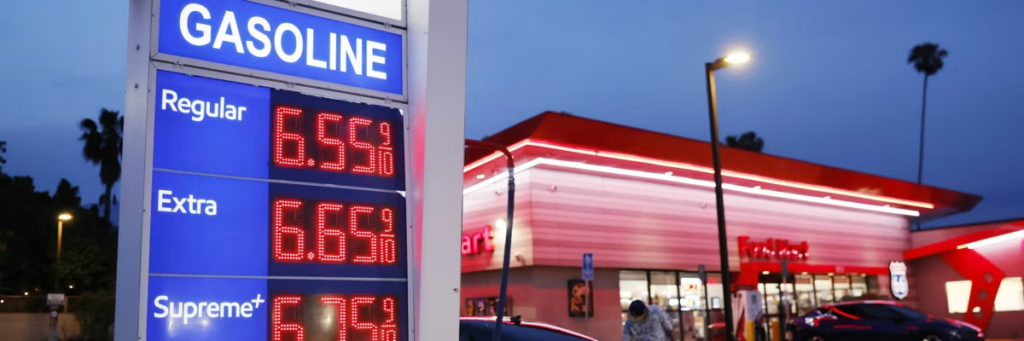
Gas prices are displayed at a Mobil gas station on March 30, 2026 in Pasadena, California, as the average price of one gallon of regular self-service gasoline rose to $5.99 in Los Angeles County. (Photo by Mario Tama/Getty Images)
Trump’s Iran War Has Already Cost Americans Over $40 Billion Extra on Gas and Diesel
“This data shows that energy price shocks function as an economy-wide, unacknowledged tax on households, with costs comparable to large federal programs and policies,” said the Climate Solutions Lab director.
May 18, 2026
An analysis released Monday by Brown University researchers shows President Donald Trump’s illegal war on Iran has cost American consumers over $40 billion more at the fuel pump since late February.
Iran has responded to the US-Israeli aggression by restricting ship traffic through the Strait of Hormuz, which has limited the trading of fertilizer and fuel. The International Energy Agency’s executive director warned Monday that the world only has weeks’ worth of oil reserves left.
With the trade route largely closed, including during the current ceasefire, fuel prices around the world have soared. As of Monday, the average price for a gallon of gasoline in the United States was $4.515. Brown’s Climate Solutions Lab and Costs of War Project have launched an online tool to track the rising costs for US consumers.
So far, according to the tool, price hikes tied to the war have cost Americans over $41.9 billion extra for diesel ($18.66 billion) and gas ($23.28 billion), based on prewar data, or an average of more than $320 per US household.
“This data shows that energy price shocks function as an economy-wide, unacknowledged tax on households, with costs comparable to large federal programs and policies,” said Jeff Colgan, director of the Climate Solutions Lab, in a statement.
The new research brief from Brown highlights how that money could have been spent to improve Americans’ lives. For example, that $40 billion “could pay for the entire federal Bridge Investment Program announced in 2024 to repair, restore, and modernize over 10,200 of the nation’s bridges.”
The full figure also exceeds “the estimated cost of completely redoing the US air traffic control system ($31.5 billion),” the brief states. It’s also two times the cost of the Biden administration’s proposed electric vehicle charging and electrification programs ($18.9 billion).
“Rising fuel costs are just one of the many financial costs of this war,” noted Costs of War director Stephanie Savell. “Official estimates of Iran War costs are just scratching the surface of the actual burdens Americans will face because of it.”
Researchers, policymakers, and other critics have been sounding the alarm about the various costs of Trump’s war—including human lives lost, infrastructure damage in the Middle East, and rising prices around the world—throughout the conflict.
Earlier this month, a report from the office of US Sen. Ed Markey (D-Mass.) projected that if gas prices remain at their current level, it will cost Americans an extra $73.06 per month, or $876 per year, to fill up just one vehicle.
An analysis published Friday from the liberal think tank Center for American Progress stressed that the increased fuel and fertilizer prices are hitting rural families and farmers—which are key to Trump’s base—particularly hard.
Globally, during the first month of the war, consumers and businesses lost up to $111.6 billion due to rising fuel prices, according to the climate group 350.org—which emphasized that its estimate did not account for “wider knock-on effects, such as rising fertilizer and food costs, declines in economic output and employment, or broader inflation driven by fossil fuel price volatility.”
“Over $100 billion has gone straight into the pockets of fossil fuel companies,” 350.org chief executive Anne Jellema said at the time, “while families struggle to afford energy and basic necessities.”
In his public comments, the president has repeatedly made clear that he does not care about how his war impacts the public. Last week, when asked about how much “Americans’ financial situations” were on his mind as he tries to negotiate an end to the conflict, Trump said, “Not even a little bit.”
Our work is licensed under Creative Commons (CC BY-NC-ND 3.0). Feel free to republish and share widely.
Jessica Corbett is a senior editor and staff writer for Common Dreams.
Here are some “ETs” recorded from around the U.S. the last couple of days, their consequences, and some extreme temperature outlooks, as well as any extreme precipitation reports:
Here is More Climate News from Monday:
(As usual, this will be a fluid post in which more information gets added during the day as it crosses my radar, crediting all who have put it on-line. Items will be archived on this site for posterity. In most instances click on the pictures of each tweet to see each article. The most noteworthy items will be listed first.)