The main purpose of this ongoing blog will be to track planetary extreme, or record temperatures related to climate change. Any reports I see of ETs will be listed below the main topic of the day. I’ll refer to extreme or record temperatures as ETs (not extraterrestrials).😜
Here is a new feature for this blog, which I will add daily. This is the latest inciteful Green News Report from my friends Desi Doyen and Brad Friedman at Progressive Voices. Hit ‘continue reading,’ listen, then hit return to see my daily topics:
Dear Diary. The entire North American continent is excited to host the World Cup this year. Since the big event is happening during summer, officials will have to watch athletes to see that they don’t get overheated. Excess heat is a player that is very much nit wanted on fields, but at some venues must be dealt with.
West Coast and southern U.S. cities, as well as those in Mexico, look most vulnerable to extreme heat on the field. Thankfully, a cool vortex milling about the Midwest will keep most of the country near average or cooler than average for the rest of this month:
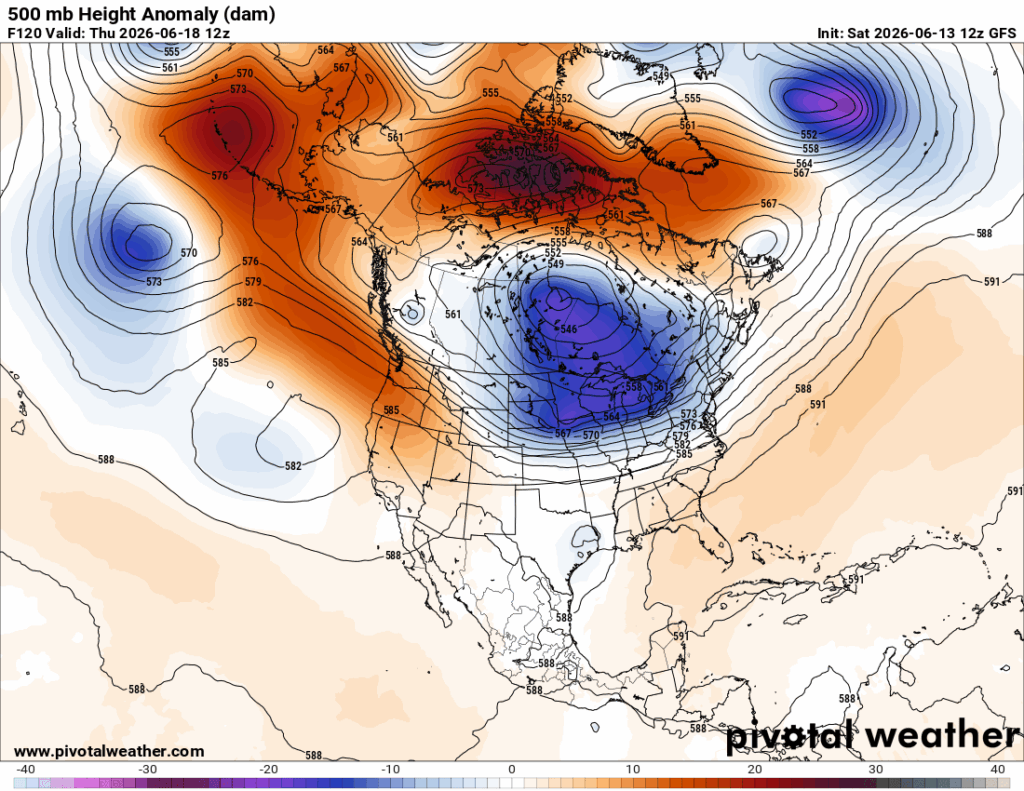
Still, climate change has already come to Miami where heat and humidity have ramped up compared to what typically was experienced twenty years ago. Miami would be my pick for a venue in which the most heat issues will be occurring during the 2026 World Cup.
Here are more details from the New York Times:
Hazardous Temperatures Forecast for Many World Cup Games – The New York Times
Also Expected to Take the Field at the World Cup: Hazardous Heat
Many of the tournament’s host cities risk hitting dangerous heat levels this year, raising questions about the safety of players and fans.

Thiago Santos, a player with Brazil’s Fluminense team, during a cooling break at a match in New Jersey last July.Credit…Paul Ellis/Agence France-Presse — Getty Images
June 11, 2026
As the world’s elite soccer players take the pitch on Thursday to begin the 2026 World Cup, heat, too, is expected to be right there with the athletes and spectators.
Since the last time World Cup matches were played in North America in 1994, the world has warmed roughly 1.3 degrees Fahrenheit. And the frequency of extreme heat in June and July has on average tripled across this year’s 10 host cities that previously hosted World Cup games.
The numbers raise questions not only about the safety of players and fans, but also whether international football is prepared for an ever-warmer future caused by the burning of fossil fuels.
In recent days, the English team has practiced in the Miami sun in an effort to acclimatize its athletes and prepare for what could be one of the hottest tournaments on record. And last month a group of 21 scientists, including physiologists and climate experts, wrote to FIFA, the sport’s governing body, saying that its current safety guidelines for heat were insufficient and “impossible to justify,” and urging it to give players longer breaks and implement “aggressive” locker-room cooling, among other steps.
The previous World Cup tournament, played in Qatar in 2022, was scheduled during the winter months partly to avoid blazing temperatures.
This year’s World Cup will feature 104 matches, or 40 more than any previous tournament, and a quarter of the games are likely to be played under conditions that risk heat stress, according to World Weather Attribution, a climate science research initiative at the Imperial College London.
A FIFA spokesman wrote in a statement that the organization is “committed to protecting the health and safety of all players, referees, fans, volunteers and staff.” When forecasts indicate high temperatures, World Cup venues will “activate additional cooling capacity, including shaded areas, misting systems, cooling buses and expanded water distribution,” he wrote, and FIFA has trained match doctors to use custom cooling bags that allow immediate treatment at any location.
This World Cup will be the first to implement mandatory three-minute cooling breaks midway through each half. The organization will also install climate-controlled benches for substitutes and staff at outdoor stadiums. Several matches have been scheduled for evening hours to account for higher daytime temperatures.
The heat risks are a consequence of global warming, climate scientists and others said. “Climate change is now affecting the spectacle that you see,” said Mike Tipton, a professor of human applied physiology at the Extreme Environments Laboratory at the University of Portsmouth in England.

A player seating area in the Kansas City Stadium.Credit…Denny Medley/Imagn Images, via Reuters
To measure the effect of heat danger on athletes, researchers generally use what’s called a wet bulb globe temperature, which measures the combined effects of ambient air temperature, humidity, sun exposure and wind, and reflects the ability of the human body to cool itself.
At a wet bulb temperature of 26, heat strain becomes a risk for players, and this year a quarter of the 104 World Cup matches are expected to take place at that temperature or higher. Five of those games are likely to take place above the “unsafe” 28 degree threshold on the wet bulb globe scale, according to the World Weather Attribution estimates.
FIFA’s guidelines call for potential postponement of a match at a wet bulb temperature of 32 degrees. That’s higher than the 28-degree threshold recommended by other organizations including the players’ union and the American College of Sports Medicine.
Under hot conditions, players can experience uncontrollable increases in deep body temperature, resulting in heat exhaustion and heat stroke, Professor Tipton said. Games played in high temperatures tend to be less intense, he said. For example, sprinting frequency drops, players run shorter distances, and games are more likely to result in a penalty shootout, Professor Tipton said
Already this year, top athletes in other sports have been struggling to adapt to warmer conditions. At the French Open last month in Paris, amid the city’s hottest May on record, Czech tennis player Jakub Mensik collapsed on the court after playing for more than four-and-a-half-hours. He was taken to the locker room in a wheelchair by medical staff and called the heat “insane.”

Jannik Sinner, the Italian tennis player, was also affected by the heat during the French Open last month. Credit…Aurelien Morissard/Associated Press
Even at the locations where climate-controlled stadiums will be able to reduce heat exposure during World Cup matches (venues in Atlanta, Dallas and Houston are climate controlled), the WWA study notes that “dangerous conditions” will remain for fans as they watch from outdoor viewing areas, wait in long lines to enter stadiums or celebrate victories afterward.
The risks are particularly dangerous at venues without roofing or cooling facilities, according to Joyce Kimutai, a climate change attribution scientist at Imperial College of London. She pointed to Miami, Kansas City, Missouri, and Philadelphia as places likely to experience the “dangerously hot” 28 degree wet bulb temperature.
Fans who are older or very young, or who may have complicating health conditions, face higher risks too, Professor Tipton said. He advised spectators to recognize early signs of heat illness including lightheadedness, fatigue, rapid pulse, cramps and pins and needles and to prepare to “get somewhere in the shade, get horizontal and get hydrated.”
More:
Here are some “ETs” recorded from around the U.S. the last couple of days, their consequences, and some extreme temperature outlooks, as well as any extreme precipitation reports:
Here is More Climate News from Saturday:
(As usual, this will be a fluid post in which more information gets added during the day as it crosses my radar, crediting all who have put it on-line. Items will be archived on this site for posterity. In most instances click on the pictures of each tweet to see each article. The most noteworthy items will be listed first.)