Updated March 2023/January 2025/March 2026
The purpose of this post is merely to catalogue counts of monthly record high maxes, high minimums, low maxes and low minimums coming into the National Center for Environmental Information’s site and all related charts and graphs produced in my Excel files for Canadian data sets. Monthly records are those set for the entire period of one month. For example, the highest temperature set during the month of March at Atlanta Hartsville-Jackson Airport was 89F set on 3/23/1995. I am in the process of constantly updating this data verifying the 2009 Meehl et. all surface Records published in geophysical Science that I initiated from 2009. Each individual count could be a tied surface record or one broken by several degrees Fahrenheit.
Here is the link to the NCEI site:
https://www.ncdc.noaa.gov/cdo-web/datatools/records
More from NCEI:
“The daily records summarized here are compiled from a subset of stations in the Global Historical Climatological Network. A station is defined as the complete daily weather records at a particular location, having a unique identifier in the GHCN-Daily dataset.
For a station to be considered for any parameter, it must have a minimum of 30 years of data with more than 182 days complete each year. This is effectively a “30-year record of service” requirement, but allows for inclusion of some stations which routinely shut down during certain seasons. Small station moves, such as a move from one property to an adjacent property, may occur within a station history. However, larger moves, such as a station moving from downtown to the city airport, generally result in the commissioning of a new station identifier. This tool treats each of these histories as a different station. In this way, it does not “thread” the separate histories into one record for a city.
This tool provides simplistic counts of records to provide insight into recent climate behavior, but is not a definitive way to identify trends in the number of records set over time. This is particularly true outside the United States, where the number of records may be strongly influenced by station density from country to country and from year to year. These data are raw and have not been assessed for the effects of changing station instrumentation and time of observation.”
An updated 2016 study from Dr. Jerry Meehl indicates that the daily ratio from year to year will average around 15 to 1 by 2100:
Per one of the authors of both the 2009 and 2016 studies, Claudia Tebaldi said “This climate is on a trajectory that goes somewhere we’ve never been. And records are a very easy measure of that.”
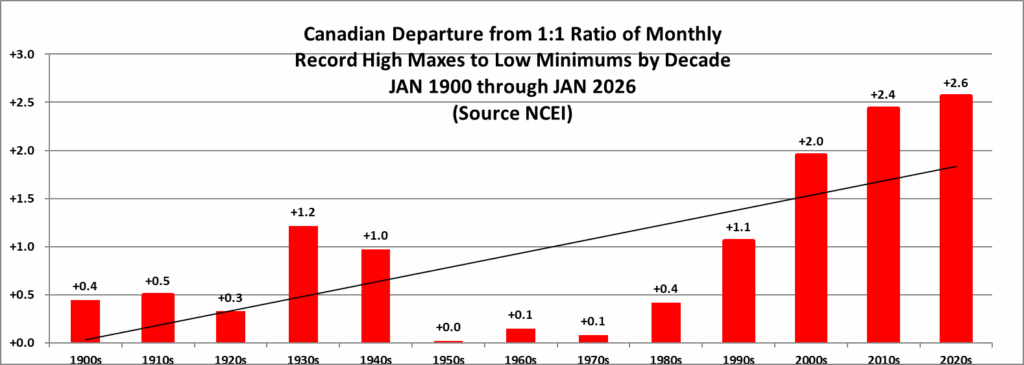
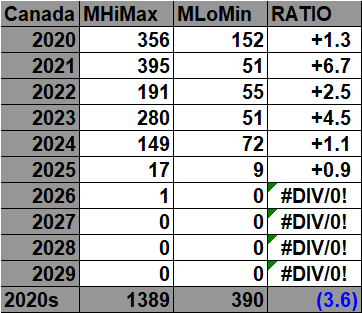
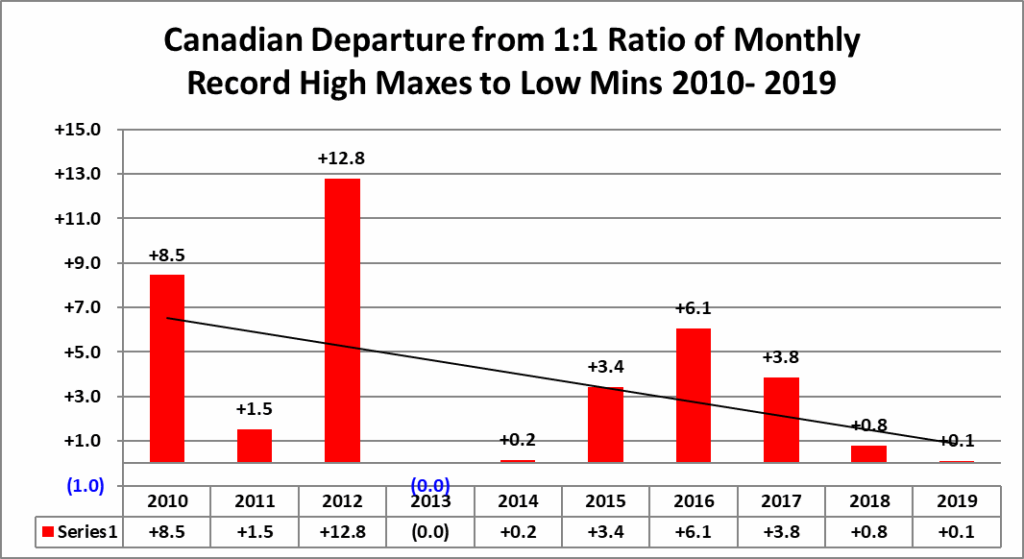
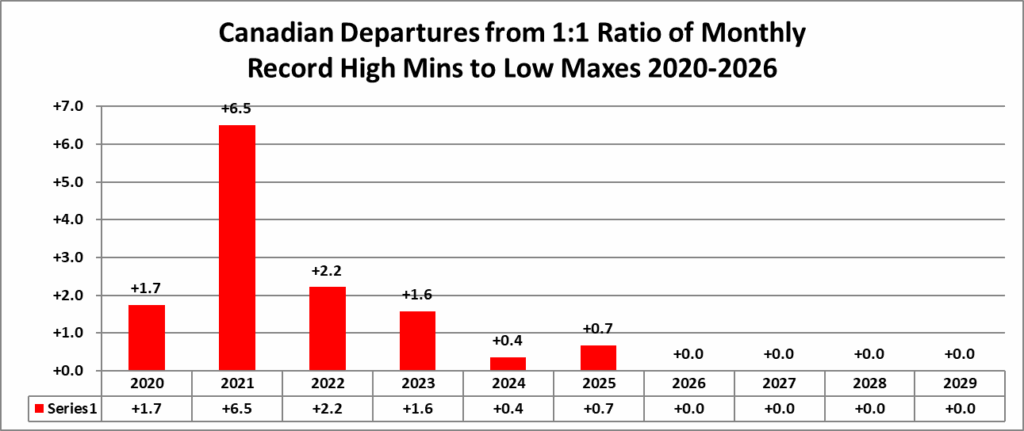
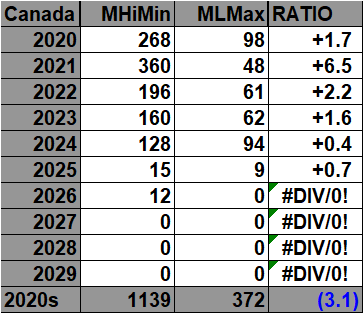
All of the data listed below is part of this one chart. The ratio of monthly record high maxes to low minimums for the 2020s (so far) is higher than any decade since the 1900s:
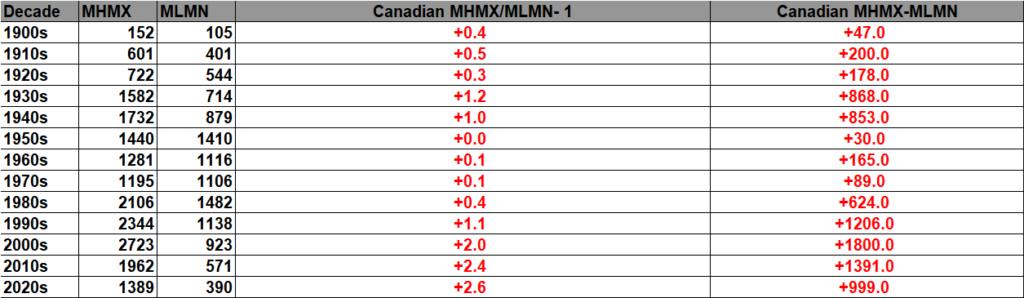
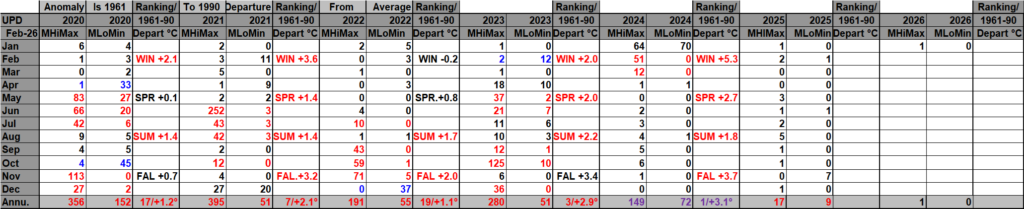
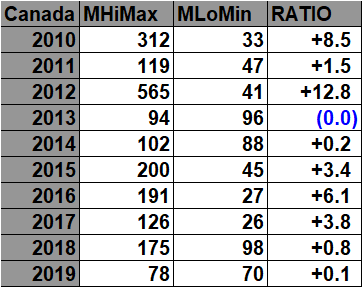
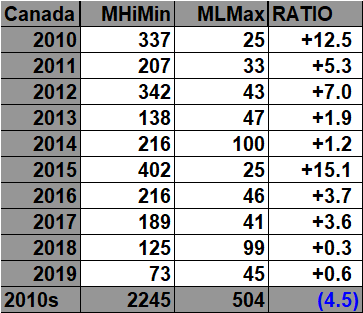
Here are the current Canadian monthly record counts per decade (including ties):
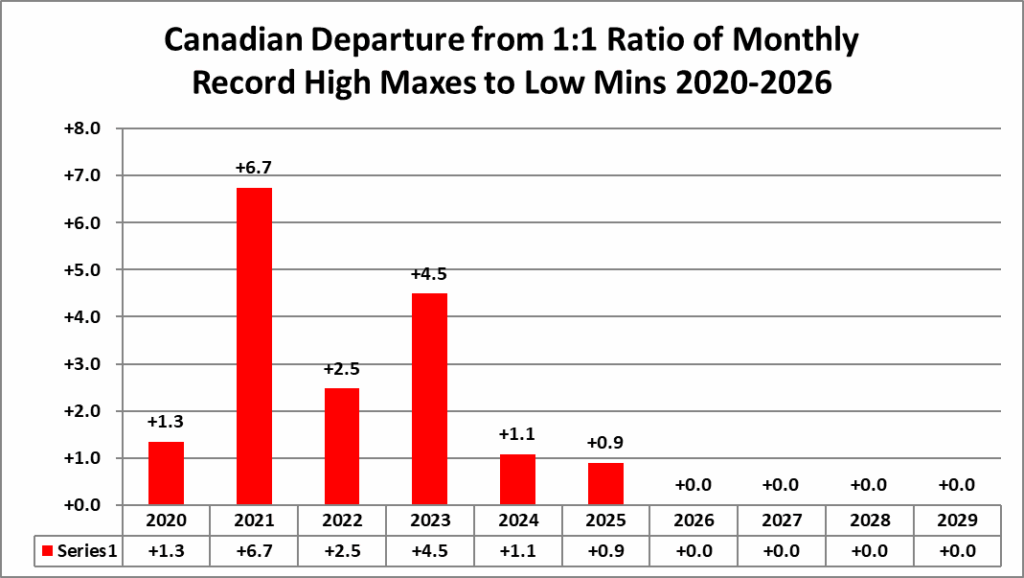
I found this Canadian site that has seasonal and yearly national temp anomalies: Temperature change in Canada – Canada.ca It does not have monthly anomalies and only goes back to 1948, unfortunately. This update includes its data. The Canadian site has yet to include 2025 data, and reports getting into NCEI are incomplete after April 2025, which continue to trickle into their system, thus another reason to create that WMO site. On my chart 2025 was the warmest year in Canadian history, thus it was colored purple. Record numbers correlate fairly well with seasonal anomaly values.
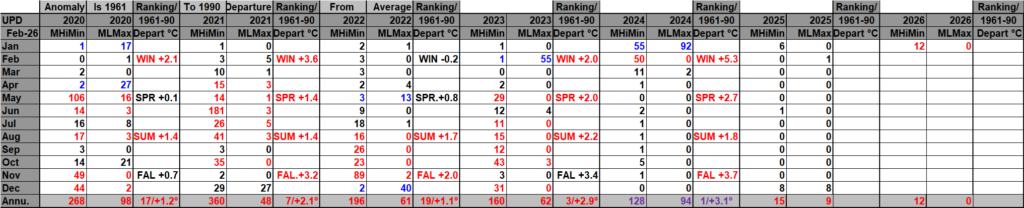
In the following charts blue colors represent cold months and years, and red warm. Those months with counts close to a 1 to 1 ratio of highs to lows are colored black. I have opted not to catalogue data prior to 1890 since record counts decrease substantially prior to that year. Time stamps for when I last updated counts are located in the upper left-hand corner of each chart. Drop me a note if you see an error or if you have suggestions for improvements.
The 2020s:
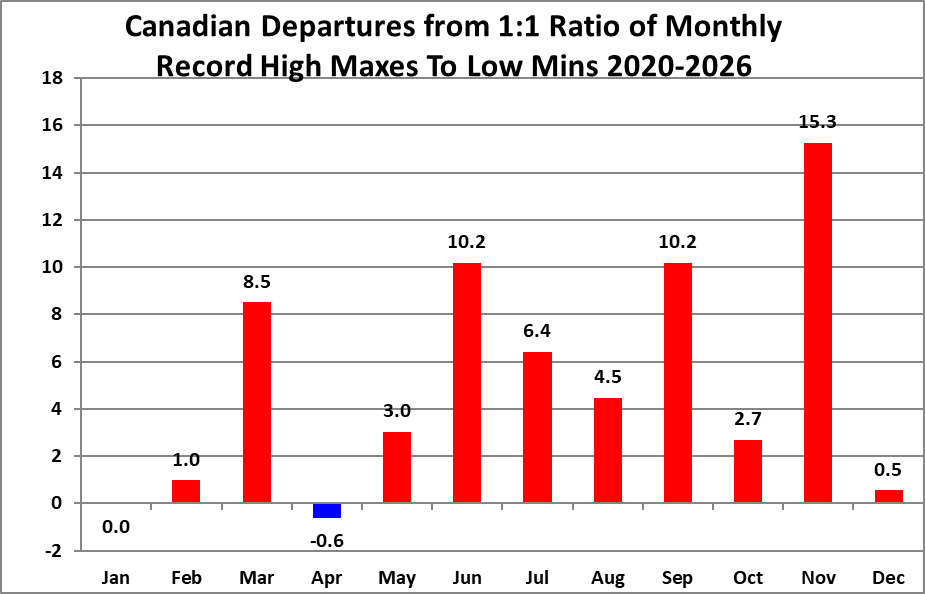
The 2010s:

The 2000s:


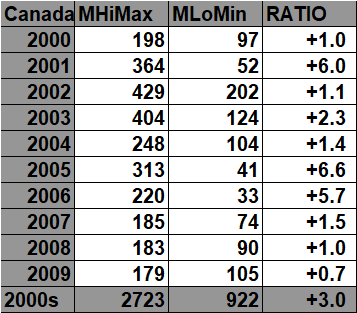

The 1990s:



The 1980s:


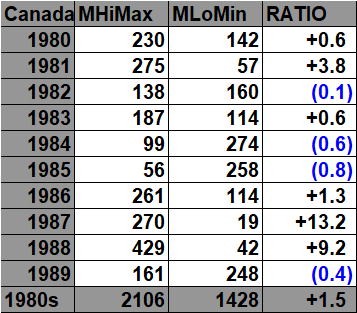

The 1970s:


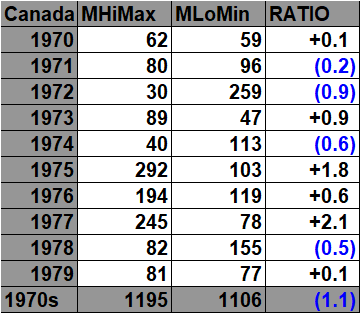

The 1960s:


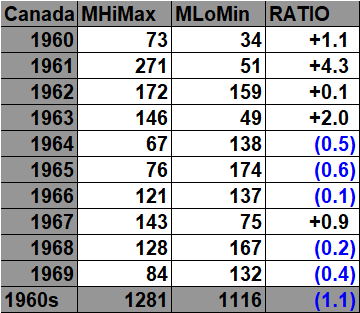

The 1950s:



The 1940s:



The 1930s:

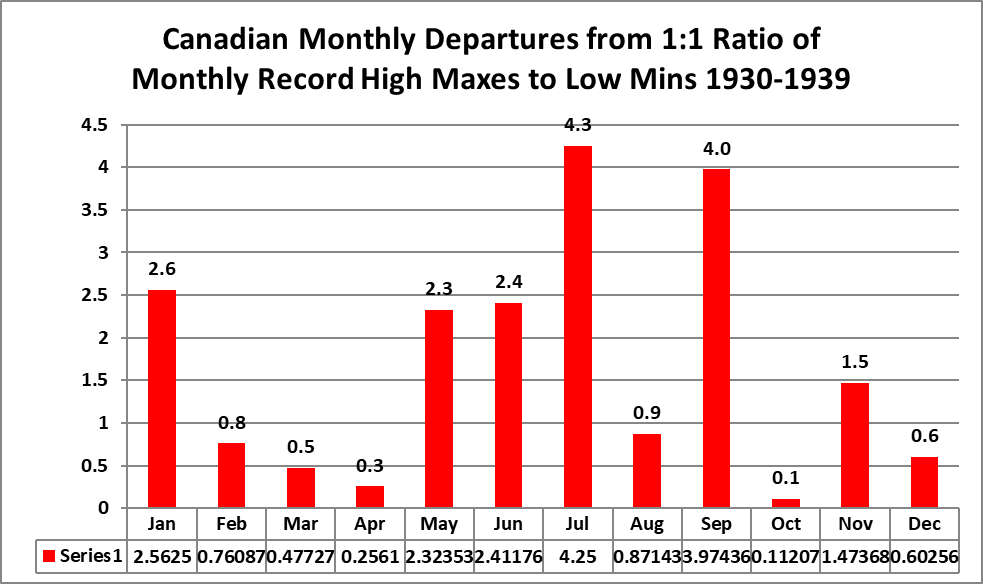


The 1920s:


The 1910s:


The 1900s:


I found this Canadian site that has seasonal and yearly national temp anomalies: Temperature change in Canada – Canada.ca It does not have monthly anomalies and only goes back to 1948, unfortunately. This update includes its data. The Canadian site has yet to include 2025 data, and reports getting into NCEI are incomplete after April 2025, which continue to trickle into their system, thus another reason to create that WMO site. On my chart 2025 was the warmest year in Canadian history, thus it was colored purple. Record numbers correlate fairly well with seasonal anomaly values.
In the following charts blue colors represent cold months and years, and red warm. Those months with counts close to a 1 to 1 ratio of highs to lows are colored black. I have opted not to catalogue data prior to 1890 since record counts decrease substantially prior to that year. Time stamps for when I last updated counts are located in the upper left-hand corner of each chart. Drop me a note if you see an error or if you have suggestions for improvements.
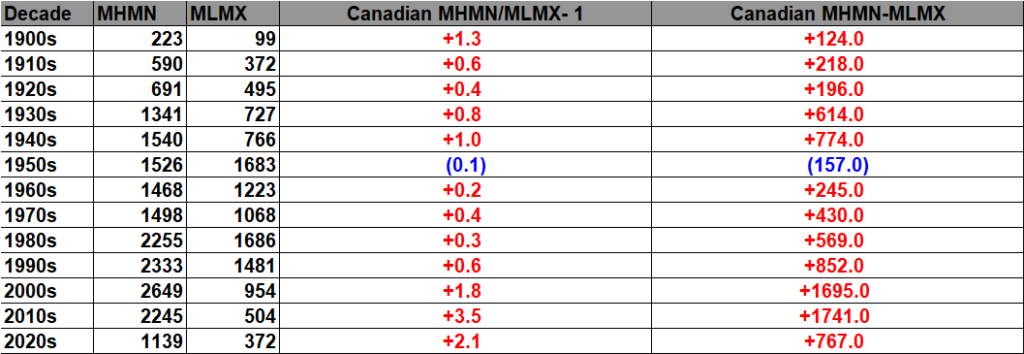
All of the data listed below is part of this one chart. The ratio of monthly record high minimums to low maximums for the 2010s (so far) are higher than any other decade since the 1900s:
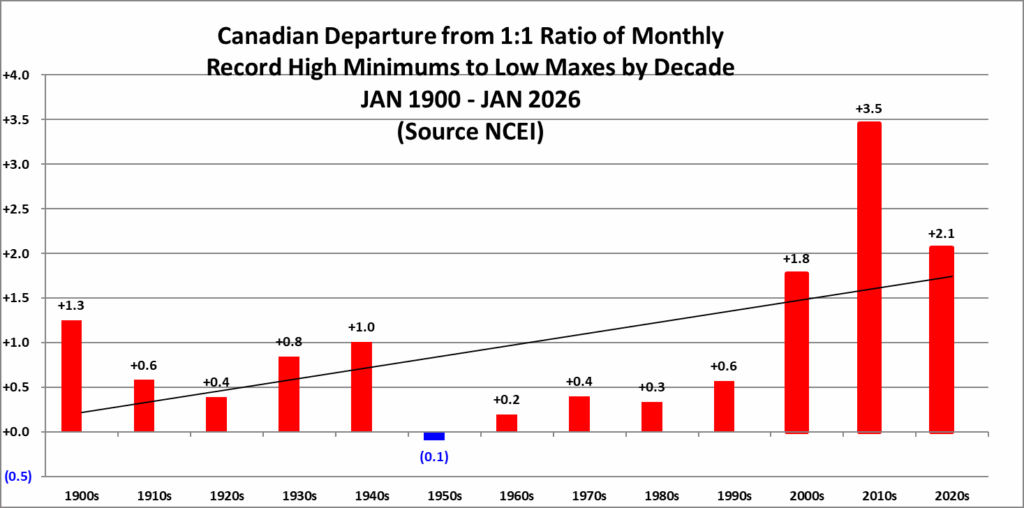
Here are the current monthly record counts per decade:
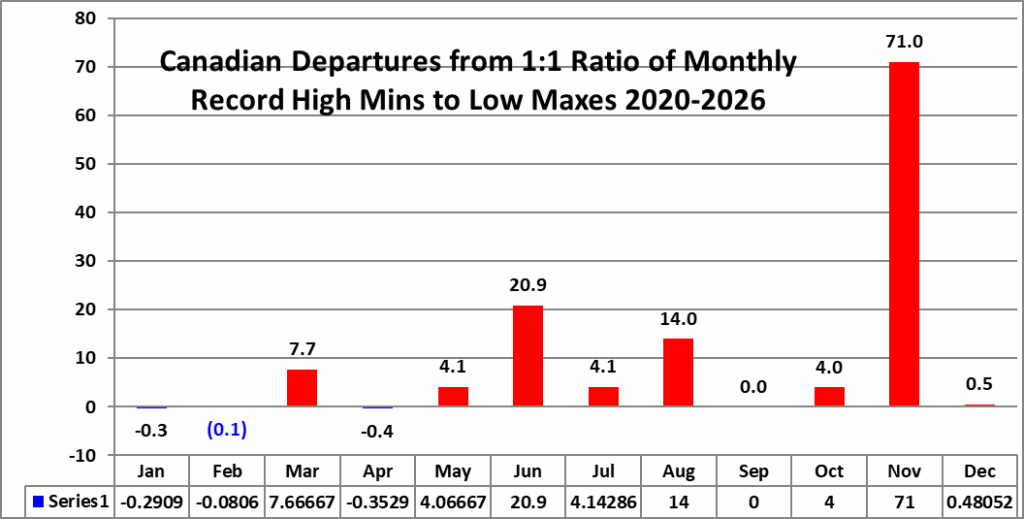
The 2020s:
The 2010s:



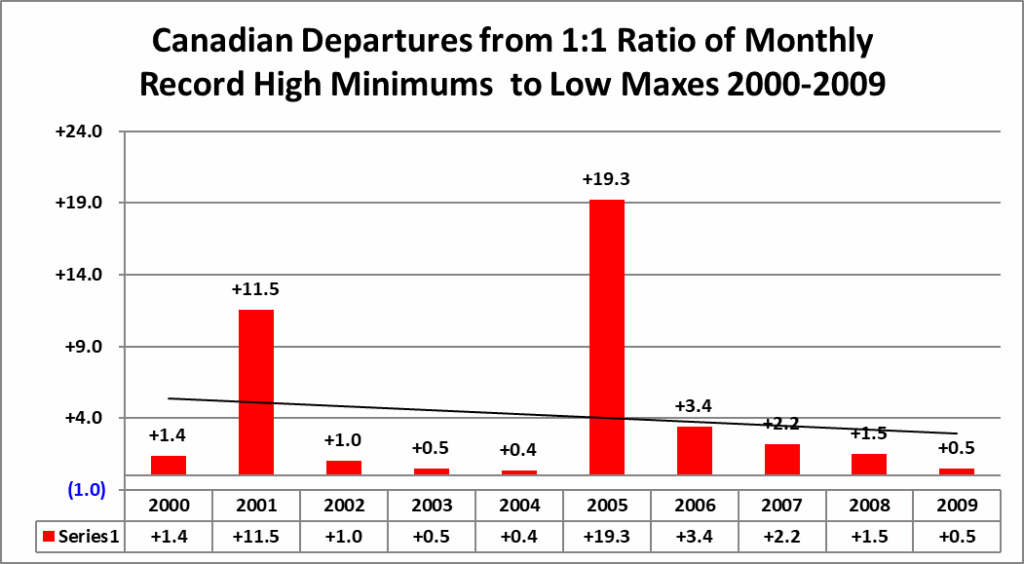
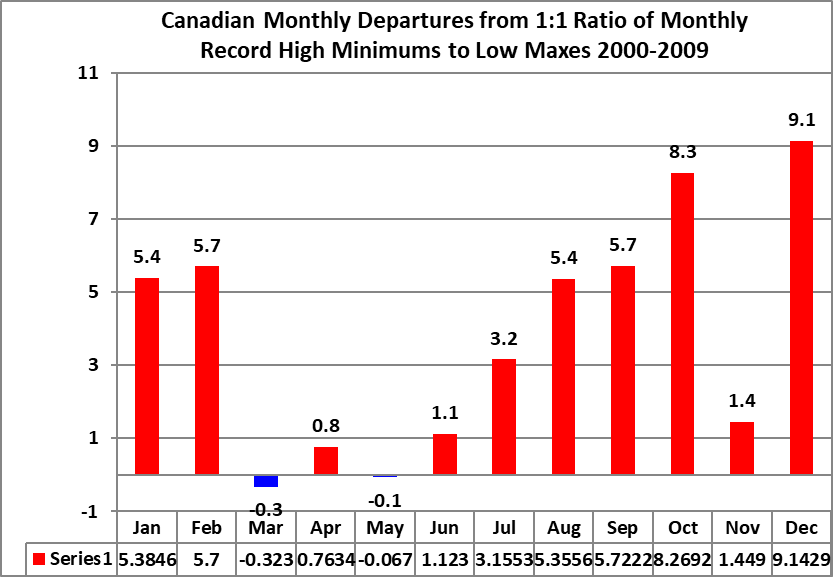
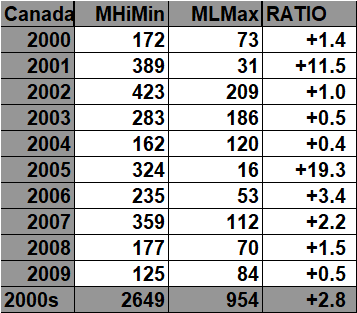
The 2000s:

The 1990s:



The 1980s:



The 1970s:



The 1960s:



The 1950s:



The 1940s:



The 1930s:


The 1920s:


The 1910s:


1900s:


This is all of the NCEI Canadian monthly record count data going back to 1900.
Guy Walton…”The Climate Guy”