The main purpose of this ongoing blog will be to track planetary extreme, or record temperatures related to climate change. Any reports I see of ETs will be listed below the main topic of the day. I’ll refer to extreme or record temperatures as ETs (not extraterrestrials).😜
Here is a new feature for this blog, which I will add daily. This is the latest inciteful Green News Report from my friends Desi Doyen and Brad Friedman at Progressive Voices. Hit ‘continue reading,’ listen, then hit return to see my daily topics:
Extreme Temperature Diary Thursday June 4th, 2026/Main Topic: Why Is Europe Still Not Ready for Extreme Heat?
Dear Diary. We as human beings are still evolving, not so much physically, but through our tools and inventions to adapt to a changing world, trying to make life better for our species. Air conditioning was perhaps one of the greatest inventions for living in areas that are hot and humid. Of course, AC units do cost money to install and maintain, so in areas of the planet that are traditionally fairly cool, these were deemed unnecessary before the era of climate change started.
Most of northern and central Europe prior to the 21st century was comfortable without AC during the summer. Then the heatwave of 2003 hit, killing thousands. People across the country should have begun installing AC then, but many didn’t with cost being a concern. Since then, there have been many severe heatwaves, the last occurring this May. Why hasn’t Europe learned recent lessons and installed AC just as fast as green infrastructure is going up? Evolution means adapt or die.
Here are answers to that question from the Guardian:
Why is Europe still not ready for extreme heat? | World news | The Guardian
Why is Europe still not ready for extreme heat?
The first heatwaves of the season reveal how ill-prepared governments across the continent are to protect people from increasingly dangerous temperatures

France, like much of Europe, experienced record breaking temperatures last month. Photograph: Simon Wohlfahrt/AFP/Getty Images
Don’t get This Is Europe delivered to your inbox? Sign up here

Ajit Niranjan, Europe environment correspondent
Wed 3 Jun 2026 10.25 EDT
Meteorological summer has begun, ushered in with scorching heat that struck before spring was up. Although western Europe is now mostly free from last week’s heat dome – which shattered temperature records for May in the UK and Ireland – it is already bracing for yet another sweltering summer. Oppressive days, restless nights and furious fires are brewing. On Tuesday, the World Meteorological Organisation warned us all to prepare for the imminent return of the warming weather pattern El Niño.
Scientists have not worked out how many people died during this latest bout of hot weather, but one environmental epidemiologist’s early modelling pegged it at 250 extra deaths in the UK alone on the weekend before temperatures peaked. The full death toll is likely to be particularly high because the heat struck before people had properly adjusted their behaviour to stay safe in the heat.
Before I look at what’s being done to keep us safe as temperatures climb, let’s consider three points that slightly spoiled my ability to enjoy these hot early summer days (I promise there is a bright spot at the end).
First, heat kills more people in Europe than almost any other issue you worry about – from crime to terror attacks – with many tens of thousands of early deaths each year. Second, burning fossil fuels has already made heatwaves hotter, longer and more deadly – a study in September attributed two in every three heat deaths in European cities to climate breakdown. Third, simple steps to save lives, many of which are cheap or would pay for themselves in the long run, are largely absent from national politics. A survey of European countries in 2024 found just 21 of 38 had heat-health action plans. Efforts to turn carparks into green spaces are often still considered radical.
There are exceptions to the collective denial, such as the rise of climate shelters in which people can take refuge, cool down and drink a glass of water. European cities tend to lack the huge sports facilities used as cooling centres in the US and Australia but what air-conditioning they do have is often in big public buildings – such as schools, museums, libraries – that are well-known and easy to reach.
Ana Terra Amorim-Maia, a researcher at the Basque Centre for Climate Change, said “the thing that clicked” in Barcelona was the realisation that minor investments could open these spaces to citizens in need.
The task for local governments and owners of businesses that double up as shelters is fairly simple. “You need to maybe change the opening hours, put more staff in, train them more, [add] some signs and communication material. But these are minimal adaptations and they can, hopefully, save a life.”
Climate shelters became popular in Barcelona, where they have grown in number to more than 400 since the local programme began in 2020, and have now spread across Spain. In December, Pedro Sánchez, the socialist prime minister, announced a national network of climate shelters as part of a “state pact to tackle the climate emergency”. Cities across Europe are adopting them too, with formal cooling zones cropping up from Paris to Vienna.
The situation is not perfect. Daytime shelters offer little relief to the rise in tropical nights that prevent exhausted bodies recovering. What’s more, extreme heat this year started in May but many climate shelters were only scheduled to open in June. And there are certainly teething problems in the rollout: one of Amorim-Maia’s friends, she tells me, went to a climate shelter in Bilbao in 30C heat last year and found it closed. Its opening hours had actually been reduced over summer.
On the continent, southern Europe is most exposed to punishing temperatures but the real test for adapting to a warmer world may come in northern Europe. Streets and buildings in Mediterranean countries have been designed with heat in mind – think shutters, awnings, shaded streets and public fountains – and there are signs that people are already reducing risk by adapting. It is northern European countries such as the UK, Switzerland and Norway that will suffer the greatest relative rise in uncomfortable temperatures, a study found in 2023.
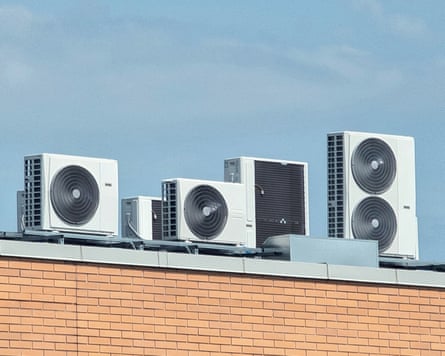
In the UK, poorly insulated homes expose people to dangerous temperatures in both winter and summer. In parts of the country, heatwaves are expected to get so much worse that passive cooling solutions such as natural shading will not be enough to keep people safe. Two weeks ago, the UK government’s official climate advisers recommended that air conditioning be installed in all care homes and hospitals within the next 10 years, and in all schools within 25 years. Some climate campaigners have echoed their calls.
The good news I promised earlier is that heat (unlike, say, air pollution) is a killer that you have a surprising amount of control over. Drawing blinds, drinking water and staying indoors during the hottest parts of the day are all simple actions we can take. But one often overlooked piece of advice, to my mind, is to check in on neighbours. Older people living alone are vastly over-represented in mortality statistics and simple interventions could alert authorities before tragedy strikes.
This isn’t to distract from the importance of greening cities or rapidly reducing planet-heating pollution. But doctors and scientists assure me this can make a meaningful difference. So the next time it gets too hot, consider calling your older relatives or introducing yourself to the retired neighbour next door with an ice-cream or cool drink – it might just mean the difference between life and death.
To receive the complete version of This Is Europe in your inbox every Wednesday, please subscribe here.
Here are some “ETs” recorded from around the U.S. the last couple of days, their consequences, and some extreme temperature outlooks, as well as any extreme precipitation reports:
Here is More Climate News from Thursday:
(As usual, this will be a fluid post in which more information gets added during the day as it crosses my radar, crediting all who have put it on-line. Items will be archived on this site for posterity. In most instances click on the pictures of each tweet to see each article. The most noteworthy items will be listed first.)