The main purpose of this ongoing blog will be to track planetary extreme, or record temperatures related to climate change. Any reports I see of ETs will be listed below the main topic of the day. I’ll refer to extreme or record temperatures as ETs (not extraterrestrials).😜
Main Topic: European Farmers Face ‘Unprecedented Crisis’ After Successive Heatwaves
Dear Diary. This summer’s heat has affected Europe more than what we saw here in the United States, mainly because it has caused more drought and forest fires there. Take a look at this graphic:
So, it’s no wonder that European farmers are struggling, which will affect food prices and supplies going through harvest season. We can only blame climate change and the decades long dithering on the issue for this.
Here are more details from the Guardian:
European farmers face ‘unprecedented crisis’ after successive heatwaves | Farming | The Guardian
European farmers face ‘unprecedented crisis’ after successive heatwaves
Vegetable and grain growers call for urgent action, warning of ‘catastrophic’ harvests due to continent-wide drought

The French agriculture ministry estimates its maize harvest will be down 35% on 2025 levels. Photograph: Mourad Allili/SIPA/Shutterstock
Jon Henley in Paris, Angela Giuffrida in Rome and Stephen Burgen in Barcelona
Mon 17 Aug 2026
Successive intense heatwaves and an increasingly severe, continent-wide drought have left many of Europe’s farmers in an “unprecedented” crisis, with vegetable and grain growers in particular warning of “catastrophic” harvests.
French vegetable production is down by “a very significant extent” compared with previous years, French growers have said, with shortfalls put at 25% for courgettes, 35% for lettuces, 40% for peas, 60% for broccoli and 50% to 100% for artichokes.
“The vegetable sector is facing a historic crisis,” said Prince de Bretagne, which groups together more than 1,300 vegetable producers in Brittany, calling for “urgent action” to address a “dramatic” fall in yields and in the quality of many crops.
Accelerated, human-caused global heating and a supersized El Niño have scorched fields across Europe this summer, with plant development prevented by temperatures routinely exceeding 30C and often 35C, almost no rainfall, and hot winds.
“Usually one region fares better, which helps compensate,” Eric Legras, of the 4,400-member French canned and frozen vegetable producers’ association, told Le Monde. “This year, all our main production areas have been hit, and at the same time.”
Cereal production has been equally hard hit, with the agriculture ministry estimating the maize harvest in France – Europe’s largest grains producer – will be down by 35% on 2025 levels at about 9m tonnes, a quantity last seen in 1980.
Part of the fall is due to farmers’ switching to other crops, such as sunflowers, the ministry said, but it also reflects the impact of this summer’s vicious heatwaves, which have battered the crucial crop during critical stages of its growth cycle.
That is likely to cause big problems for livestock farmers. With dairy cows typically starting to suffer from heat stress above 25C, many producers have already reported milk yields down by 10%-15%. Most are now also concerned about winter feed.
Agreste, the agriculture ministry’s statistics service, said last week that production of hay for winter cattle forage was running about 30% lower than the 1989-2018 average, a shortfall that “is worsening and is now affecting a growing numbers of regions”.
Egg production, too, has been hit by a catastrophic mortality rate in poultry houses, particularly during the June heatwave. According to France’s national egg promotion board, output has is about 1m eggs a day lower than the norm.
In Italy, about 60% of farmland across the country is now affected by drought ranging from mild to severe, according to data published earlier this month by Coldiretti, the country’s largest farmers’ organisation.
Crop yields, especially for corn, rice and soya beans as well as vegetables and fruit, have been badly hit, and milk production has fallen by 20%. The overall cost to the sector, including damage caused by wildfires and heavy storms, is put at more than €3bn.
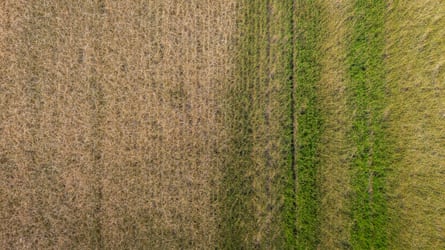
The drought is particularly acute in the Po valley, a huge geographical area straddling four northern regions, the backbone of Italian agriculture and home to about 80% of the Italian rice production, due to severe depletion of the country’s longest river.
Italy is Europe’s largest rice producer, with about 235,000 hectares (580,000 acres) planted in 2025. This year, however, the severe drought has forced growers to adopt an unprecedented response to save the season, irrigating crops only on alternate weeks.
In Spain, cereal harvests are 35% below the previous year in Castilla y León, 49% in the Madrid region and 24% in Andalucía. Sheep and goat’s milk production is also down 6.5% and 10.8% respectively, authorities have said.
After a disastrous harvest in drought-stricken 2024, olive oil production increased significantly last year and the wet winter and spring were good news for a crop not harvested until late autumn. Growers say it is too early to say how this year will look.
However, Spain’s national wine federation has predicted a 20% fall in production for 2026, and its director, José Luis Benítez, warned that successive heatwaves will reduce crops as grapes are smaller for lack of moisture.
Governments have pledged costly aid packages to help the sector. The French prime minister, Sébastien Lecornu, has promised €145m (£124) in immediate aid, along with “structural support and investment measures” in the 2027 budget.
Here are more “ET’s” recorded from around the planet the last couple of days, their consequences, and some extreme temperature outlooks, as well as any extreme precipitation reports:
Here is More Climate News from Wednesday:
(As usual, this will be a fluid post in which more information gets added during the day as it crosses my radar, crediting all who have put it on-line. Items will be archived on this site for posterity. In most instances click on the pictures of each tweet to see each article. The most noteworthy items will be listed first.)