The main purpose of this blog will be to track planetary extreme, or record temperatures related to climate change. Any reports I see of ETs will be listed below the main topic of the day. I’ll refer to extreme or record temperatures as ETs (not extraterrestrials).😜
Main Topic: Arctic Endured Year of Record Heat as Climate Scientists Warn of ‘Winter Being Redefined’
Dear Diary. Over the last several months I have reported on various areas of the world that have seen record heat due to climate change. It’s been a while since I have seen any data on, in my opinion, the most important area of the world to keep tabs on temperature, the Arctic region. Should the Arctic retain a fever, it will continue to lose sea ice, which means the albedo of the Arctic ocean will continue to go down, thus further absorbing more solar radiation.
The climate situation in the Arctic appears to be dire. We can see how bad things are there given this latest Guardian article:
Arctic endured year of record heat as climate scientists warn of ‘winter being redefined’
Region known as ‘world’s refrigerator’ is heating up as much as four times as quickly as global average, NOAA experts say
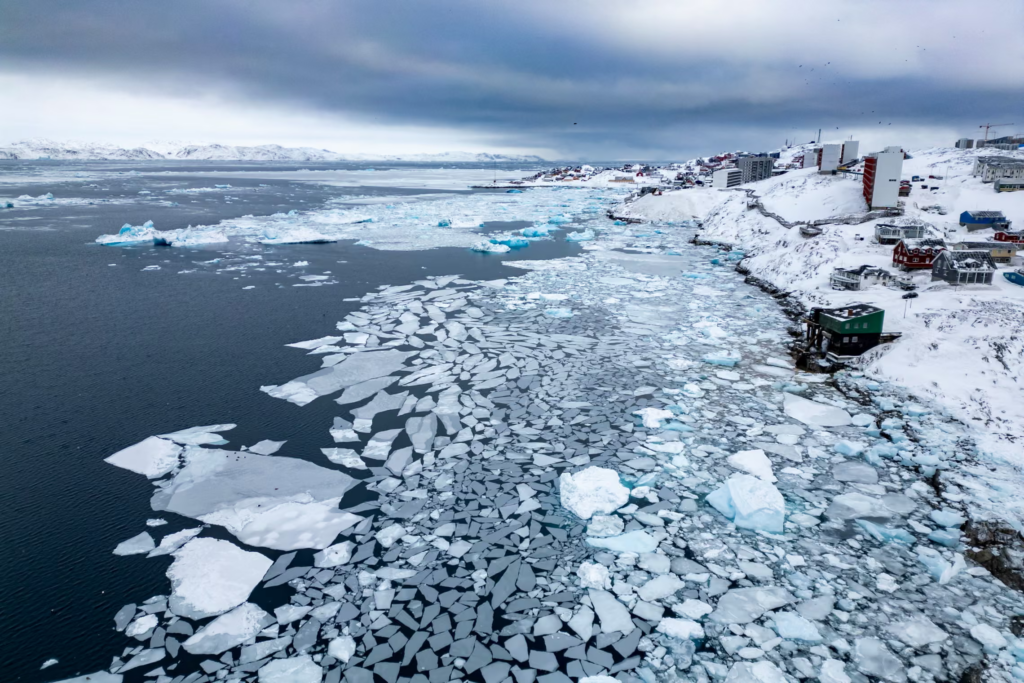
This aerial view shows icebergs and ice sheets floating in the water off Nuuk, Greenland, on 07 March 2025. Photograph: Odd Andersen/AFP/Getty Images
Tue 16 Dec 2025
The Arctic endured a year of record heat and shrunken sea ice as the world’s northern latitudes continue a rapid shift to becoming rainier and less ice-bound due to the climate crisis, scientists have reported.
From October 2024 to September 2025, temperatures across the entire Arctic region were the hottest in 125 years of modern record keeping, the US National Oceanic and Atmospheric Administration (NOAA) said, with the last 10 years being the 10 warmest on record in the Arctic.
The Arctic is heating up as much as four times as quickly as the global average, due to the burning of fossil fuels, and this extra heat is warping the world’s refrigerator – a region that acts as a key climate regulator for the rest of the planet.
The maximum extent of sea ice in 2025 was the lowest in the 47-year satellite record, Noaa reported on in its annual Arctic report card. This is the latest landmark in a longer trend, with the region’s oldest, thickest ice declining by more than 95% since the 1980s as the Arctic becomes hotter and rainier.
This year was a record for precipitation in the Arctic. Much of this is not settling as snow – the June snow cover extent over the Arctic today is half of what it was six decades ago.
“This year was the warmest on record and had the most precipitation on record – to see both of those things happen in one year is remarkable,” said Matthew Langdon Druckenmiller, an Arctic scientist with the National Snow and Ice Data Center at the University of Colorado and an editor of the Arctic report card. “This year has really underscored what is to come.”
Scientists have been struck by how exceptional warmth in other seasons, particularly summer, is now becoming evident in winter too, affecting the annual growth of sea ice across the Arctic in its coldest months. In the past month or so, sea ice extent has been the lowest on record, potentially heralding another reduced maximum for sea ice next year.
“There’s been a steady decline in sea ice and unfortunately we are seeing rain now even in winter,” said Druckenmiller. “We are seeing changes in the heart of winter, when we expect the Arctic to be cold. The whole concept of winter is being redefined in the Arctic.”
These changes are acutely felt by people and wildlife in the Arctic – rain falling on to snow can freeze into a barrier that makes it harder for animals to forage for food, while also making for more slippery, hazardous conditions for people traveling by road. The retreat of glaciers can also cause potentially dangerous flooding, as seen in Juneau, Alaska, this year.
The loss of sea ice is opening up vast areas of dark ocean, which is absorbing, rather than reflecting, more of the heat that is raising global temperatures. While the melting sea ice isn’t itself causing the seas to rise, the loss of land-based glaciers is, with Noaa reporting that the huge Greenland ice sheet lost 129bn tons of ice in 2025. This will add to sea level rise that will menace coastal cities for generations to come.
“We are seeing cascading impacts from a warming Arctic,” said Zack Labe, a climate scientist at Climate Central. “Coastal cities aren’t ready for the rising sea levels, we have completely changed the fisheries in the Arctic which leads to rising food bills for sea food. We can point to the Arctic as a far away place but the changes there affect the rest of the world.”
Here are some “ETs” recorded from around the planet the last couple of days, their consequences, and some extreme temperature outlooks, as well as any extreme precipitation reports:
Here is More Climate News from Tuesday:
(As usual, this will be a fluid post in which more information gets added during the day as it crosses my radar, crediting all who have put it on-line. Items will be archived on this site for posterity. In most instances click on the pictures of each tweet to see each article. The most noteworthy items will be listed first.)