The main purpose of this blog will be to track planetary extreme, or record temperatures related to climate change. Any reports I see of ETs will be listed below the main topic of the day. I’ll refer to extreme or record temperatures as ETs (not extraterrestrials).😜
Main Topic: U.S. Has Third Most Billion Dollar Disasters Without a Landfalling Hurricane In 2025
Dear Diary. Think about this folks. What if the U.S. had a couple of landfalling hurricanes like Helene from 2024 during 2025? That probably would have pushed 2025 into the most billion-dollar disaster stat, so our country was lucky last year. As the planet warms it is obvious that more billion-dollar weather disasters will occur, particularly from wildfires as happened in January 2025 from the Los Angeles Palisades fire.
By the way, thank goodness that Climate Central has taken on the mantel of compiling billion-dollar stats after Trump axed that ability from NOAA. Here is their assessment written today.
For a video and downloadable graphics that I did not repost, hit the following link:
2025 in Review: U.S. Billion-Dollar Disasters | Climate Central
2025 in Review: U.S. Billion-Dollar Disasters
KEY FACTS
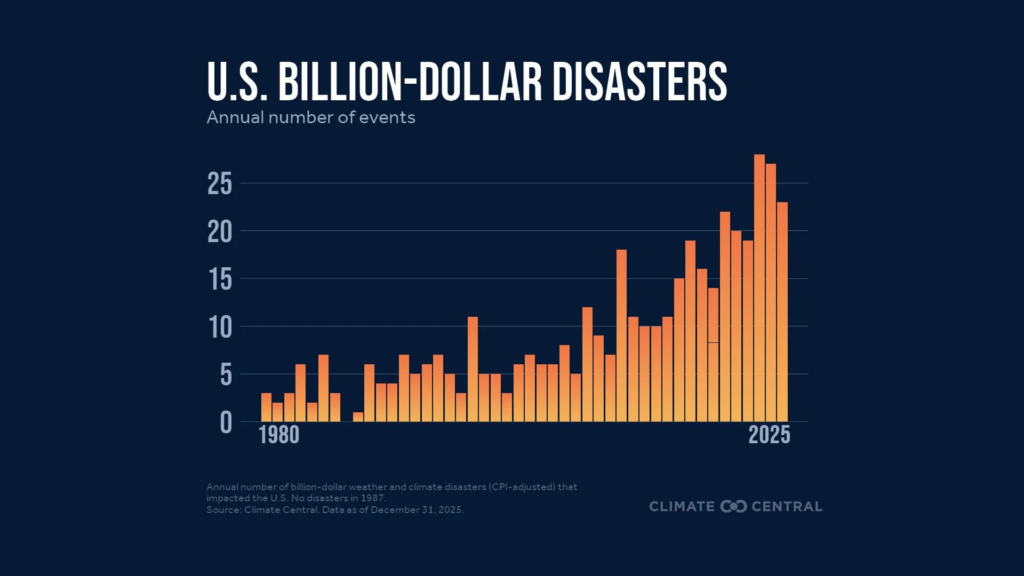
- According to Climate Central, 2025 ranks as the third-highest year (after 2023 and 2024) for billion-dollar weather and climate disasters — with 23 such events costing a total of $115 billion in damages.
- The January 2025 Los Angeles wildfires were the costliest event of the year as well as the costliest wildfire on record. With $61.2 billion in damages, this devastating event was about twice as costly as the previous record wildfire.
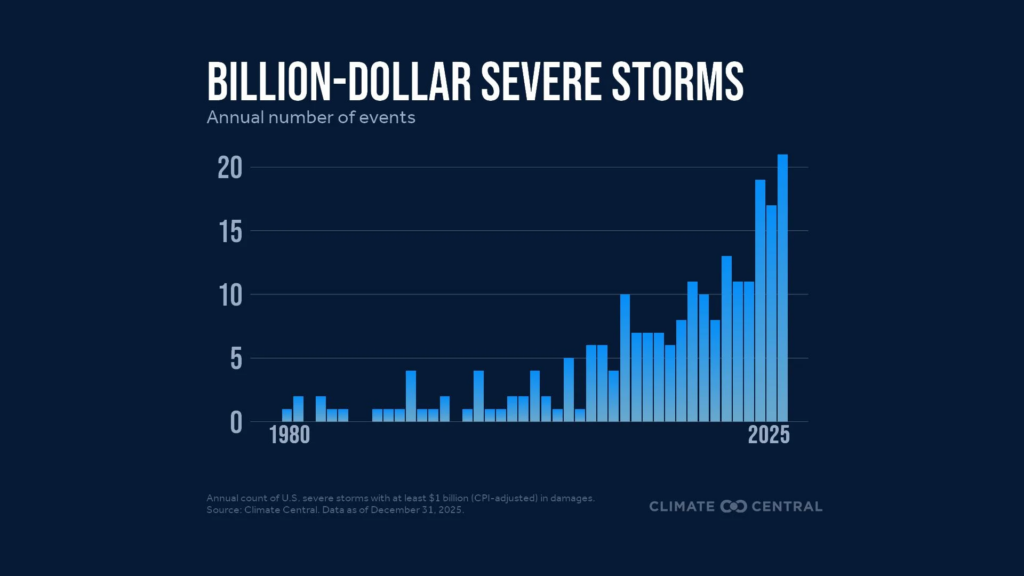
- Severe weather accounted for a record 21 billion-dollar disasters in 2025 — concentrated in a series of spring and summer tornado outbreaks across the central U.S.
- Since 1980, the U.S. has sustained 426 billion-dollar disasters, with a total cost exceeding $3.1 trillion.
- The frequency of U.S. billion-dollar disasters has increased dramatically since 1980 due to the rise in extreme weather and a growing number of people, homes, and businesses in harm’s way.
- Climate Central plans to expand its U.S. Billion-Dollar Disasters Database in 2026. Sign up here to get notified when new data are available.
STAY TUNED: On January 13 and 14, Climate Matters will cover U.S. and global temperatures in 2025.
Explore the database
Click to download this ready-to-air video, The Underground Heat That Could Cut Electric Bills. This fully produced news story can be used by media outlets at no cost for broadcasts, streaming, and digital stories. Click here for other available packages.
U.S. billion-dollar disasters in 2025
Climate Central has finalized its analysis of billion-dollar weather and climate disasters that impacted the U.S. between January and December of 2025.
- Explore the latest data in the U.S. Billion-Dollar Weather and Climate Disasters database.
In 2025 there were 23 weather and climate disasters with at least $1 billion (inflation-adjusted) in U.S. damages. These 23 events caused an estimated 276 fatalities and cost a total of $115 billion in damages.
This places 2025 third (behind 2023 and 2024) for the annual number of billion-dollar disasters — and well above the average annual number (nine events per year) and cost ($67.6 billion per year) of billion-dollar disasters based on data going back to 1980.
What’s new?
Climate Central launched its U.S. Billion-Dollar Weather and Climate Disasters database in October 2025, with data through June 2025. This is our first update since then. Here’s a quick summary of the new insights:
- The past three years rank highest for the annual number of billion-dollar disasters: 2023 (28 events), 2024 (27 events), and 2025 (23 events).
- The number of billion-dollar severe storms set a new record in 2025, with 21 such events. This reflects near-record numbers of damaging high wind and tornado reports during the spring and summer of 2025.
- A billion-dollar drought affected the western U.S. in 2025. This event was primarily driven by heat, rather than by a lack of precipitation. This is consistent with an emerging trend of heat-driven drought in the western U.S.
- The catastrophic flash flooding in the Texas Hill Country in July 2025 was one of the deadliest inland floods in U.S. history. This event did not result in losses of at least $1 billion, underscoring that the full toll of extreme weather events isn’t reflected in dollar-value losses alone.
More costly disasters, more often: 2025 in context
As the 15th consecutive year with an above-average number of billion-dollar disasters, 2025 is part of a growing trend.
The frequency of billion-dollar disasters has increased dramatically since 1980.
- The average number of billion-dollar disasters per year has surged from about three events annually during the 1980s to 20 events annually during the last 10 years (2016-2025).
- The prior two years (2023 and 2024) shattered previous records with 28 and 27 billion-dollar disasters, respectively, followed by 2025 (with 23 events).
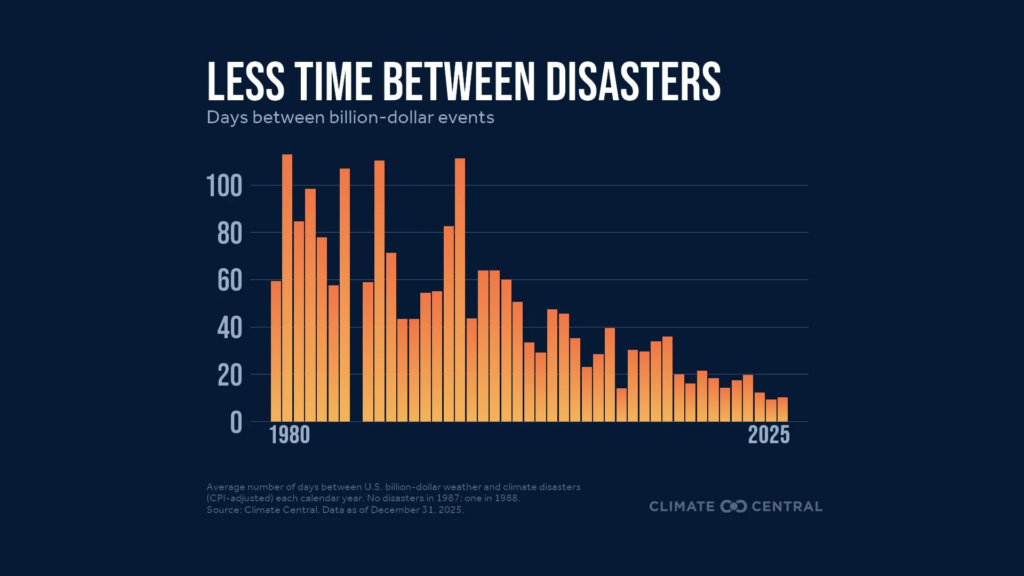
The time between disasters is shrinking.
- As the frequency of billion-dollar disasters rises, the average length of time between them has fallen — from 82 days during the 1980s to 16 days during the last 10 years (2016-2025).
- The average time between billion-dollar disasters in 2025 was just 10 days.
- Back-to-back disasters, like the wave of billion-dollar severe storms during spring 2025, can strain the resources available for communities to respond, recover, and prepare for future risks.
The long-term rise in billion-dollar disasters reflects both the increasing frequency and intensity of extreme weather and the growing number of people, homes, and businesses exposed to these hazards. Accelerated development in fire-prone areas, along coasts, and in floodplains can multiply the damage from extreme events.
The 46-year toll of billion-dollar disasters
From 1980 through 2025, the U.S. suffered 426 separate billion-dollar weather and climate disasters. These catastrophic events took an estimated 17,194 lives and resulted in damages exceeding $3.1 trillion (inflation-adjusted).
These figures are staggering and deeply tragic. And yet, they are conservative estimates reflecting only the direct costs of these events — including the physical damage to homes, property, crops, and critical infrastructure. These estimates also do not include the many climate and weather disasters that have caused up to $999 million in damages.
The full toll of these disasters — including the effects on mental and physical health and related healthcare costs; the loss of cultural heritage, biodiversity, and habitats; supply chain disruptions; and all other indirect and long-term costs — is not reflected in these assessments.
The most costly U.S. billion-dollar disasters of 2025
The 23 billion-dollar weather and climate disasters affecting the U.S. in 2025 spanned fire (1), drought (1), and severe storms (21). The costliest events of the year were:
- Los Angeles Wildfires (January 7-28, 2025): $61.2 billion
Event summary: In January 2025, Los Angeles was devastated by wildfires that caused 31 deaths, destroyed over 16,000 homes and businesses, forced more than 200,000 evacuations, and exposed millions to unhealthy smoke and other harmful toxins.
- The Los Angeles wildfires were the most costly event of 2025, and the country’s most costly wildfires on record. With $61.2 billion in damages, this event was about twice as costly as the previous record wildfire.
What was the role of climate change? Hot, dry, windy conditions known as fire weather, along with exceptionally dry vegetation, primed the landscape for the blazes to grow and spread once they were ignited. A rapid analysis found that human-caused warming made fire weather conditions at the time of the Los Angeles fires about 6% more intense and 35% more likely.
2. Central Tornado Outbreak (March 14-16, 2025): $11.0 billion
Event summary: This was the second-most costly event of 2025 and the most deadly, resulting in 43 fatalities. This outbreak of more than 180 tornadoes spanned central, southeastern, and eastern states and caused widespread damage to homes, businesses, vehicles, vegetation, and infrastructure.
3. North Central and Eastern Tornado Outbreak and Severe Storms (May 15-17, 2025): $6.3 billion
Event summary: An outbreak of about 60 tornadoes swept across the central and eastern U.S., producing large hail and severe thunderstorm winds. This event caused $6.3 billion in damages, 29 deaths, and over 600,000 power outages.
What was the role of climate change? There has not yet been an analysis to determine whether human-caused climate change played a role in either of these most costly severe storms of 2025.
- Rapid analysis of another 2025 billion-dollar severe storm (the Central Tornado Outbreak and Flooding of April 1-7) found that human-caused climate change made the storm’s exceptional heavy rainfall — which led to catastrophic flooding in the Central Mississippi river valley — more likely and more intense.
- See Climate Central’s Extreme Weather Toolkit: Severe Weather for quick facts and the latest reporting resources on climate change and severe weather in the U.S.
Severe storms are the most frequent type of billion-dollar weather and climate disaster, accounting for more than half of all such events in the U.S. since 1980. Severe storms are the leading cause of weather-related power outages in the U.S.
What’s next for Climate Central’s billion-dollar disasters database?
Climate Central’s U.S. Billion-Dollar Weather and Climate Disasters database currently focuses on weather and climate disasters with costs of $1 billion or more in damages (adjusting for inflation).
Climate Central’s database is a continuation of the foundational work previously led by NOAA up until the agency discontinued this work in 2025.
In October 2025, Climate Central launched its U.S. Billion-Dollar Weather and Climate Disasters database with the latest available data and the full archive (starting in 1980).
The peer-reviewed methodologies behind this dataset remain unchanged at Climate Central, where the project continues to be led by Adam Smith, who served as the lead scientist for the project at NOAA for the last 15 years.
Climate Central is restarting and sustaining this publicly accessible resource at a time when the frequency and costs of these devastating events have risen to unprecedented levels.
Climate Central plans to expand its U.S. Billion-Dollar Weather and Climate Disasters database in 2026 with more data characterizing the impacts of weather and climate extremes in the U.S.
Sign up for Climate Matters here to get notified when new data are available.
LOCAL STORY ANGLES
Reporting on extreme weather events and disasters near you:
For more information on billion-dollar disasters, explore Climate Central’s new database including an events overview, summary statistics, interactive charts and maps of archived data (since 1980), and summaries of all 426 events on record.
Climate Central’s Extreme Weather Toolkits provide quick facts and reporting resources on the links between climate change and severe storms, heavy rainfall and flooding, wildfire, and more.
Local and state emergency managers, agricultural departments, and insurance data, can give an early sense of the damage and who is affected after extreme weather events. USDA crop reports, state climatologists, and regional climate centers can also help put an event into context.
What hazard mitigation or adaptation measures are happening in your local area?
The U.S. Climate Resilience Toolkit provides links to numerous government agencies, tools for assessing hazards, and case studies of adaptation and resilience efforts around the country. Climate Mapping for Resilience and Adaptation integrates information from across the federal government to help communities assess and plan for climate-related hazards in their area.
Local officials and state emergency management agencies can provide information about official disaster planning, emergency response, and available state-funded and federal disaster assistance programs. The Society for Environmental Journalism has compiled disaster resilience resources to support local reporting.
CONTACT EXPERTS
To request an interview with a Climate Central scientist about this analysis, please contact Abbie Veitch, aveitch@climatecentral.org.
METHODOLOGY
All billion-dollar disaster cost estimates included in this Climate Matters are adjusted for inflation (CPI-adjusted). For a full methodology: https://www.climatecentral.org/climate-services/billion-dollar-disasters/references.
Read the FAQs on Climate Central’s U.S. Billion-Dollar Weather and Climate Disasters database.
U.S. billion-dollar disaster data and analysis for 2025 (including CPI-adjustments) reflects the latest available data as of December 31, 2025. Note: as of January 8, 2026, final data is not yet available for the mid-December 2025 flooding event in Washington state.
Note: some of the newly added 2025 billion-dollar disasters occurred prior to June 2025 but weren’t included in Climate Central’s prior (October 2025) release due to data latency. Lags in the data on which this analysis is based are typical and may have been exacerbated in 2025 due to the government shutdown.
Here are some “ETs” recorded from around the planet the last couple of days, their consequences, and some extreme temperature outlooks, as well as any extreme precipitation reports:
Here is More Climate News from Thursday:
(As usual, this will be a fluid post in which more information gets added during the day as it crosses my radar, crediting all who have put it on-line. Items will be archived on this site for posterity. In most instances click on the pictures of each tweet to see each article. The most noteworthy items will be listed first.)