The main purpose of this ongoing blog will be to track global extreme or record temperatures related to climate change. Any reports I see of ETs will be listed below the main topic of the day. I’ll refer to extreme or record temperatures as ETs (not extraterrestrials).😜
Main Topic: ‘Groundbreaking’ Model Can Calculate True Impact of Climate Change with Bad News for Europe
Dear Diary. Yesterday we highlighted a new model that verified that climate change has affected the jet stream over Australia such that much of that country is getting drier and hotter. Today we note that a new model is pegging extreme heat in Europe on climate change, and it’s not good news.
Here on this site our only debate that will be entertained is how hot the Earth will eventually get from our long-term carbon pollution and how fast climate change will disturb our world. New science in association with Australian and European climate change certainly fits that bill. This science can also be used for litigation purposes to make fossil fuel companies pay for the damages that the burning of their products for fuel and electricity has caused.
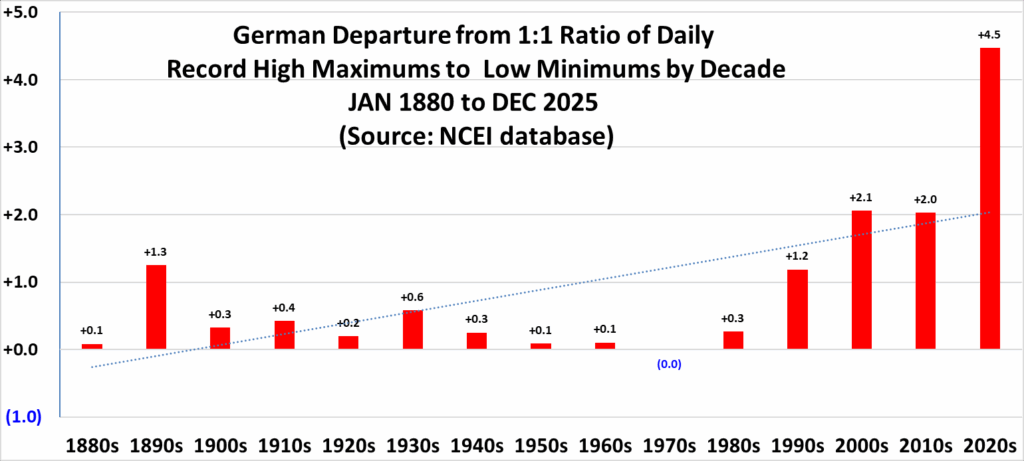
My own research from Germany looking at the ratio of hot to cold record reports verifies this new model:
Here are more details from euro news:
‘Groundbreaking’ model can calculate true impact of climate change and it’s bad news for Europe
Published on 24/02/2026
Researchers have created a new mathematical solution to analyse how emission-intensive actors are responsible for increasing climate damage.
A “groundbreaking” study has lifted the lid on just how much human-made climate change is impacting extreme weather across Europe.
Climate researcher Gottfried Kirchengast and his team at the University of Graz in Austria have developed a new method for computing the hazards from extreme events such as heat waves, floods and droughts.
Using a new mathematical solution, the model can be used to compute the frequency, duration, intensity, spatial extent and other variables of extreme events. This allows researchers to analyse the extent to which emission-intensive actors such as states or companies are responsible for increasing climate damages and risks.
“If suitable long-term climate data are available, the development of climate hazard metrics for extremes of interest can be tracked year by year and decade by decade – in European countries and any other region worldwide,” says Kirchengast.
How climate change is baking Europe
Researchers used the new method to investigate changes in extreme heat events in Austria and across Europe, using datasets of daily maximum temperatures from 1961 to 2024.
The threshold for “extreme” was taken as the temperature at each location that exceeded the daily values in the period from 1961 to 1990 by one per cent. For Austria, this was 30°C, in southern Spain it was over 35°C and in Finland it was around 25°C.
Related
- EU slammed as study reveals climate-harming beef and lamb get 580 times more subsidies than legumes
- Meet the struggling coffee farmers whose harvests are under threat from fossil-fuelled warming
The study, published in the journal Weather and Climate Extremes, found that the total extremity of heat in Austria and most regions of Central and Southern Europe has increased about tenfold in the current climate period from 2010-2024 compared to 1961-1990
“This massive increase in the total extremity metric goes far beyond its natural variability and shows the influence of human-made climate change with a clarity that even I as a climate researcher have never seen before,” says Kirchengast.
The cost of extreme weather
Thousands of deaths across Europe last summer were attributed to extreme heat, as temperatures soared to 40℃ across large parts of the continent and pushed several countries into drought.
Researchers at Imperial College London and the London School of Hygiene & Tropical Medicine looked at 854 European cities and found that climate change was responsible for 68 per cent of the 24,400 estimated heat deaths during this period, having raised temperatures by up to 3.6°C.
2025’s extreme summer weather also sparked short-term economic losses of at least €43 billion, with total costs slated to hit a staggering €126 billion by 2029.
A study published back in September, led by Dr Sehrish Usman at the University of Mannheim in collaboration with European Central Bank (ECB) economists, found that heatwaves, droughts and floods affected a quarter of all EU regions during the 2025 summer.
The immediate losses amount to 0.26 per cent of the EU’s economic output in 2024, but the study’s authors stress that these estimates are likely conservative as they don’t include compound impacts when extreme events occur simultaneously, such as heatwaves and droughts.
Here are some “ETs” recorded from around the U.S. the last couple of days, their consequences, and some extreme temperature outlooks, as well as any extreme precipitation reports:
Here is More Climate News from Wednesday:
(As usual, this will be a fluid post in which more information gets added during the day as it crosses my radar, crediting all who have put it on-line. Items will be archived on this site for posterity. In most instances click on the pictures of each tweet to see each article. The most noteworthy items will be listed first.)