The main purpose of this ongoing blog will be to track planetary extreme, or record temperatures related to climate change. Any reports I see of ETs will be listed below the main topic of the day. I’ll refer to extreme or record temperatures as ETs (not extraterrestrials).😜
Main Topic: Computational ‘Time Machine’ Shows Solar and Wind Power on Track For 2°C Target, But Not 1.5°C
Dear Diary. Despite its requirements for too much of our precious energy, Artificial Intelligence has and will be beneficial for mankind. In the realm of medicine it will help cure cancer and other diseases. In the realm of climate science it can help guide us through this difficult period in which we are trying to keep the planet from having a climate none of us can live with.
The case in point today is yet another prediction in my ‘how fast how bad’ category, and it’s basically good news. Here we see AI look at the erection of wind and solar infrastructure worldwide with a prediction of how warm planetary temperatures will eventually get based on 13,000 different scenarios.
Here are more details from TechXplore:
Computational ‘time machine’ shows solar and wind power on track for 2°C target, but not for 1.5°C
April 14, 2026
Computational ‘time machine’ shows solar and wind power on track for 2°C target, but not for 1.5°C
by Chalmers University of Technology
edited by Stephanie Baum, reviewed by Robert Egan
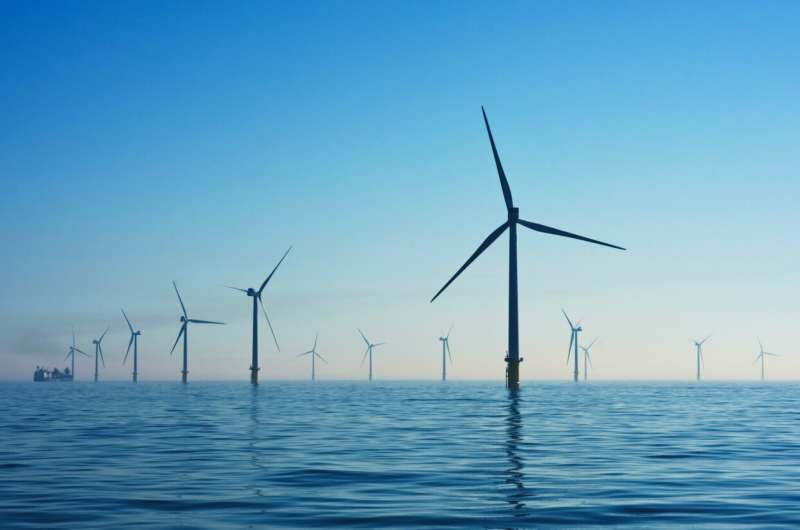
Credit: Unsplash/CC0 Public Domain
Wind and solar power have grown faster than almost anyone predicted, but projecting their future expansion remains surprisingly difficult. Researchers at Chalmers University of Technology, Sweden, have developed what they call a computational “time machine”—a model that outperforms existing projection methods by using AI techniques to analyze historical growth patterns across countries. Their central projection shows that onshore wind is likely to supply around 25% of global electricity by 2050, with solar reaching about 20%. This is consistent with the 2°C target, but falls short of what is required for 1.5°C. The work appears in Nature Energy.
Predicting the future is particularly challenging for technologies like wind and solar, where rapid cost declines are offset by growing barriers such as public opposition, infrastructure constraints and policy shifts.
“Existing models are very good at identifying what needs to happen to reach climate targets, but they can’t tell us which developments are most likely. That’s the gap we wanted to fill,” says Jessica Jewell, Professor at Chalmers University of Technology.
Across more than 200 countries, the researchers identified a recurring pattern in how wind and solar power grow: long periods of relatively steady expansion punctuated by sudden growth spurts often triggered by policy shifts.
“Most models assume a smooth S-shaped growth curve, but that’s not how it actually looks in the real world. Growth often comes in bursts, and if you ignore that, you can misjudge how fast technologies will expand,” says Avi Jakhmola, Ph.D. Student at Chalmers University of Technology and first author of the paper.
13,000 virtual worlds for the future
So, with the goal of improving the predictions, Jakhmola created a model built on 13,000 virtual worlds. In each of these worlds, solar and wind power develop in different ways—from the fastest possible expansion to the slowest—and everything in between. A machine learning algorithm was then trained on all these worlds to learn to predict global outcomes from early national trends.
“When we apply the model to real-world data, it can tell us what is the most probable outcome for the future—given what we have seen so far and given all the virtual worlds it has seen,” says Jakhmola.
By 2050, the model projects onshore wind reaching around 26% of global electricity (central range: 20–34%), and solar around 21% (15–29%). This broadly aligns with 2°C-compatible pathways but falls short of what’s needed for 1.5°C.
The projections also put the COP28 pledge to triple renewables capacity by 2030 in perspective. The pledge falls near the 95th percentile, meaning that it would require growth rates rarely observed.
“The tripling of the renewables pledge is not impossible, but it would require everything to go extremely well in all countries,” says Jewell.
The researchers also tested what would actually be required for us to reach the 1.5°C goal.
“If we start now, the required growth rates are demanding but not unprecedented, comparable to what the EU targets for wind with REPowerEU and what India has planned for solar power,” says Jakhmola. “But if we delay until 2030, the acceleration needed becomes much steeper and much more abrupt. The window for ramping up closes quickly.”
Going back in time to ensure the model’s reliability
The researchers also used the model to test the reliability of its projections—by going back in time.
“We wanted to know if our projections will hold up ten or twenty years from now. When we fed the model only data from 2015, we found that it correctly predicts what has happened since then. This is what we mean by a computational time machine, and it gives us real confidence in the projections going forward,” says Jakhmola.
The study points toward a broader ambition to develop scientifically-rigorous methods for projecting the most likely growth paths for other low-carbon technologies, not just wind and solar.
Jewell says, “It’s long been a joke how bad technology forecasts are. But if you’re a decision maker, trying to figure out how hard to push for change, you need a realistic baseline. Our study is the first step towards developing such a realistic view of the future.”
Publication details
Probabilistic projections of global wind and solar power growth based on historical national experience, Nature Energy (2026). DOI: 10.1038/s41560-026-02021-w
View an online visualization tool of the results.
Journal information: Nature Energy
Here are some “ETs” recorded from around the U.S. the last couple of days, their consequences, and some extreme temperature outlooks, as well as any extreme precipitation reports:
Here is More Climate News from Thursday:
(As usual, this will be a fluid post in which more information gets added during the day as it crosses my radar, crediting all who have put it on-line. Items will be archived on this site for posterity. In most instances click on the pictures of each tweet to see each article. The most noteworthy items will be listed first.)