The main purpose of this ongoing blog will be to track planetary extreme, or record temperatures related to climate change. Any reports I see of ETs will be listed below the main topic of the day. I’ll refer to extreme or record temperatures as ETs (not extraterrestrials).😜
Here is a new feature for this blog, which I will add daily. This is the latest inciteful Green News Report from my friends Desi Doyen and Brad Friedman at Progressive Voices. Hit ‘continue reading,’ listen, then hit return to see my daily topics:
Main Topic: From Hockey Sticks to EV Fires: The Circular Economy of Climate Disinformation
Dear Diary. The planet is just cool enough to fool people into believing climate disinformation, which aids fossil fuel interests to keep on drilling and mining as of 2026. However, the planet has warmed enough to settle the science so that climate change denialists are in retreat and most folk even without a college education are convinced that carbon pollution is warming the planet.
So, how are this film flam artists continuing to pull the wool over the eyes of fillable people? Here is a good summary from Reneweconomry:
From hockey sticks to EV fires: The circular economy of climate disinformation
From hockey sticks to EV fires: The circular economy of climate disinformation
May 19, 2026
Climate misinformation often looks new only because the packaging has changed. The underlying claims are old.
A graph is attacked again. A wind farm is blamed again. An electric vehicle fire is presented as if petrol and diesel vehicles have never burned. A blackout is stripped of weather, transmission, protection systems, market rules, interconnectors, and operational detail, then blamed on renewables.
The target shifts, the phrasing changes, the local hook is refreshed, but the structure is familiar.
I was reminded of this recently when Michael Mann noted on LinkedIn that a German outlet was publishing attacks on the hockey stick again. The oddity is not that the claim exists. It is that the same class of claim keeps returning as if there were no research history, no public debate, and no shelves full of answers.
The hockey stick has been examined scientifically, politically, rhetorically and legally for decades, yet it remains useful because the attack is not really about one paleoclimate reconstruction. It is about institutional distrust.
That is the larger pattern. The only circular economy many opponents of climate action seem to have mastered is the circular economy of bad arguments.
Disinformation recycling takes claims that have lost evidentiary value and puts them back into rhetorical use. A claim does not have to survive scrutiny. It only has to create hesitation, distrust, delay, or a socially acceptable reason to oppose something that is already disliked.
Australia is a good place to watch this happen because the energy transition is visible there. Rooftop solar is everywhere. Wind farms are no longer theoretical. Transmission corridors are being planned and contested.
Batteries are moving from novelty to grid infrastructure. EVs are appearing in driveways and parking lots. Fossil fuel exports remain politically and economically large.
Each visible change creates real work for planners, regulators, engineers, communities, and politicians. It also creates fresh triggers for old claim templates.
This is not a new observation for me. More than a decade ago, I was writing about Australian anti-wind campaigns, including the Waubra Foundation, wind turbine syndrome claims, infrasound claims, and the social amplification of fear around wind projects.
In 2013, the Australian wind debate already had the features that now show up across climate, EV,` and clean energy misinformation. A project would appear. A mix of health, noise, property, landscape, trust, and process claims would gather around it. Experts and advocates would respond. The claims would lose force in one venue, then move to another with only small edits.
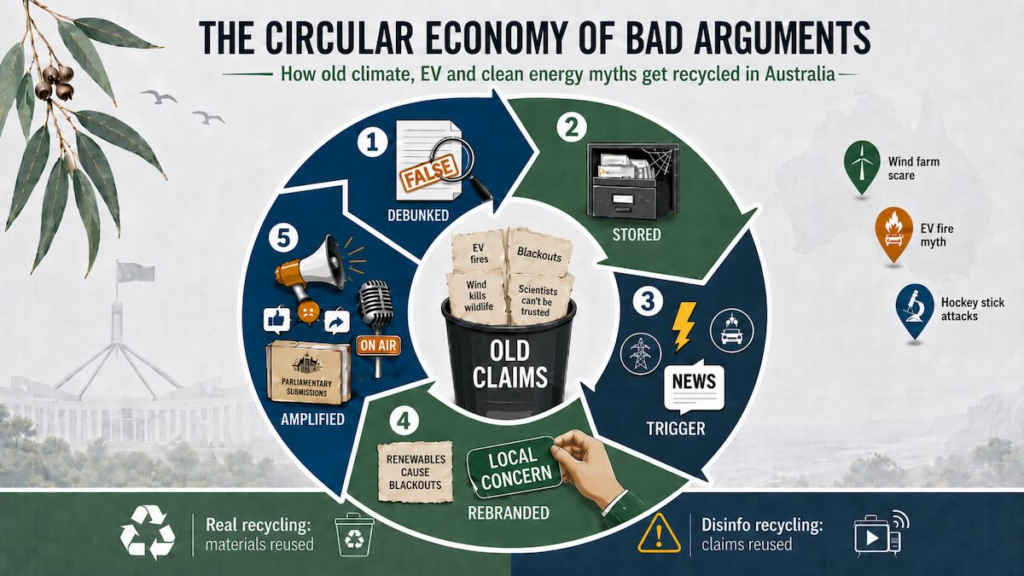
The loop was already visible. A claim was debunked. It was stored in blogs, submissions, activist newsletters, community meetings, old media clips, and political memory. A new project, policy, court case, rally, blackout, or media story created a trigger.
The claim was rebranded as a fresh local issue, then amplified through talk radio, social media, politicians, local campaigners, think tanks, or formal submissions. After that, people who had already addressed it had to start over. Debunked, stored, triggered, rebranded, amplified, repeated. That is the recycling loop.
Wind was the prototype because wind farms were among the earliest large, visible symbols of the energy transition. Solar panels on roofs became ordinary by being small and distributed.
Wind turbines were tall, rural, and politically legible. They changed views. They required planning approvals. They created local winners and local objectors. Some concerns were real. Community consultation could be poor. Benefit sharing could be weak. Transmission planning could be clumsy. Biodiversity questions had to be answered.
But those real issues also created an opening for claims that went much further, claiming exotic illness, sweeping ecological harm, collapsing property values, useless generation, or hidden conspiracies.
The wind health cycle was especially instructive. Wind turbines produce sound, and people near infrastructure deserve clear information, measurement, and respectful treatment. But that is not the same as proving a new turbine-caused disease.
Much of the wind farm syndrome debate depended on turning fear, annoyance, poor process, and pre-existing opposition into a medical narrative. Australian research at the time found that complaints were strongly correlated with areas where anti-wind campaigners had been active. That did not mean every complaint was invented. It did mean that expectations, social signalling, and fear messaging mattered.
The same structure now appears in EV fire panic. EVs can catch fire. So can petrol and diesel vehicles. The useful question is comparative risk, not whether any technology has any risk. A world with 1.5 billion road vehicles has fires. A world electrifying transport will have battery incidents.
The disinformation move is to take a rare, vivid event and turn it into a general indictment of the technology. One burning EV becomes a claim that EVs are always catching fire. A chart showing fires per 100,000 vehicles requires a reader to slow down. A photo of flames requires nothing.
Blackout claims use the same deletion trick in a systems context. Power systems are complex machines. Reliability depends on generation, transmission, reserves, protection systems, fuel supply, market rules, weather, and demand.
A major grid event almost never has a single clean cause. But the recycled claim compresses all of that into one sentence: renewables caused the blackout.
Australia knows this loop well. South Australia became a global prop in anti-renewables arguments after its 2016 blackout, despite the actual event involving severe storms, transmission damage, protection settings and system response. The claim worked because it deleted the system and left a villain.
The same pattern travels across clean technologies. Batteries are blamed for fires without comparative data. Solar is described as toxic waste without lifecycle context or recycling pathways. Transmission is treated as proof that renewables are uniquely invasive, as if coal, gas, oil, hydro, roads, rail, ports, and pipelines arrived without land use. EVs are described as coal-powered even in grids getting cleaner year by year.
The facts vary by technology, but the method is stable. Remove scale, comparison, trend, and system context, then amplify the simplified claim.
Academic research has studied most of these pieces, although it does not always call the full process bad-argument recycling. Work by Coan, Boussalis, Cook, and Nanko on climate contrarian claims identified recurring families: climate change is not happening, humans are not causing it, impacts are not serious, solutions will not work, and scientists or institutions cannot be trusted.
Work by Lamb and colleagues on climate delay shows how the argument shifted from denying the problem to attacking action. The newer form accepts enough of the climate problem to avoid looking silly, then argues that every practical response is too expensive, too risky, too unfair, too dependent on China, or too disruptive to local communities.
That shift explains why hockey stick attacks and EV fire myths belong in the same article. They are not the same claim, but they serve connected functions. One attacks climate science. Another attacks a climate solution. Another attacks grid reliability. Another attacks local legitimacy.
Together they create a permission structure for delay. People do not need to reject climate science outright if they can be persuaded that every solution is worse than the problem, every institution is suspect, and every project is an imposition.
The repetition also matters. Misinformation research has shown that repeated exposure can increase the perceived truth of a claim, even when people have seen corrections. The continued influence effect describes how false information can keep shaping reasoning after it has been corrected.
A correction puts evidence on the record and gives journalists, advocates, policymakers, and citizens something to point to. But it does not erase the claim from memory or from the networks that store it.
My experience with wind disinformation made this clear. Debunking anti-wind health myths helped communities, reporters, and decision-makers distinguish evidence from fear campaigns. It clarified what acoustics research did and did not show. It exposed links between local groups, ideological organisations, and broader anti-renewables politics. That work mattered. But it did not finish the job. The claims did not die. They changed address.
The practical response is not to scold the public for being misled. It is to build better information habits. When an old claim reappears, the response should not treat it as new evidence. It should identify the family of claim, show where it appeared before, and explain what changed, if anything.
Sometimes nothing important has changed. Sometimes new evidence requires an update. Either way, the conversation should not be reset to zero every time someone recycles a claim.
Comparison classes and prebunking matter. EV fires should be compared with petrol and diesel fires per vehicle, per kilometre, and by severity where data allows.
Wind wildlife impacts should be compared with buildings, cats, vehicles, power lines, habitat loss, fossil fuel extraction, and climate change. Grid reliability should be assessed against actual event sequences, not political labels.
Before predictable conflicts peak, communities should have plain-language information on the claims most likely to appear, including health, fires, wildlife, construction impacts, benefits, and grid effects.
Real concerns also have to be separated from recycled misinformation. If every objection is dismissed as misinformation, institutions lose trust. If every objection is accepted as equally valid, misinformation gains veto power.
A farmer worried about access roads, compensation, drainage, or construction disruption is raising a governance issue. A campaign claiming that turbines cause a mysterious disease already examined for years is recycling an old template. Those are different conversations.
That distinction matters because good process is part of the misinformation defense system. Trust cannot be demanded. It has to be earned through accuracy, transparency, responsiveness, and accountability. Climate and energy institutions should make the reasoning visible.
Show the data. Show the uncertainty. Show who benefits and who carries costs. Good debunks should also be reusable: short, searchable, visual, updated, and written for journalists, community leaders, teachers, councillors, and ordinary citizens. If the bad argument is designed to travel, the correction has to travel too.
Scrutiny is necessary. Wind farms, transmission lines, EV policies, batteries, mines, factories, grid rules, and climate models deserve serious examination. But serious scrutiny is not the same as recycling claims that were already answered years ago.
When old myths are passed off as fresh evidence, public attention is wasted. Instead of improving projects, correcting inequities, accelerating useful infrastructure, and reducing emissions, people are dragged back into arguments that should have been archived as examples of what not to do.
The claims will keep coming back because the system that stores and reuses them still has value to the people deploying them. That does not mean the rest of us have to be surprised each time.
The useful response is to recognize the pattern, label it clearly, answer it proportionately, and move the conversation back to the real questions. Australia does not need a better supply of recycled climate, EV, and clean energy myths. It needs better decisions about the transition already underway.
Michael Barnard is a climate futurist, company director, advisor, and author. He publishes regularly in multiple outlets on innovation, business, technology and policy.
Here are some “ETs” recorded from around the U.S. the last couple of days, their consequences, and some extreme temperature outlooks, as well as any extreme precipitation reports:
Here is More Climate News from Wednesday:
(As usual, this will be a fluid post in which more information gets added during the day as it crosses my radar, crediting all who have put it on-line. Items will be archived on this site for posterity. In most instances click on the pictures of each tweet to see each article. The most noteworthy items will be listed first.)