Made August 2023/Updated SEP 2024/SEP 2025/SEP 2026
The purpose of this post is to catalogue counts of all-time records (record high maximums\record high minimums\record low minimums\record low maximums) coming into the National Centers for Environmental Information’s site and all related charts and graphs produced in my Excel files for those data sets from China. All-time records are the highest or lowest temperatures recorded over the entire time a station has been recording data. For example, the all-time record high max for Atlanta Hartsville-Jackson Airport was 106°F set on 6/30/2012. I am in the process of constantly updating this data verifying the 2009 Meehl Et al. Surface Records Study published in Geophysical Research Letters that I initiated from 2000. Each individual count could be a tied surface record or one broken by several degrees Fahrenheit.
Here is the link to the NCEI site:
https://www.ncdc.noaa.gov/cdo-web/datatools/records
More from NCEI:
“The daily records summarized here are compiled from a subset of stations in the Global Historical Climatological Network. A station is defined as the complete daily weather records at a particular location, having a unique identifier in the GHCN-Daily dataset.
For a station to be considered for any parameter, it must have a minimum of 30 years of data with more than 182 days complete each year. This is effectively a “30-year record of service” requirement, but allows for inclusion of some stations which routinely shut down during certain seasons. Small station moves, such as a move from one property to an adjacent property, may occur within a station history. However, larger moves, such as a station moving from downtown to the city airport, generally result in the commissioning of a new station identifier. This tool treats each of these histories as a different station. In this way, it does not “thread” the separate histories into one record for a city.
This tool provides simplistic counts of records to provide insight into recent climate behavior, but is not a definitive way to identify trends in the number of records set over time. This is particularly true outside the United States, where the number of records may be strongly influenced by station density from country to country and from year to year. These data are raw and have not been assessed for the effects of changing station instrumentation and time of observation.”
All counts include ties of records.
An updated 2016 study from Dr. Jerry Meehl indicates that the ratio from year to year will average around 15 to 1 by 2100 for the United States for daily records:
Per one of the authors of both the 2009 and 2016 studies, Claudia Tebaldi said “This climate is on a trajectory that goes somewhere we’ve never been. And records are a very easy measure of that.”
All of the data listed below is part of this one chart. So far, the ratio of all-time record high maxes to low minimums for the 2020s is higher than any other decade since the 1970s:
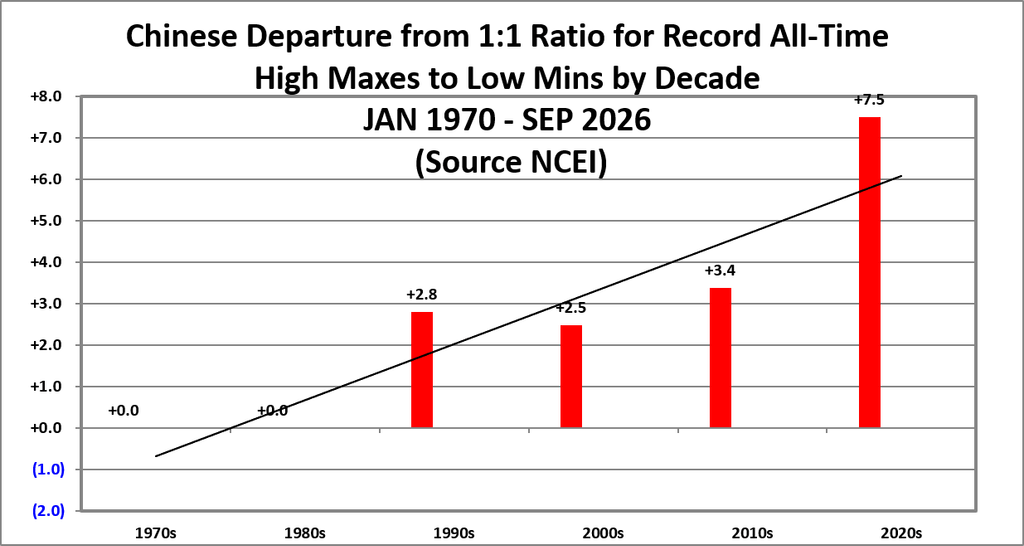
Here are the current all-time record counts per decade, which have gone into the prior charts:

A note on data availability: Unfortunately, relatively few Chinese all-time temperature-record reports are currently available through NCEI, particularly for earlier decades. Consequently, the limited number of observations makes detailed statistical comparisons less reliable than those presented in the Chinese daily and monthly record-count archives. This page is maintained primarily as a historical catalogue of available all-time records and will be updated as additional reports enter the NCEI database.
The 2020s:

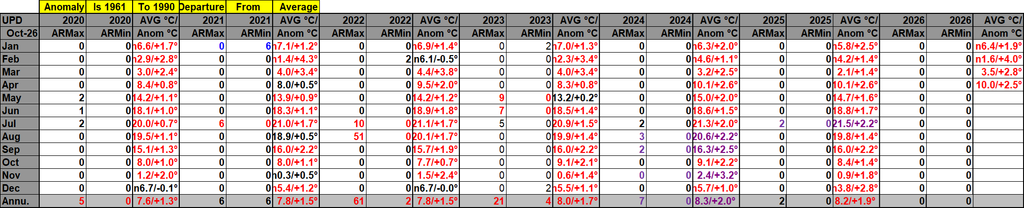
For the following data sets of record of all-time high maximums and low minimums I have opted not to boldly highlight ratios greater than 10 to 1. Blue colors represent cold months and red warm. Months and years that are all-time record cold or hot are colored purple. Temperature anomalies greater than +0.5°C are shown in red, while anomalies below −0.5°C are shown in blue. Values within ±0.5°C are shown in black. All-time warmest and coldest months and years are highlighted in purple. Record-count ratios are displayed separately using the established warm-versus-cold comparison. I have opted not to catalogue data prior to 1970 since all-time record counts decrease substantially prior to the decade of the 1970s. Time stamps for when I last updated counts are located in the upper left-hand corner of each chart. Drop me a note if you see an error or if you have suggestions for improvements.
The 2010s:


The 2000s:


The 1990s:


The 1980s:


The 1970s:




The sparse data from the 1970s has limited statistical value.
All of the Chinese NCEI AHMN/ALMX data is compiled below in this one chart:
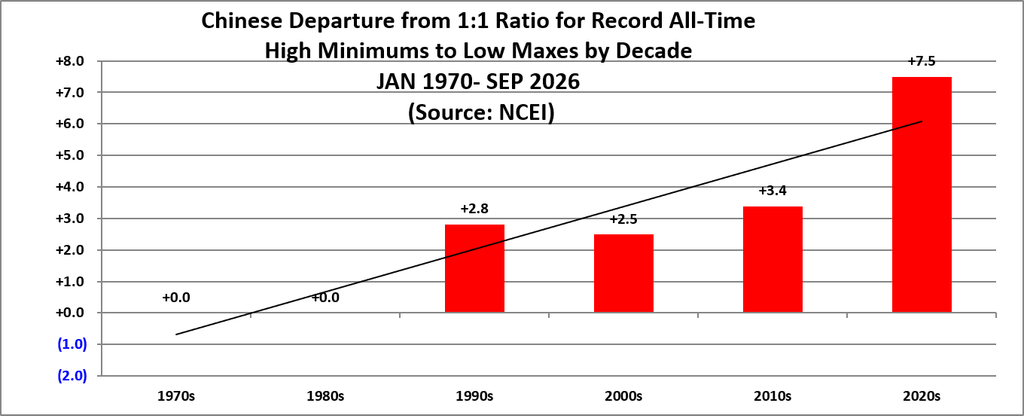
Here are the current all-time record counts per decade, which have gone into the prior chart:

The 2020s:
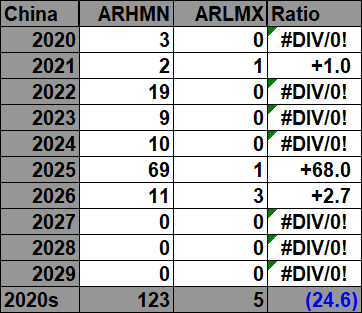
For the following data sets of record of annual high minimums and low maximums I have opted not to boldly highlight ratios greater than 10 to 1. Blue colors represent cold months and red warm. Months and years that are all-time record cold or hot are colored purple. Temperature anomalies greater than +0.5°C are shown in red, while anomalies below −0.5°C are shown in blue. Values within ±0.5°C are shown in black. All-time warmest and coldest months and years are highlighted in purple. Record-count ratios are displayed separately using the established warm-versus-cold comparison. I have opted not to catalogue data prior to 1970 since record counts decrease substantially prior to the decade of the 1970s. Time stamps for when I last updated counts are located in the upper left-hand corner of each chart. Drop me a note if you see an error or if you have suggestions for improvements.
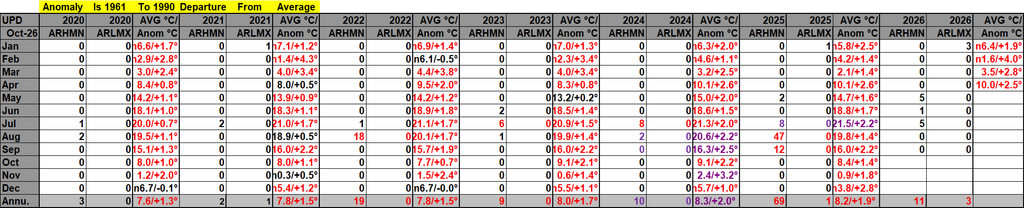
The 2010s:


The 2000s:


The 1990s:


The 1980s:


The 1970s:




These are all of the counts of NCEI all-time record Chinese reports back to January 1970.
Guy Walton…The Climate Guy