The main purpose of this ongoing blog will be to track planetary extreme, or record temperatures related to climate change. Any reports I see of ETs will be listed below the main topic of the day. I’ll refer to extreme or record temperatures as ETs (not extraterrestrials).😜
Main Topic: Drought, Migration and the Fall of Civilization: A Cautionary Tale
Dear Diary. I’m a big student of history as most of my readers know. What fascinates me the most about the past is the rise and fall of various civilizations, whether they be from internal corruption or external pressures from invasion or climate change. We can learn from history so that we won’t repeat it.
One fascinating era that scholars have focused on the last decade or so is the Late Bronze Age Collapse around 1200 BC. One factor was climate change:
Late Bronze Age collapse – Wikipedia
A thousand years before that we had the fall of the Akkadian Empire, also at least partially due to climate change:
The Curse of Agade: Naram-Sin’s Fictional Battle with the Gods – World History Encyclopedia
Dr. Michael Mann has picked up on the Curse of Agade as a warning to us in this time of rapid climate change due to the burning of fossil fuels. Here is his op-ed from a few years ago, which rings true today from The Hill:
Drought, migration and the fall of civilization: A cautionary tale
Drought, migration and the fall of civilization: A cautionary tale
Comments: by Michael E. Mann, opinion contributor – 10/13/23
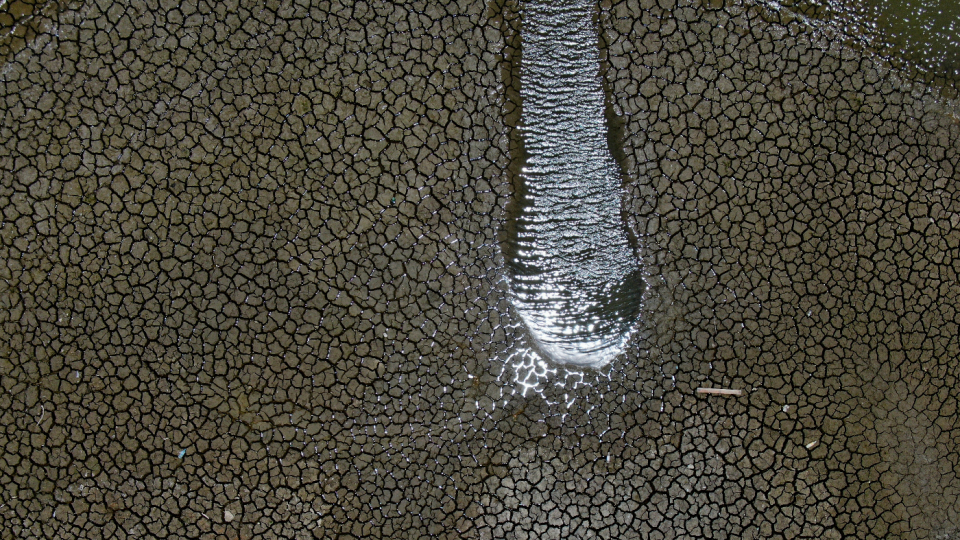
The Boca reservoir, that supplies water to the northern city of Monterrey, is almost dry as the northern part of Mexico is affected by an intense drought, in Santiago, Mexico, July 9, 2022. Tens of millions of people are being uprooted by natural disasters due to the impact of climate change, though the world has yet to fully recognize climate migrants or come up with a formalized mechanism to assess their needs and help them. (AP Photo/Fernando Llano, File)
The writer George Santayana once famously said: “Those who cannot remember the past are condemned to repeat it.”
This adage seems especially poignant at this moment with the twin conflicts that are playing out in the Western and Eastern hemispheres. For, this is not the first time we’ve witnessed the construction of a massive border wall to impede refugees fleeing environmental degradation. Nor is it the first time that we’ve seen instability in the Middle East, amplified by conflict over precious water resources.
History, it seems, has some lessons for us. Consider the cautionary tale of the rise and fall of Mesopotamia.
Having arisen 6,000 years ago in the Middle East, Mesopotamia was the first true civilization. It consisted of individual city-states with populations comparable to modern towns and small cities. They were separated from each other by canals or stone boundaries and connected by trade and commerce. These interconnected city-states arose, as it turns out, as a response to climate-driven environmental stress.
Agriculture had taken hold in the aptly named fertile crescent around 10,000 years ago when it was relatively lush and humid. But as the region became steadily drier over the ensuing millennia, driven by long-term changes in Earth’s orbit around the Sun, it had become too dry for rain-fed agriculture 6,000 years ago.
It’s been said that “necessity is the mother of invention” and such was the case here. The challenge of a drying climate led to the innovation of irrigation, with the land between the Tigris and Euphrates rivers (Mesopotamia translates to “the land between the rivers”) constituting an ideal laboratory for nascent hydrological engineering.
However, engineering projects require a specialized workforce and division of labor. Aided, in turn, by irrigation technology that tapped into the water supply of the two rivers, farmers could grow an abundance of crops. That freed others to perform other roles such as construction. It was a symbiotic relationship.
The social organization, division of labor and hierarchy afforded by civilization led to increased power and influence of the city-states, and by 4,300 years ago, they had merged to form the first great empire — the Akkadian empire — extending, at its peak, from present-day Kuwait in the south, through parts of Iraq, Iran and Syria, to southern Turkey in the north.
Civilization afforded increased resilience, as irrigation could support farming even when rainfall became increasingly intermittent as the region continued to grow more arid. But resilience has its limits, as we learn from the fall of the Akkadian Empire around 4,200 years ago.
The likely culprit was a massive volcanic eruption that cooled off and dried out the subtropics, including the Middle East, for a decade or more. The Akkadian Empire had become dependent on the productivity of the northern part of the empire. The agricultural surplus from the north was typically distributed to other regions and used to support a massive army. But the extended drought decimated agricultural productivity, as grimly reported in “The Curse of Akkad”: “The large arable tracts yielded no grain, the inundated fields yielded no fish, the irrigated orchards yielded no syrup or wine, the thick clouds did not rain.”
The agricultural collapse was followed by mass southward migration of the northern populations. The caravan met with opposition from the southern populations, including the construction of a 100-mile-long wall known as the “Repeller of the Amorites.” Stretching from the Tigris all the way to the Euphrates, it was built in a desperate effort to keep out immigrants as climate conditions deteriorated.
It is difficult — nay impossible — not to draw a connection with another wall — the one former U.S. President Donald Trump promised to build at the southern border of the United States to keep out Mexican and Central American refugees. What might have been dismissed as a cynical ploy by an authoritarian president to placate his nativist base and a dim prospect during the Biden presidency suddenly has renewed life. An ongoing fear campaign by right-wing media to frighten Americans with apocalyptic tales of mass invasions by dangerous, lawless hordes of migrants has apparently borne fruit, goading Democrats now into supporting the gambit.
There are multiple factors behind the ongoing migration. But human-caused climate change and its detrimental impact on food and water is a key underlying factor. Speaking of those seeking to cross the U.S. border, United Nations adviser Andrew Harper said that “climate change is reinforcing underlying vulnerabilities and grievances … leading to people having no other choice but to move.” The construction of a wall cannot solve the larger problem of growing food and water insecurity and ensuing conflict on a warming planet.
And there is no greater reminder of that fact than what is happening right now in the Middle East, once home to the Akkadian Empire.
Unrest erupted in Syria in mid-March 2011, growing into an outright civil war in Syria that has now cost hundreds of thousands of lives and produced one of the greatest mass migrations on record. The underlying cause was a decade-long drought in Syria that is likely the worst in a millennium. The devastating agricultural impacts of the unprecedented, climate change-fueled drought forced rural farmers into the cities of Aleppo and Damascus, where they were competing for food, water and space with existing residents. The conflict, unrest and violence created a favorable recruiting environment for the international terrorist organization known as Islamic State of Iraq and Syria, aka “ISIS.”
Decades ago, agronomist Daniel Hillel argued that conflict in the Middle East, while nominally over land disputes, has always fundamentally been about the battle for water. The battle over access to fresh water has contributed directly to tensions between Israel and Palestine, tensions that have now erupted into all-out war.
Hillel contended that peace in the region can only come when the need for water is met. Given that climate change is projected to continue to decrease freshwater resources in the region, a logical extension of Hillel’s maxim is that peace can only come about if we address the underlying factors, which include climate-induced competition for precious water resources.
There is an even larger lesson here for all of us. We see that civilization is both resilient and fragile at the same time. The Akkadian empire was able to reduce its vulnerability to limited water resources through the tools of civilization: large workforces that could implement water storage and irrigation, and transport of resources from where there are surpluses to where there are deficits. But sprawling civilizations, as we see, are fragile, requiring cooperation and a degree of common interest among diverse communities. In response to the shock of an epic drought, the empire collapsed.
What implications does that have for our truly globally connected, planetary-scale civilization today? Is it susceptible to collapse given a large climate perturbation? Just how large does that perturbation have to be?
Michael E. Mann is presidential distinguished professor and director of the Center for Science, Sustainability and the Media at The University of Pennsylvania. He is author of the book “Our Fragile Moment: How Lessons from Earth’s Past Can Help Us Survive the Climate Crisis.”
Here are some “ETs” recorded from around the U.S. the last couple of days, their consequences, and some extreme temperature outlooks, as well as any extreme precipitation reports:
Here is More Climate News from Saturday:
(As usual, this will be a fluid post in which more information gets added during the day as it crosses my radar, crediting all who have put it on-line. Items will be archived on this site for posterity. In most instances click on the pictures of each tweet to see each article. The most noteworthy items will be listed first.)